🏛️ Official Ministry & State Schemes Source Reviewed

Government Schemes & Capital Subsidies

Explore source-reviewed central and state financial assistance programs, margin money subsidies, and credit facilities for Indian businesses. Rules, limits, and eligibility can change, so confirm current terms on the linked official portal before applying.

Clear
Central Ministry
Verified
Ministry of Micro, Small and Medium Enterprises through Khadi and Village Industries Commission

Prime Minister's Employment Generation Programme (PMEGP)

PMEGP is a credit-linked subsidy scheme for setting up new micro-enterprises in the non-farm sector. Eligible applicants can receive margin money subsidy ranging from 15% to 35%, with maximum project cost of ₹50 lakh for manufacturing and ₹20 lakh for service/business activities.

Max Financial Support ₹17.5 Lakh
Subsidy Rate / Benefit 35% Subsidy
View Scheme Blueprint
Central Ministry
Verified
Department of Financial Services, Ministry of Finance

Pradhan Mantri Mudra Yojana (PMMY)

Pradhan Mantri Mudra Yojana provides collateral-free institutional credit to eligible micro enterprises in non-farm income-generating activities. Loans are available under Shishu, Kishore, Tarun and Tarun Plus categories, with the maximum loan limit reaching ₹20 lakh under Tarun Plus for eligible entrepreneurs who have successfully repaid a previous Tarun loan.

Max Financial Support Credit Support
Subsidy Rate / Benefit Collateral Free Micro Enterprise Credit Scheme
View Scheme Blueprint
Central Ministry
Verified
Department of Fertilizers, Ministry of Chemicals and Fertilizers

Market Development Assistance

Market Development Assistance (MDA) supports the sale of Fermented Organic Manure, Liquid Fermented Organic Manure and Phosphate Rich Organic Manure produced from eligible GOBARdhan and CBG plants. Assistance is ₹1,500 per metric tonne for eligible quantity sold through Point of Sale systems.

Max Financial Support ₹1.5 K
Subsidy Rate / Benefit Market Development Assistance for Organic Fertilizers
View Scheme Blueprint
Central Ministry
Verified
Ministry of Micro, Small and Medium Enterprises (MoMSME)

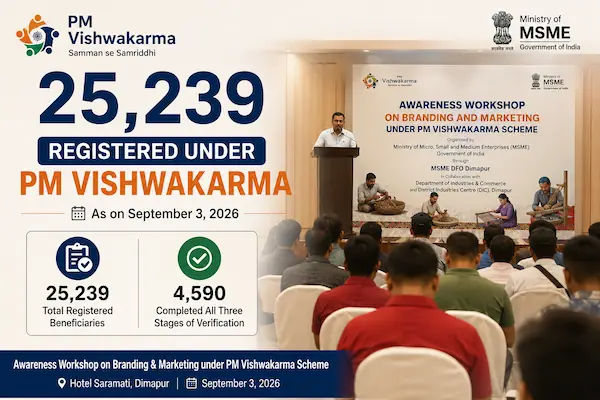
PM Vishwakarma

PM Vishwakarma provides end-to-end support to artisans and craftspeople in 18 traditional trades through recognition, skill training, toolkit assistance, collateral-free enterprise development loans up to ₹3 lakh, concessional 5% interest, digital transaction incentives and marketing support.

Max Financial Support ₹15 K
Subsidy Rate / Benefit 8% Subsidy
View Scheme Blueprint
Central Ministry
Verified
Ministry of Micro, Small and Medium Enterprises (MSME) through Coir Board

Coir Udyami Yojana

Coir Udyami Yojana (CUY) is a Central Sector credit-linked subsidy scheme for setting up coir units. The scheme provides 40% Government subsidy, 55% bank credit and 5% beneficiary contribution on eligible project cost, with a maximum project cost of ₹10 lakh plus working capital up to 25% of project cost.

Max Financial Support ₹4 Lakh
Subsidy Rate / Benefit 40% Subsidy
View Scheme Blueprint
Central Ministry
Verified
Ministry of Micro, Small and Medium Enterprises (MSME) through Khadi and Village Industries Commission (KVIC)

Khadi Gramodyog Vikas Yojana: Khadi Vikas Yojana

Khadi Vikas Yojana (KVY) is a sub-scheme of Khadi Gramodyog Vikas Yojana implemented by KVIC to promote Khadi production, strengthen Khadi institutions and support artisans. Key assistance includes 35% MMDA for Cotton/Muslin, Wool and Polyvastra, 20% for Silk Khadi, concessional 4% interest under ISEC, and work-shed assistance up to ₹1.20 lakh for an individual work-shed.

Max Financial Support Credit Support
Subsidy Rate / Benefit Khadi Development and Financial Assistance Scheme
View Scheme Blueprint
🚀 Standard Application Lifecycle

How to Apply & Claim Government Subsidies

Universal 4-step roadmap applicable across Central and State credit-linked financial assistance schemes.

01

Project Formulation & DPR

Prepare a Detailed Project Report (DPR) detailing capital costs, machinery quotations with GSTIN, site layout, and 5-year financial projections (cash flow, DSCR & break-even).

02

Portal Filing & Registration

Obtain free Udyam MSME registration and submit your online proposal on official nodal portals (such as JanSamarth.in, KVIC PMEGP Portal, or State Single Window Portals).

03

Scrutiny & Bank Credit Sanction

The Nodal Agency / District Task Force (DTFC / DIC) reviews the application and forwards it to your selected financing bank. The bank conducts techno-economic appraisal and issues a formal Sanction Letter.

04

Loan Disbursement & Subsidy Claim

Upon borrower promoter equity deposit (5% to 15%), the bank disburses credit and files the subsidy claim. The grant is parked in a 3-year Term Deposit Receipt (TDR) and adjusted against principal upon audit.

📋 Standard Compliance Checklist

Mandatory Documents Required for Subsidy Approval

Standard, verified documentation required by nodal agencies, District Task Forces, and lending banks.

1. Identity & Personal KYC

  • Aadhaar Card (linked to active mobile number) & PAN Card
  • Recent passport-size photographs & signature specimen
  • Special Category / Caste Certificate (SC/ST/OBC/Women/Ex-Servicemen/PwD) if claiming higher subsidy
  • Educational Qualification Certificate (8th pass or higher where project ceiling mandates)

2. Enterprise & Legal Entity Proof

  • Udyam MSME Registration Certificate (free on udyamregistration.gov.in)
  • Constitution proof: Sole Proprietorship declaration, Partnership Deed, or LLP/Pvt Ltd Certificate of Incorporation
  • GST Registration Certificate (if applicable or turnover requires)
  • Local Trade License / Shop & Establishment Registration (where applicable)

3. Land & Operating Premises

  • Registered Rent Agreement / Lease Deed (minimum 3 to 5 years tenure) with Landlord NOC
  • Or Ownership Title Deed / 7/12 Extract / Municipal Property Tax Receipt
  • Electricity Utility Bill & Sanctioned Power Load confirmation for the unit
  • Basic factory / office layout plan with machine installation area demarcation

4. Project Financials & Banking

  • Comprehensive Detailed Project Report (DPR) certified by CA or DIC
  • Machinery & Equipment Quotations from registered suppliers with valid GSTIN
  • Last 6 months operative Bank Account Statements of applicant / promoters
  • Cancelled Cheque & CIBIL Credit Bureau Report (>650 score recommended)
📊 Subsidy Matrix

Key Government Assistance Schemes Compared

Compare financial ceilings, capital subsidy rates, and promoter margin requirements across flagship schemes.

Scheme Name Nodal Ministry Project Ceiling Capital Subsidy Grant Promoter Margin Collateral Policy
PMEGP Prime Minister Employment Generation Ministry of MSME & KVIC ₹50 Lakhs (Mfg)
₹20 Lakhs (Services)
15% to 35%
Up to ₹17.5 Lakhs grant
5% to 10% Collateral-free (CGTMSE coverage)
PM Mudra Yojana (PMMY) Micro Units Development & Refinance Ministry of Finance & MUDRA Ltd ₹20 Lakhs
Shishu / Kishore / Tarun
Credit Facility
0% Subsidy (Pure Debt)
Nil to 15% 100% Collateral-Free Institutional Loan
Stand-Up India For Women & SC/ST Entrepreneurs Ministry of Finance & SIDBI ₹10 Lakhs to ₹1 Crore Credit Guarantee
Margin Money Support
Up to 15% Credit Guarantee Support (CGFSI)
State CMEGP (e.g. Maharashtra) Chief Minister Employment Generation State Directorate of Industries ₹50 Lakhs (Mfg)
₹10 Lakhs (Services)
15% to 35%
Up to ₹12.5 Lakhs grant
5% to 10% Bank norm & CGTMSE support
❓ Frequently Asked Questions

Everything You Need to Know About MSME Subsidies

Common questions regarding government scheme eligibility, lock-in rules, and bank approvals.

Under credit-linked government subsidy programs (such as PMEGP and state-level schemes), the government provides financial assistance as margin money subsidy ranging from 15% to 35% of the total project cost. The entrepreneur contributes 5% to 15% as promoter equity, and the financing bank provides the remaining amount as term loan and working capital. The subsidy is deposited into an interest-free Term Deposit Receipt (TDR) / Subsidy Reserve Account locked for 3 years, which adjusts against the loan principal upon physical unit verification.

No. Loans under PM Mudra Yojana (up to ₹20 Lakhs) and PMEGP loans up to ₹10 Lakhs (and up to ₹5 Crores under CGTMSE credit guarantee coverage) are 100% collateral-free. Eligible micro and small enterprises do not require third-party collateral or immovable property mortgages.

Special category applicants—including Women, SC/ST, OBC, Minorities, Ex-Servicemen, Differently-Abled (PwD), and units located in rural, hilly, or North-Eastern areas—qualify for higher capital subsidies (typically 25% to 35%) with reduced promoter equity contribution (as low as 5%).

Government subsidies are sanctioned as credit-linked back-ended grants. The subsidy amount is held in a separate 3-year interest-free fixed deposit linked to the borrower loan account. Upon maintaining active and continuous commercial operations for 3 years, a joint physical verification is conducted and the subsidy is credited to permanently reduce the principal loan amount.

Yes. Operating micro and small units that have demonstrated profitable operations and timely repayments under earlier credit schemes are eligible for 2nd stage expansion and upgradation credit support (up to ₹1 Crore for manufacturing and ₹25 Lakhs for service enterprises under PMEGP expansion norms).

National portals such as JanSamarth (jansamarth.in) and KVIC Online (kviconline.gov.in) serve as single-window digital gateways. They connect applicants with partner commercial banks, track application progress in real time, and route proposals directly to District Task Forces and bank branches.

📖 Practical Knowledge & Playbooks

How-To Guides, News & Success Stories

Practical step-by-step guides on government scheme applications, MSME policy updates, and founder stories.

View All Guides →
🏛️ Government Subsidies & Capital

Ready to Apply for a Government Scheme?

Match verified business blueprints with central capital subsidies and calculate your exact project economics before applying.