25,239 artisans registered under PM Vishwakarma in Nagaland
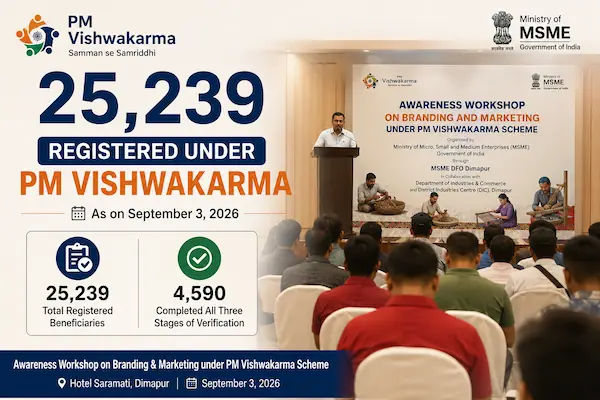
The PM Vishwakarma Scheme has registered 25,239 artisans in Nagaland, while 4,590 beneficiaries have completed all three stages of verification required to access scheme benefits, according to figures shared by Mohd Ali Rahman, Director of the MSME Development and Facilitation Office in Dimapur.
The latest figures were shared during an awareness workshop on branding and marketing under PM Vishwakarma held at Hotel Saramati in Dimapur on September 2, 2026. The programme was organised by the Ministry of Micro, Small and Medium Enterprises through MSME DFO Dimapur in collaboration with the Department of Industries and Commerce and the District Industries Centre, Dimapur.
Registration and verification are different stages
The latest figures show a significant difference between the number of artisans who have registered and those who have completed the full verification process.
Out of 25,239 registered Vishwakarmas, 4,590 have completed all three verification stages needed to receive benefits under the scheme. This means the registration figure should not be treated as the number of artisans who have already received all available scheme benefits.
The fully verified beneficiaries become eligible for support such as skill training, toolkit assistance and credit-linked benefits subject to the applicable scheme process and conditions.
Around 1,900 artisans have completed trade training
According to the latest information shared at the Dimapur workshop, around 1,900 Vishwakarma beneficiaries have undergone training in their respective traditional trades.
Skill development is an important part of PM Vishwakarma because the programme is designed to strengthen traditional artisans while improving the quality and marketability of their products and services.
884 toolkits delivered to beneficiaries
The latest update also states that 884 toolkits have been delivered to beneficiaries in Nagaland.
Toolkit assistance is intended to help artisans improve their ability to work with the tools required for their traditional trade. Better tools can support productivity, product quality and the ability to expand small-scale artisan enterprises.
419 loans sanctioned worth ₹4.07 crore
Credit access is another major component of the PM Vishwakarma programme in Nagaland.
So far, 419 loans worth ₹4.07 crore have been sanctioned, according to the latest figures shared by the MSME DFO Dimapur.
Of these sanctioned loans, 404 loans worth ₹3.91 crore have already been disbursed.
The difference between sanctioned and disbursed loans is important because a loan sanction represents approval of credit, while disbursement refers to the release of the approved funds after the applicable requirements are completed.
Artisans are being connected with online marketplaces
The Nagaland programme is also focusing on helping traditional artisans reach customers beyond their local markets.
Officials said 33 artisans have been onboarded on Meesho, while some artisans have also been onboarded on Amazon.
Digital marketplace access can help artisans present their products to a wider customer base and potentially build a more scalable business beyond traditional local sales channels.
Branding and marketing workshop held in Dimapur
The September 2 workshop focused on practical business skills that can help artisans move from traditional production towards more organised enterprise development.
The sessions covered product packaging, labelling and design, export development, financial literacy, business development, artificial intelligence, e-commerce and digital payments.
The objective was to help beneficiaries understand how better product presentation, digital tools and business planning can improve market access.
Packaging and labelling are becoming important for artisan businesses
One technical session focused on product packaging, labelling and design. Participants were introduced to different packaging approaches and how packaging can be matched to the type of product being sold.
For small artisan businesses, packaging can influence product presentation, customer perception and the ability to sell through organised retail or online marketplaces.
Financial literacy and bank credit also discussed
The programme included a financial literacy session followed by an interaction with the Lead District Manager of State Bank of India, Dimapur.
Participants were able to discuss banking facilities, credit requirements and loan application related questions. Loan sanction letters were also handed over to eight PM Vishwakarma artisans during the programme.
Digital payments and AI introduced to artisans
Digitalisation was another important part of the workshop. India Post Payments Bank officials demonstrated QR code generation to help artisans adopt digital payment methods.
An interactive session on artificial intelligence and e-commerce onboarding was also conducted through the PM Vishwakarma State Programme Management Unit.
These initiatives are intended to help artisans adopt digital tools for payments, promotion, customer engagement and business development.
What PM Vishwakarma offers artisans
The PM Vishwakarma Scheme covers 18 traditional trades and provides a combination of recognition, skill development, toolkit assistance, credit and marketing support.
The scheme provides a toolkit incentive of up to ₹15,000 through an e-voucher at the beginning of basic skill training.
Eligible beneficiaries can also access collateral-free credit of up to ₹3 lakh in two stages. The first tranche is ₹1 lakh and the second tranche is ₹2 lakh, with a concessional fixed interest rate of 5%.
The scheme also provides incentives for eligible digital transactions and marketing support that can include quality certification, branding and onboarding on e-commerce platforms.
Which traditional trades are covered?
PM Vishwakarma covers 18 traditional occupations. These include carpenters, boat makers, armourers, blacksmiths, hammer and toolkit makers, locksmiths, goldsmiths, potters, sculptors and stone breakers, masons, cobblers, basket and mat makers, doll and toy makers, barbers, garland makers, washermen, tailors and fishing net makers.
Why PM Vishwakarma matters for small businesses in Nagaland
For traditional artisans, the main challenge is often not limited to production. Access to suitable tools, working capital, market information, packaging, digital payments and customers can determine whether a traditional skill develops into a sustainable enterprise.
The latest Nagaland programme is therefore significant because it combines several parts of the business journey instead of focusing only on financial assistance.
Training can strengthen skills, toolkit support can improve production capacity, credit can help with enterprise requirements and digital marketing can create access to customers outside the immediate local market.
The next challenge is converting registration into active enterprise growth
Nagaland has recorded 25,239 registrations, but only 4,590 beneficiaries have completed all three verification stages according to the latest figures.
This gap highlights the importance of helping registered artisans move through the remaining verification and implementation stages so that eligible beneficiaries can actually access training, toolkit and credit related support.
The long term impact of the programme will ultimately depend not only on registrations but also on how many artisans receive support, use it productively and build sustainable businesses.
What Nagaland artisans can focus on next
Artisans who have completed the applicable verification process can use the available scheme support to strengthen their core business operations.
Beyond obtaining tools or credit, artisans can benefit from improving packaging, maintaining consistent product quality, adopting digital payments, building an online presence and exploring wider domestic markets.
For eligible businesses, the combination of traditional skills and modern marketing can create a stronger path from local craftsmanship to organised small enterprise.
Key takeaway
Nagaland has registered 25,239 artisans under PM Vishwakarma, with 4,590 completing all three verification stages. Around 1,900 artisans have undergone trade training, 884 toolkits have been delivered and 419 loans worth ₹4.07 crore have been sanctioned, of which 404 loans worth ₹3.91 crore have been disbursed.
The latest workshop in Dimapur shows that the scheme is also moving beyond registration and credit towards branding, packaging, digital payments, e-commerce and business development. For Nagaland artisans, the next step is to convert scheme access into stronger products, wider markets and sustainable enterprises.