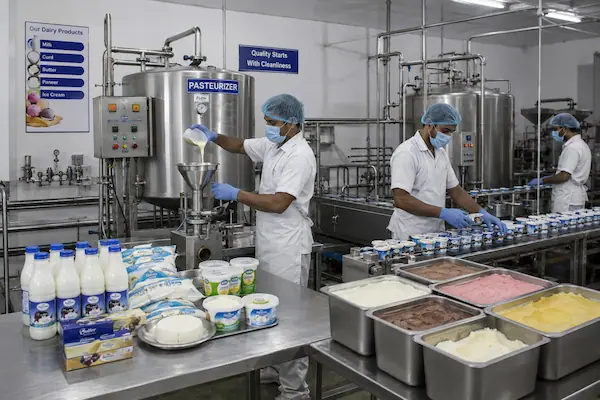
Ice cream and dairy products manufacturing is a scalable food business
Ice cream and dairy products manufacturing can be developed as a food processing business serving retail stores, distributors, restaurants, hotels, cafes, institutions and direct consumers. The business can range from a small local production unit to a larger manufacturing facility supplying products across multiple markets.
The opportunity is not limited to ice cream alone. A properly planned dairy and frozen food unit can manufacture or market products such as ice cream, kulfi, flavoured milk, curd, lassi, paneer, milk based desserts and other permitted dairy products depending on the equipment, product formulation and regulatory approvals.
The strongest business model is usually built around a focused product range, consistent quality, cold chain management, hygienic production and reliable distribution rather than trying to manufacture too many products from the beginning.
What products can be manufactured?
The exact product portfolio depends on the scale of the plant, available machinery, target customers and local demand. A unit can begin with a limited range and gradually add products as distribution improves.
- Ice cream
- Kulfi and frozen dairy desserts
- Flavoured milk
- Curd and yoghurt products
- Lassi and other fermented dairy beverages
- Paneer
- Milk based desserts
- Other permissible dairy and frozen products
Businesses should confirm the applicable food standards and product classification before commercial production.
Why this business can work in local and regional markets
Ice cream has a strong seasonal demand pattern, while several dairy products can generate sales throughout the year. Combining frozen products with regular dairy products can therefore create a more balanced product mix.
Demand can come from neighbourhood retailers, supermarkets, dairy outlets, cafes, restaurants, hotels, caterers, institutional buyers and distributors.
For a new entrepreneur, the regional brand model can be more practical than immediately competing with large national brands. Local distribution, fresh supply, competitive pricing and products suited to regional preferences can provide an entry point.
How an ice cream and dairy manufacturing unit works
The production process depends on the specific product, but a typical dairy based manufacturing operation involves raw material procurement, quality testing, formulation, processing, cooling, product specific treatment, filling or moulding, packaging, cold storage and distribution.
For ice cream, ingredients are generally combined into a mix, processed under controlled conditions, homogenised where applicable, cooled and matured before freezing and incorporation of the desired overrun. The finished product is then filled into suitable packaging and hardened before cold storage and distribution.
Dairy products such as paneer, curd, flavoured milk and other products follow different processing sequences and require product specific controls.
Major machinery required
Machinery requirements change significantly according to the products being manufactured and the intended production capacity.
A basic ice cream and dairy unit may require equipment such as milk reception and storage systems, weighing and mixing equipment, pasteurisation equipment, homogenisation equipment, chilling systems, ageing tanks, batch freezers or continuous freezers, filling machines, sealing equipment and cold storage.
Additional machinery may be necessary for products such as paneer, curd, yoghurt or flavoured milk.
The entrepreneur should design the machinery list around the actual product portfolio rather than purchasing every available machine at the beginning.
Raw materials required
Raw material requirements depend on the product formulation. Dairy production can involve milk and milk solids along with permitted ingredients, stabilisers, emulsifiers, flavours, sweeteners, fruits or other ingredients appropriate for the product.
Packaging materials are equally important. Cups, tubs, wrappers, bottles, pouches, cartons and other packaging formats should be selected according to product requirements, shelf life and distribution conditions.
Raw material quality has a direct effect on product consistency, taste and shelf life. Supplier selection and incoming material testing are therefore important parts of the business.
Cold chain is one of the most important parts of the business
An ice cream and dairy manufacturing business cannot be treated like a normal dry food manufacturing unit. Temperature control is required across processing, storage, transportation and retail distribution according to the product.
Cold storage capacity, insulated transportation and reliable electricity supply can therefore become major operating considerations.
Breaks in temperature control can affect product quality and can create inventory losses. New businesses should calculate cold chain requirements before finalising plant capacity and distribution routes.
Factory location and infrastructure
The plant location should provide reliable access to raw materials, utilities, labour, transport and target markets.
For dairy processing, proximity to milk collection areas can be useful where fresh milk is a major input. For ice cream distribution, proximity to major consumption markets can help reduce transportation time and cold chain cost.
The facility should be designed with adequate production areas, raw material handling space, packaging space, cold rooms, finished goods storage, sanitation facilities and appropriate waste management arrangements.
Food safety and regulatory compliance
Food manufacturing businesses in India must comply with the applicable food safety and other legal requirements. Depending on the nature and scale of the operation, registrations, licences and approvals can differ.
Food businesses should determine their applicable FSSAI licence or registration category before starting commercial production. They should also follow applicable requirements relating to food safety, hygiene, labelling, packaging, storage and permitted ingredients.
Other registrations and approvals may also apply depending on the location, building, labour arrangements, pollution requirements, electricity load, boiler or refrigeration systems and local business regulations.
Compliance should be checked with the relevant authorities before investment rather than after the plant is operational.
Packaging and branding can make a major difference
In the ice cream market, the product is often purchased on the basis of taste, price, appearance, availability and brand familiarity. Packaging therefore serves both a functional and marketing purpose.
A strong package should clearly communicate the product name, required declarations, storage instructions, net quantity, date information and other information required under applicable rules.
For a regional brand, a distinctive identity combined with consistent packaging across products can help customers recognise the brand in retail outlets.
Distribution models for a new business
An entrepreneur can choose among several distribution approaches depending on the target market.
- Direct retail: Selling through the company own outlets or dedicated freezers.
- Distributor model: Appointing distributors to cover specific towns or districts.
- Retail network: Supplying kirana stores, supermarkets and dairy outlets.
- Institutional sales: Supplying hotels, restaurants, cafes, caterers and other businesses.
- Direct consumer sales: Selling through company outlets or suitable online channels where the product and delivery model permit it.
For ice cream, freezer placement and retail visibility can be as important as production capacity. Distribution should therefore be planned alongside manufacturing.
How to choose the right product strategy
A new unit should not attempt to compete with established brands across every product category. A narrower product portfolio can make quality control and inventory management easier.
An entrepreneur can begin with one or two strong product categories and test demand before expanding. For example, a business may focus initially on a local ice cream range or combine ice cream with a small number of high demand dairy products.
The right strategy depends on local consumption patterns, available milk supply, customer preferences, distribution reach and competition.
Profitability depends on more than the selling price
The gross selling price of an ice cream or dairy product does not represent business profit. Profitability depends on raw material cost, formulation cost, packaging, labour, electricity, refrigeration, wastage, distribution, retailer margin, distributor margin, marketing and financing cost.
Cold chain and distribution can become significant expenses, especially when products are sold over a wide geographic area.
Entrepreneurs should therefore prepare unit economics for each product separately instead of estimating profit from a simple percentage applied to turnover.
Common mistakes new entrepreneurs should avoid
Buying excessive machinery before validating market demand is one of the common risks in food manufacturing. A plant with low capacity utilisation can carry high fixed costs.
Another risk is entering a large market without a clear distribution strategy. Ice cream and dairy products require repeat availability, and products can lose value when inventory moves slowly or cold chain conditions are not maintained properly.
Inconsistent taste, weak quality control, poor packaging, inadequate hygiene and delayed regulatory compliance can also damage a new brands reputation quickly.
How to start the business step by step
- Choose the initial product range.
- Study demand and competition in the target market.
- Prepare a realistic business plan and financial model.
- Select an appropriate manufacturing location.
- Determine the required production capacity.
- Select machinery based on the actual product mix.
- Arrange qualified raw material suppliers.
- Set up food safety and quality control systems.
- Complete the required licences and registrations.
- Develop packaging and brand identity.
- Build distribution and cold chain arrangements.
- Conduct trial production and validate product quality.
- Launch in a controlled market and scale after demand is established.
Is ice cream and dairy manufacturing suitable for a small entrepreneur?
It can be, but the answer depends on the intended scale, product mix, local demand and access to distribution. A smaller unit may focus on a limited regional market instead of trying to build a national brand immediately.
The biggest challenge is not simply manufacturing the product. It is maintaining consistent quality while controlling cold chain, distribution and customer acquisition costs.
Business opportunities beyond manufacturing
An entrepreneur does not necessarily need to build a large multi product dairy factory from the beginning. Smaller opportunities can exist in private label manufacturing, regional distribution, specialised dairy products, institutional supply, ice cream parlours and supporting services.
Packaging, cold storage, refrigeration maintenance, dairy equipment servicing and ingredient supply can also form part of the wider value chain.
Final assessment
Ice cream and dairy products manufacturing can offer a practical food business opportunity when the entrepreneur has a clear product strategy, reliable raw materials, strong quality control and an effective cold chain.
The business should be planned around the local market rather than around machinery alone. Before investment, the entrepreneur should validate demand, calculate product level margins, understand regulatory requirements and design a distribution network capable of maintaining product quality.
Key takeaway
The ice cream and dairy products manufacturing business can be developed from a focused regional unit into a larger food brand. The strongest foundation is a manageable product range, consistent quality, compliant production, efficient cold storage and a well planned distribution network.