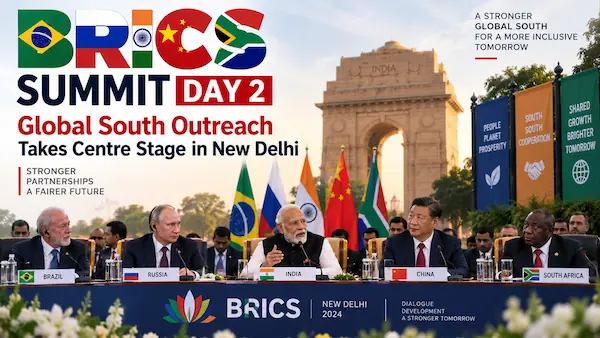
BRICS Summit enters its second day in New Delhi
The 18th BRICS Summit enters its second day in New Delhi today, September 13, 2026, with the focus shifting to partner countries and outreach participants under Indias BRICS chairship.
The summit is being held at Bharat Mandapam and is taking place under the theme Building for Resilience, Innovation, Cooperation and Sustainability.
The second day is scheduled to include the arrival of BRICS partner country leaders and outreach invitees, followed by a session focused on resilience, innovation, cooperation and sustainability for inclusive global growth.
What is scheduled for Day 2?
According to the published summit programme, partner country leaders and outreach invitees are scheduled to arrive at Bharat Mandapam from the morning onward.
The programme includes a family photograph followed by the open session titled Resilience, Innovation, Cooperation and Sustainability: Shaping the Future for Inclusive Global Growth.
The session is expected to provide a broader platform for emerging markets and developing countries to discuss common economic, technological and development challenges.
New Delhi Declaration already adopted
The first day of the summit ended with the unanimous adoption of the New Delhi Declaration.
The declaration reaffirmed BRICS cooperation across political and security, economic and financial, and cultural and people to people areas.
It also placed emphasis on a more representative international system, sustainable development, inclusive growth and stronger cooperation with emerging markets and developing countries.
Why the declaration matters for India
For India, the declaration is important because the country is using its 2026 BRICS chairship to push a broader Global South agenda rather than limiting the grouping to traditional economic cooperation.
Prime Minister Narendra Modi has argued that developing countries should have a stronger role in shaping global rules and institutions.
The summit discussions have therefore included issues such as reform of global institutions, trade, technology, energy security, development finance and cooperation among emerging economies.
BRICS members call for restraint over global conflicts
The New Delhi Declaration also addressed major international conflicts and called for dialogue, consultation and diplomacy to resolve disputes.
The declaration came as the wider global environment remains tense, particularly because of the continuing conflict in the Middle East.
BRICS members stressed the importance of protecting civilians, respecting sovereignty and supporting international law while seeking political and diplomatic solutions to conflicts.
Trade and tariffs become an important BRICS issue
Trade policy has emerged as another significant theme at the summit.
BRICS countries expressed concern over unilateral tariff and non tariff measures that they believe can disrupt international trade and create additional pressure on developing economies.
For India, the issue is particularly relevant because access to international markets, supply chain stability and predictable trade rules are important for manufacturing, exports and investment.
Local currency trade and payment systems remain in focus
The summit has also continued discussions on improving cross border payments and increasing the use of national currencies in trade and investment.
The New Delhi Declaration supports efforts to make cross border settlements more efficient and encourages greater use of local currencies where practical.
BRICS payment cooperation is therefore being discussed as a way to reduce transaction friction without creating a single BRICS currency.
No single BRICS currency announcement
One important point for Indian readers is that the summit has not resulted in the launch of a common BRICS currency.
The current approach is focused more on improving payment systems, facilitating settlements in member currencies and expanding local currency financing through existing institutions.
This distinction matters because discussions around BRICS frequently generate speculation about a single currency replacing the dollar. The current summit framework does not amount to such a launch.
AI and technology gain importance
Technology and artificial intelligence are also important parts of the BRICS agenda.
The New Delhi Declaration supports greater cooperation on artificial intelligence and highlights the need for trustworthy, inclusive and energy efficient AI systems that can support development across emerging economies.
India is also promoting cooperation through digital public infrastructure, science and research networks and technology focused initiatives under its BRICS chairship.
Energy security remains a major concern
BRICS leaders have highlighted the need for secure and diversified energy markets as well as resilient infrastructure and supply chains.
The declaration also recognises that fossil fuels will continue to play an important role for many developing and emerging economies during the transition towards lower carbon energy systems.
This approach reflects the different energy needs and economic conditions of BRICS countries and supports a transition that takes national circumstances into account.
What BRICS means for Indian businesses
For Indian companies, the significance of BRICS is increasingly linked to practical economic cooperation rather than only geopolitics.
Trade settlement mechanisms, supply chain cooperation, technology partnerships, energy security, infrastructure finance and wider market access can directly affect exporters, manufacturers, startups and investors.
Indian businesses can potentially benefit if BRICS cooperation reduces payment barriers, improves logistics and opens additional markets across emerging economies.
India China talks add another economic dimension
Prime Minister Narendra Modi and Chinese President Xi Jinping also met on the sidelines of the summit.
The two leaders discussed improving business and transport links, market access, trade imbalances and broader bilateral relations.
For Indian industry, the economic significance of these discussions lies in supply chains, imports, exports and the long term stability of one of Indias most important trading relationships.
What to watch on the second day
The key developments to watch today are the outreach session involving partner countries, statements from participating leaders and any additional announcements on economic cooperation, technology, trade and development finance.
India is also likely to highlight practical outcomes from its year long BRICS chairship and the initiatives developed around resilience, innovation, cooperation and sustainability.
What the summit means for the Global South
The broader direction of the New Delhi summit suggests that BRICS is seeking to position itself as a larger platform for emerging and developing countries rather than simply as a grouping focused on five original members.
The expanded membership and partner country framework give India an opportunity to promote cooperation across Asia, Africa, the Middle East and other developing regions.
Key takeaway
The second day of the BRICS Summit is underway in New Delhi with partner countries and outreach participants taking centre stage. The first day produced a unanimous New Delhi Declaration covering global governance, trade, technology, energy, development and international conflicts. For India, the immediate priority is to turn these broad commitments into practical cooperation that can improve trade, investment, technology partnerships and the voice of the Global South.