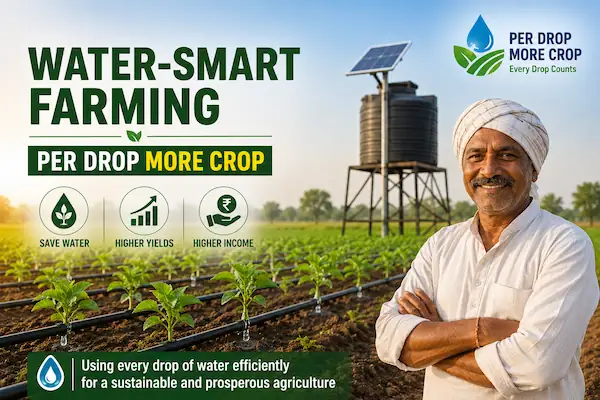
Per Drop More Crop crosses 115 lakh hectare milestone
The Per Drop More Crop scheme has expanded the use of micro irrigation across India. More than 115 lakh hectares have been brought under micro irrigation as of July 2026, according to the latest government update released through the Press Information Bureau.
The programme focuses on improving farm level water efficiency through drip and sprinkler irrigation. The latest figures show the growing scale of efforts to improve the efficiency of water use in agriculture.
The scheme combines financial assistance with digital implementation and direct benefit transfer mechanisms. These measures are intended to improve transparency and make micro irrigation facilities more accessible to farmers.
Why micro irrigation matters for Indian agriculture
More than 80% of the available water resources used in India are consumed by agriculture, while only around half of the net sown area has irrigation facilities, according to the government release.
This creates an important challenge for Indian agriculture. Farmers need reliable irrigation, but water losses during traditional irrigation can reduce efficiency. Micro irrigation addresses this issue by supplying water closer to the crop root zone.
Per Drop More Crop therefore promotes two major systems: drip irrigation and sprinkler irrigation.
How much subsidy is available under PDMC?
Under the scheme, financial assistance is available for micro irrigation systems covering up to five hectares per beneficiary.
Small and marginal farmers can receive assistance of 55%, while other farmers can receive assistance of 45%, according to the government update.
This assistance can reduce the initial cost of installing modern irrigation systems and make efficient irrigation more accessible for farmers.
Subject to applicable scheme conditions, assistance can be received again for the same land after seven years.
₹8,123.24 crore released in the last three years
The government has released ₹8,123.24 crore in central assistance during the last three years for the programme.
State governments can also provide additional financial support from their own budgets. The actual support available to a farmer can therefore vary depending on state level implementation and additional assistance.
12.30 lakh farmers benefited in 2025-26
During 2025-26, around 12.30 lakh farmers benefited from the scheme.
Approximately 20% of the beneficiaries during the year were women.
Maharashtra, Karnataka, Andhra Pradesh, Tamil Nadu, Gujarat and Rajasthan recorded the highest areas covered by micro irrigation under PDMC during 2025-26.
PDMC is implemented under PM-RKVY
Per Drop More Crop has gone through several institutional changes since its introduction. The programme began in 2006 as the Centrally Sponsored Scheme for Micro Irrigation.
From financial year 2015-16 to 2021-22, it was implemented as a core component of the Pradhan Mantri Krishi Sinchayee Yojana.
Since 2022-23, PDMC has been implemented under the Pradhan Mantri Rashtriya Krishi Vikas Yojana or PM-RKVY.
PM-RKVY was restructured in October 2024 as an umbrella agricultural programme covering several agricultural development components. The framework provides states with flexibility to reallocate funds according to local agricultural requirements.
₹3,226.36 crore allocated for PDMC in 2025-26
During 2025-26, a total of ₹8,957.72 crore was released or sanctioned for PM-RKVY.
Out of this amount, ₹3,226.36 crore was specifically dedicated to the Per Drop More Crop component.
The funding structure places micro irrigation within a broader agricultural strategy that also covers mechanisation, soil health, crop diversification and agricultural innovation.
States get more flexibility for water conservation
The latest framework gives states and Union Territories greater flexibility to undertake local water storage and conservation activities under the Other Interventions component of PDMC.
Such activities can include diggis, farm ponds and water harvesting systems. These facilities can be developed for individual farmers or community use according to local requirements.
The objective is to improve water availability for micro irrigation and create more reliable farm level water resources.
Earlier funding limits have been relaxed
Earlier, funding for these conservation activities was capped at 20% of the total allocation for general states and Union Territories.
The corresponding limit was 40% for North Eastern States, Himalayan States and the Union Territories of Jammu and Kashmir and Ladakh.
The revised guidelines allow states and Union Territories to exceed these earlier limits according to local requirements.
Drip irrigation and sprinkler irrigation explained
Drip irrigation supplies water slowly and directly near plant roots through emitters installed on irrigation tubing. This allows controlled water application and can reduce unnecessary water loss.
Sprinkler irrigation distributes water through pressurised nozzles over the crop area. The system creates a pattern similar to rainfall and can be used for different crop and field conditions.
Government material identifies portable sprinklers, micro sprinklers, mini sprinklers, semi permanent sprinklers and large volume rain guns among the systems used for different agricultural requirements.
How micro irrigation can reduce farm input costs
The government update cites studies showing that micro irrigation can reduce water, energy, labour and fertiliser consumption while improving crop productivity.
The Economic Survey assessment cited in the government material reported water savings of 20% to 48%, energy savings of 10% to 17%, labour cost reductions of 30% to 40% and fertiliser savings of 11% to 19%.
The same assessment reported crop yield increases ranging from 20% to 38%.
A NITI Aayog evaluation cited in the source reported water use efficiency improvements ranging from 30% to 70% and income gains ranging from 10% to 69% in the areas studied.
Farmer example from Andhra Pradesh
The government update cites LAM Srinivasa Rao from Palnadu in Andhra Pradesh as an example of drip irrigation adoption.
He installed drip irrigation on his two acre acid lime orchard and replaced traditional flood irrigation. The system also allowed fertigation.
His yield increased from 90 to 105 quintals per acre. His cultivation cost declined from ₹3 lakh to ₹2.4 lakh.
With stable market prices, his net income increased from ₹1.5 lakh to ₹2.85 lakh. The government source reports additional income of ₹1.35 lakh.
Results can vary between farms because crop type, market prices, soil, water availability, farm management and system quality all influence the final outcome.
Fertigation improves precision in nutrient application
PDMC also promotes fertigation, where fertiliser is supplied together with irrigation water near the crop root zone.
This approach can improve the precision of nutrient application and forms part of the broader precision water management strategy supported by the programme.
Integration with other irrigation systems
The programme encourages integration of micro irrigation with tube wells, river lift irrigation and solar powered irrigation systems.
It also promotes convergence with other government programmes so that available water resources can be used more efficiently.
The performance of a micro irrigation system depends not only on the irrigation equipment but also on water availability, storage, energy supply, filtration, maintenance and farm management.
What does 115 lakh hectare coverage mean?
The coverage of more than 115 lakh hectares demonstrates the scale of micro irrigation adoption under the programme.
However, the figure represents land area and should not be confused with the number of farmers covered by the scheme.
The government says the covered area represents approximately 8.11% of the net sown area. This indicates both the progress achieved and the remaining scope for further expansion of water efficient irrigation.
Business opportunities linked to micro irrigation
The expansion of micro irrigation can create demand for drip irrigation equipment, sprinkler systems, fertigation equipment, pumps, filtration systems, water storage infrastructure, installation services and agricultural technology.
This can create opportunities for agri businesses serving farmers and rural markets. However, actual business potential depends on state subsidy implementation, local crop patterns, farmer demand and regional market conditions.
What farmers should check before installing a system
Farmers should consider crop spacing, soil characteristics, available water, farm size, pressure requirements, filtration needs and maintenance requirements before selecting a micro irrigation system.
Subsidy percentage should not be the only factor in selecting equipment. System quality, installation standards, after sales support and suitability for the crop can have a major impact on long term performance.
Key takeaway
Per Drop More Crop has brought more than 115 lakh hectares under micro irrigation as of July 2026. Small and marginal farmers can receive assistance of up to 55%, while other farmers can receive assistance of up to 45% under the scheme.
The revised framework also gives states and Union Territories more flexibility to invest in local water storage and conservation activities. With PDMC now implemented under PM-RKVY, the programme is being positioned as part of a wider strategy for efficient water use, sustainable farming and improved agricultural productivity.