Ladakh Administration issues food safety compliance direction
The Administration of the Union Territory of Ladakh has directed all Food Business Operators (FBOs) to maintain strict and continuous compliance with the Food Safety and Standards Act, 2006, along with the applicable rules and regulations. The direction was issued through the Department of Health and Medical Education following a circular from the Commissioner of Food Safety, UT Ladakh.
The administration has specifically reminded food businesses that food safety, hygiene, sanitation and valid licensing are ongoing statutory responsibilities rather than one-time requirements.
More than 8,700 FSSAI licence and registration holders in Ladakh
According to the Ladakh Administration, the Union Territory currently has 428 FSSAI licence holders and 8,355 FSSAI registration holders. Together, this represents 8,783 food businesses covered by the licensing and registration framework mentioned in the government notice.
The administration has asked all such operators to review their existing compliance practices and immediately address any deficiencies.
What food businesses have been asked to maintain
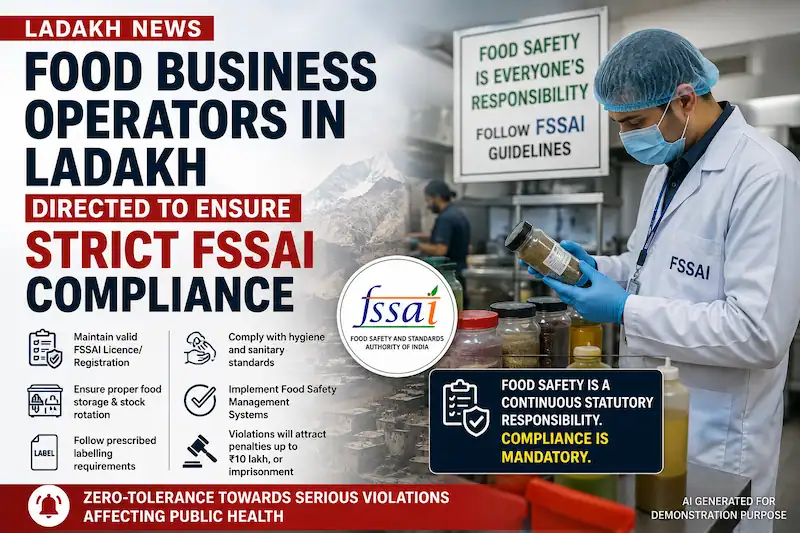
The directions cover several operational areas that directly affect day-to-day food businesses. FBOs have been advised to ensure that their FSSAI licences or registrations remain valid and that their premises comply with prescribed hygiene and sanitation requirements.
- Maintain a valid FSSAI licence or registration.
- Follow prescribed food hygiene and sanitary requirements.
- Implement an appropriate Food Safety Management System.
- Maintain proper food storage conditions and stock rotation.
- Follow applicable food labelling requirements.
- Prevent the manufacture, storage, distribution or sale of unsafe or non-compliant food.
The administration has also cautioned businesses against dealing in sub-standard, misbranded, adulterated, contaminated or expired food products.
Inspections, sampling and enforcement action
The Food Safety Department has announced a zero-tolerance approach towards deliberate and serious violations that could affect public health. Enforcement action may include inspections of food businesses, collection of samples for analysis, seizure of unsafe food and prohibition of sale where violations are established.
Depending on the nature of the violation, the department may also take action relating to suspension or cancellation of licences, statutory penalties and prosecution.
What penalties can apply under food safety law?
The Food Safety and Standards Act, 2006 provides different penalties and punishments depending on the nature and seriousness of a violation. For example, certain offences can carry monetary penalties of up to ₹10 lakh. The Act also provides for imprisonment and fines in serious cases involving unsafe food, with the punishment depending on the consequences of the offence.
Under Section 57 of the Act, possession of an adulterant that is injurious to health can attract a penalty of up to ₹10 lakh. Section 59 provides progressively higher punishment for unsafe food depending on whether the violation causes no injury, non-grievous injury, grievous injury or death.
Food businesses should therefore not treat an FSSAI registration or licence as sufficient by itself. Compliance with applicable food safety, hygiene, storage, labelling and operational requirements must be maintained continuously.
Food Safety Officers to verify compliance
The Ladakh Administration has stated that Food Safety Officers will conduct inspections and verify compliance by food businesses. Serious or repeated violations are expected to be dealt with strictly under the applicable law.
For businesses operating restaurants, hotels, food manufacturing units, retail outlets, catering operations or other food-related activities, the latest direction means that internal compliance checks and corrective action should be completed before an inspection identifies deficiencies.
What food business operators in Ladakh should do now
Food businesses should first check whether their FSSAI licence or registration is valid and matches their current business activity. They should then review hygiene and sanitation conditions, food storage arrangements, stock rotation practices, labelling and food safety procedures.
Businesses should also maintain proper records and address deficiencies promptly, especially where a non-compliance issue could affect food safety or consumer health.
Why this matters for small businesses
For small food businesses, compliance failures can create more than a regulatory problem. Unsafe or improperly labelled food can affect consumer trust, lead to product losses and expose the operator to enforcement proceedings.
The Ladakh directive reinforces the need for food businesses to treat FSSAI compliance as a continuing operational requirement rather than something that is checked only when applying for a licence or registration.
Key takeaway
The Ladakh Administration has asked all Food Business Operators to maintain continuous compliance with food safety law. With 428 licensed and 8,355 registered FBOs currently covered, the administration has made it clear that inspections and enforcement will be used against serious or repeated violations. Businesses should review their licences, hygiene systems, storage practices, labelling and other food safety controls without delay.