India and Argentina seek wider economic cooperation
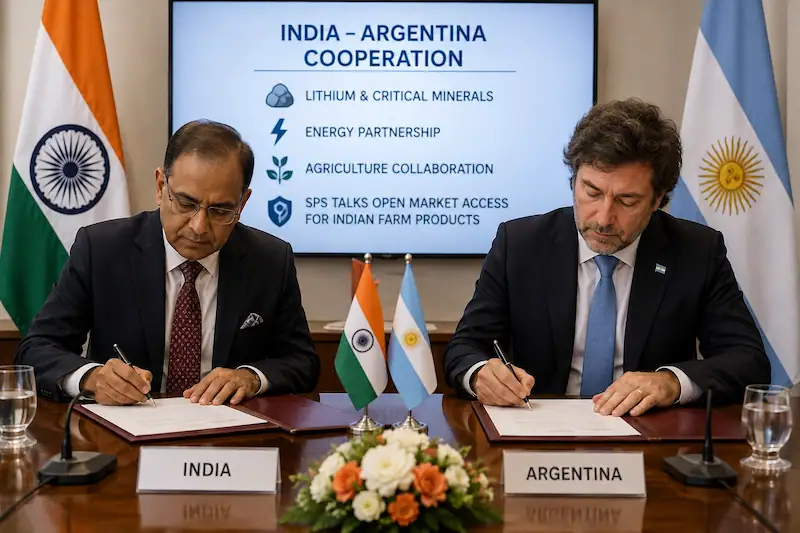
India and Argentina have moved to deepen their trade and economic relationship, with both countries identifying new opportunities across critical minerals, agriculture, pharmaceuticals, energy, digital services and advanced technology. The development followed the fourth meeting of the India-Argentina Joint Trade Committee (JTC), held on 24 August 2026 in Buenos Aires.
The Indian delegation was led by Commerce Secretary Shri Rajesh Agrawal, while Argentina was represented by Ambassador Fernando Brun, Secretary for International Economic Relations. The discussions reviewed progress under the bilateral roadmap agreed during Prime Minister Narendra Modi’s visit to Argentina in 2025.
Bilateral trade crosses USD 6.5 billion
According to the Ministry of Commerce and Industry, bilateral trade between India and Argentina crossed USD 6.5 billion in 2025. Trade has recorded annual growth of more than 17 per cent, underlining the increasing commercial importance of the relationship.
India is now Argentina’s fifth-largest trading partner. Both sides, however, indicated that the existing trade basket has scope for further diversification and that improving reciprocity and market access would be important as bilateral commerce expands.
Lithium and critical minerals emerge as strategic areas
Critical minerals were an important part of the discussions, particularly lithium. Indian state-owned company KABIL has been pursuing mining opportunities in Argentina’s lithium sector.
The Catamarca project has advanced with the completion of Phase II drilling. India and Argentina are also exploring additional opportunities in the provinces of Salta and Jujuy.
Greater access to lithium resources is strategically important for industries associated with batteries, electric mobility and clean-energy supply chains, although the economic impact will depend on how the identified projects develop commercially.
Market access for Indian agricultural products
Both countries reported progress in discussions concerning sanitary and phytosanitary (SPS) requirements for several Indian agricultural products.
Technical discussions are advancing for market access involving onions, milk and milk products, grapes, potatoes, bananas and pulses. For Indian exporters, progress on SPS procedures can reduce one of the practical barriers involved in entering a foreign food market.
The development could also create additional opportunities for Indian farmers, processors and exporters as bilateral agricultural trade expands.
Pharmaceutical exports could get a boost
Pharmaceutical market access was another major issue discussed during the JTC. Argentina has committed to work towards moving India from Annex II to Annex I under its pharmaceutical regulatory framework and to reduce barriers affecting Indian pharmaceutical products.
Improved regulatory recognition could make it easier for eligible Indian pharmaceutical companies to access the Argentine market. The discussions also build on the 2019 cooperation agreement between Argentina’s ANMAT and India’s CDSCO.
The two countries also agreed to strengthen cooperation in areas including Ayurveda and Yoga.
Digital, telecom, aviation and space sectors identified for expansion
The economic agenda is not limited to conventional merchandise trade. India and Argentina identified aviation, telecommunications, digital services and space technology as areas with additional cooperation potential.
Specific technology areas highlighted in the discussions included 5G, artificial intelligence and digital infrastructure. Space cooperation was also discussed, including the possibility of further engagement between India’s ISRO and Argentina’s CONAE.
India-MERCOSUR trade agreement remains important
The India-MERCOSUR Preferential Trade Agreement was also highlighted as an important mechanism for expanding market access. Discussions on the Terms of Reference and the use of digital certificates of origin are expected to make cross-border trade more efficient.
For Indian companies, a more efficient trade documentation system can reduce administrative friction and make it easier to manage exports into the wider MERCOSUR-linked market.
India sends its largest business delegation to Argentina
The government-to-government discussions were followed by the India-Argentina Business Forum on 25 August 2026 in Buenos Aires.
Commerce Secretary Rajesh Agrawal led what the Ministry described as the first and largest-ever Indian business delegation to Argentina, with more than 25 business leaders participating. Representatives from companies including UPL, Kirloskar and Aditya Birla Group were part of the delegation.
The business forum focused on converting government-level discussions into commercial partnerships across agriculture, minerals, energy, pharmaceuticals, healthcare, tourism, banking and telecommunications.
What the developments mean for Indian businesses
The latest engagement creates potential opportunities for Indian exporters and companies looking to enter Argentina, particularly in agriculture, pharmaceuticals, technology, minerals and infrastructure.
However, market access discussions do not automatically mean that every product can immediately be exported. Businesses will still need to meet Argentina’s applicable regulatory, technical, sanitary, labelling and commercial requirements.
For companies evaluating Argentina, the most important developments to track are the implementation of SPS arrangements, pharmaceutical regulatory recognition, mineral projects, trade-documentation reforms and the evolution of the India-MERCOSUR framework.
India-Argentina relationship expands beyond traditional trade
The latest JTC discussions suggest that the economic relationship is becoming broader than conventional goods trade. Agriculture and pharmaceuticals remain important, while lithium, digital technology, space and telecommunications are emerging as strategic areas for future cooperation.
The combination of government-level negotiations and direct engagement between companies could help translate bilateral diplomatic commitments into commercial opportunities over time.
Key takeaway
India and Argentina are working to expand their economic relationship across both traditional and emerging industries. Bilateral trade crossed USD 6.5 billion in 2025, while discussions are advancing on Indian agricultural exports, pharmaceutical market access and lithium opportunities. Cooperation in digital technology, telecommunications, aviation and space could further widen the scope of the partnership.