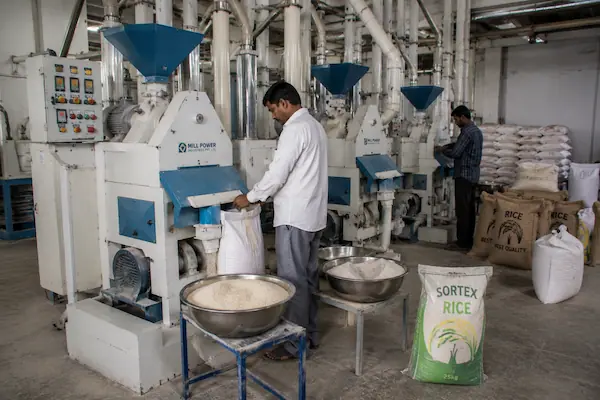
1. Mini Rice Mill Business: What Is It?
A mini rice mill is a small-scale paddy processing unit that removes the outer husk from paddy and processes the grain into rice. Depending on the machine configuration, a mini rice mill may combine husking, separation, polishing or milling in a compact system.
This creates two very different business models.
- Custom Milling: Farmers or households bring paddy and pay for milling. Your business earns a processing fee.
- Own Paddy Procurement: You buy paddy, process it into rice and sell the rice in wholesale or retail markets.
- Branded Rice: You procure paddy, mill it, grade and pack the rice under your own brand.
- B2B Supply: You supply milled rice to wholesalers, retailers, restaurants, institutions or other food businesses.
The investment and working-capital requirements of these models are completely different. A small custom milling service can operate with a compact machine, while an own-brand rice business needs money for paddy inventory, storage, packaging, transport and unsold stock.
ICAR documents mini rice mills as part of village-level agro-processing. An ICAR procurement specification for an integrated mini rice mill lists a capacity of 80–100 kg/hour, 2–3 HP motor and single-phase operation. Another government procurement specification from ICAR-Nagaland lists an automatic mini rice mill with 100–150 kg/hour production capacity, a 3 HP single-phase motor and a requirement for a valid test report from an authorised testing centre. These are machine specifications, not guarantees of commercial profit. ([icar-ciwa.org.in](https://icar-ciwa.org.in/pdf/tenders/2025/GeM/Aug2025/GeM-Bidding-8228227-2.pdf?utm_source=web_search)) ([icarnagaland.nic.in](https://icarnagaland.nic.in/RiceMill2022.pdf?utm_source=web_search))
2. Is a Mini Rice Mill a Good Business?
It can be a useful rural or semi-urban processing business when there is enough nearby paddy and a reliable market for the resulting rice.
But the important point is that a rice mill does not create value simply because a machine is installed. Your economics depend on:
- How much paddy you can process per day.
- How much rice you recover from the paddy.
- How much broken rice is generated.
- The purchase price of paddy.
- The selling price of different rice grades.
- The value of by-products such as husk and bran.
- Electricity, labour, maintenance and transport costs.
IRRI explains that rice milling quality is strongly affected by paddy quality and milling conditions. Excessive grain breakage reduces the value of the finished rice, while correct moisture, proper cleaning, suitable husking and grading improve milling performance. ([knowledgebank.irri.org](https://www.knowledgebank.irri.org/step-by-step-production/postharvest/milling?utm_source=web_search))
3. Custom Rice Milling vs Own Rice Business
Custom Milling Model
In the custom model, the customer brings paddy to your mill. You process it and charge a fee per kilogram or according to your local arrangement.
The major advantage is low inventory requirement. You do not have to buy large quantities of paddy. The challenge is that your revenue depends on local milling volume and seasonal demand.
Own Paddy Procurement Model
Here, you buy paddy, mill it and sell rice yourself. You have more control over the finished product and selling price, but you also take the risk of paddy price movements, storage, working capital and unsold inventory.
Branded Rice Model
This model adds cleaning, grading, packaging, branding, retailer margins and marketing. The selling price can be higher, but the business becomes much more working-capital intensive.
4. Where Should You Set Up a Mini Rice Mill?
Location is critical because paddy is heavy and transportation costs can quickly reduce margins.
- Near Paddy-Producing Villages: Reduces transport distance for farmers and raw material movement.
- Near Local Procurement Centres: Useful where paddy aggregation already exists.
- Rural Markets: Can be suitable for custom milling and farmer services.
- Semi-Urban Grain Markets: Better suited to wholesale and packaged rice distribution.
- Near Warehouses: Useful when you intend to carry larger paddy and rice inventories.
Before taking a location, identify the paddy-producing villages within your practical collection radius, existing rice mills, average local milling charges and possible buyers.
5. How Much Space Does a Mini Rice Mill Need?
There is no universal space requirement because a compact integrated machine takes much less room than a mill with separate cleaning, husking, polishing, grading and packaging equipment.
Plan space for:
- Incoming paddy
- Cleaning and inspection
- Rice milling machinery
- Finished rice
- Husk and bran
- Packaging
- Loading and unloading
ICAR has documented village-level agro-processing centres using mini rice mills and other agricultural processing machines. One integrated agro-processing-centre model required approximately 200–300 square yards for a group of multiple machines, not for a single mini rice mill. ([icar.gov.in](https://icar.gov.in/en/node/2184?utm_source=web_search))
For a standalone mini rice mill, the final space should therefore be planned from the selected machine layout rather than from a copied generic square-foot figure.
6. Paddy: The Most Important Raw Material
Rice quality starts with paddy quality. Poor-quality paddy can produce more broken grains, lower recovery and inconsistent rice.
Before procurement, check:
- Moisture
- Variety
- Foreign matter
- Immature grains
- Grain size
- Broken or damaged kernels
- Storage condition
- Purchase price
IRRI recommends milling paddy at an appropriate moisture level and specifically identifies approximately 14% moisture content as ideal for milling. It also notes that grain that is too dry is more prone to breakage. Use a moisture meter rather than relying only on visual inspection. ([knowledgebank.irri.org](https://www.knowledgebank.irri.org/step-by-step-production/postharvest/milling?utm_source=web_search))
7. Mini Rice Mill Manufacturing Process
A compact mini mill may combine several functions into one machine, but the basic rice-milling logic remains the same.
- Paddy Receiving: Receive and weigh the incoming paddy.
- Pre-Cleaning: Remove straw, dust, stones and other foreign material before milling.
- Husking / Dehusking: Remove the outer husk from the paddy.
- Husk Aspiration: Separate removed husk from the grain stream.
- Paddy Separation: Separate remaining unhusked paddy from brown rice and return the paddy for further husking where the system requires it.
- Whitening / Milling: Remove the bran layer according to the desired rice type.
- Polishing: Improve the appearance of the rice where the product specification requires polishing.
- Grading / Sifting: Separate broken grains and different fractions.
- Weighing: Weigh the finished rice accurately.
- Packaging: Pack rice into appropriate food-grade packaging.
- Storage and Dispatch: Protect the finished rice from moisture, pests and contamination before sale.
IRRI describes modern rice milling in stages including pre-cleaning, husking, husk aspiration, paddy separation, de-stoning, whitening, polishing, sifting, grading and weighing/bagging. A compact mini mill may combine some of these stages. ([knowledgebank.irri.org](https://www.knowledgebank.irri.org/step-by-step-production/postharvest/milling/milling-systems/commercial-milling?utm_source=web_search))
8. Why Paddy Cleaning Matters
Cleaning is not optional housekeeping. Foreign material can damage machinery and reduce the quality of the finished rice.
Large commercial systems may use cleaners, aspirators, magnetic separators, destoners and other equipment. A small mini mill may use a simpler integrated cleaning arrangement, but the goal remains the same: start the milling process with cleaner paddy.
IRRI notes that pre-cleaning removes impurities and helps protect milling machinery while improving the quality of milled rice. ([knowledgebank.irri.org](https://www.knowledgebank.irri.org/step-by-step-production/postharvest/milling?utm_source=web_search))
9. Husking and Paddy Separation
Husking removes the outer hull from paddy. After husking, the stream contains brown rice and some unhusked paddy. Proper separation is important because unhusked paddy should generally be returned for further husking rather than sent directly into the whitening stage.
IRRI recommends rubber-roll husking and paddy separation because this improves milling quality and reduces unnecessary wear on the equipment. ([knowledgebank.irri.org](https://www.knowledgebank.irri.org/step-by-step-production/postharvest/milling?utm_source=web_search))
10. Whitening, Polishing and Grading
After husking, brown rice can be processed through whitening to remove the bran layers. Polishing can then be used to improve the appearance of the finished grain depending on the intended product.
Grading is important because head rice and broken rice do not normally have the same market value. Separating them can improve product consistency and allow different rice fractions to be sold appropriately.
IRRI recommends grading milled rice to separate small brokens and chips, noting that rice with a high proportion of small brokens generally has lower market value. ([knowledgebank.irri.org](https://www.knowledgebank.irri.org/step-by-step-production/postharvest/milling?utm_source=web_search))
11. Mini Rice Mill Machinery Required
- Mini Rice Mill: Integrated or modular machine for small-scale rice milling.
- Paddy Cleaner: Removes foreign material before milling.
- Husker: Removes the outer paddy husk.
- Paddy Separator: Separates brown rice and unhusked paddy.
- Rice Whitener: Removes bran to produce white rice.
- Rice Polisher: Optional depending on target market and product.
- Rice Grader: Separates rice by size and broken fraction.
- Moisture Meter: Important for incoming paddy quality control.
- Weighing Scale: For paddy and finished rice.
- Bag Sealer: For packaged rice.
- Batch Coding Machine: Useful for organised packaged-food sales.
ICAR sources show mini rice mills in the approximately 80–100 kg/hour and 100–150 kg/hour range, depending on the machine design. ([icar-ciwa.org.in](https://icar-ciwa.org.in/pdf/tenders/2025/GeM/Aug2025/GeM-Bidding-8228227-2.pdf?utm_source=web_search)) ([icarnagaland.nic.in](https://icarnagaland.nic.in/RiceMill2022.pdf?utm_source=web_search))
12. How Much Does a Mini Rice Mill Machine Cost?
Machine price depends on capacity, integration, motor, husking technology, polishing arrangement, construction quality, automation and supplier support.
Instead of publishing one artificial price, compare machines using:
- Rated capacity
- Actual tested output
- Head-rice recovery
- Broken-rice percentage
- Power consumption
- Motor and drive system
- Ease of maintenance
- Availability of spare parts
- Warranty
- After-sales service
ICAR has specifically established machinery testing capability covering mini rice mills, with performance assessment including capacity, efficiency, energy consumption, grain losses and output quality. This is a useful principle when evaluating supplier claims. ([icar.gov.in](https://www.icar.gov.in/hi/node/24741?utm_source=web_search))
13. Investment Required for a Mini Rice Mill Business
Investment depends heavily on whether you run a custom milling service or procure paddy yourself.
Micro Custom Milling Model
A small integrated mini rice mill with basic weighing and handling equipment can be suitable for a custom milling business where the customer supplies paddy.
Small Commercial Model
Add proper raw-material storage, cleaning, grading, better packaging and working capital for buying paddy.
Integrated Commercial Model
Additional investment may be required for separate cleaners, huskers, separators, whiteners, polishers, graders, conveyors, storage and automated packing.
Do not use a large commercial rice-mill project cost as the minimum investment required for a village-level mini mill.
14. Working Capital: The Hidden Requirement
Custom milling and own-procurement businesses have completely different working-capital needs.
In customer milling, the customer owns the paddy. Your cash requirement is mainly for electricity, wages, maintenance and operating expenses.
In own-procurement milling, you must buy and hold paddy before you receive money from rice sales. This can tie up substantial working capital.
Budget for:
- Paddy inventory
- Packaging material
- Labour
- Electricity
- Transport
- Maintenance
- Storage
- Customer credit
15. Rice Recovery and Broken Rice: Why the Numbers Matter
Do not calculate your business using only the selling price of rice. The actual economics depend on how much saleable rice you recover from the paddy and how much becomes broken rice, bran, husk or process loss.
IRRI highlights head-rice recovery and broken grains as important economic indicators. Poor milling conditions and unsuitable moisture can increase breakage and reduce the value of the finished product. ([knowledgebank.irri.org](https://www.knowledgebank.irri.org/step-by-step-production/postharvest/milling?utm_source=web_search))
For every production batch, record:
- Incoming paddy weight
- Moisture
- Cleaned paddy weight
- Husk quantity
- Rice output
- Broken rice quantity
- Bran quantity
- Process loss
16. Mini Rice Mill Profit: How to Calculate It
For a custom mill:
Monthly revenue = paddy processed × milling charge per kg
For an own-procurement business:
Gross contribution = revenue from rice + by-products - paddy purchase cost - variable processing costs
Then subtract fixed expenses such as rent, salaries, depreciation, administrative costs and loan-related costs to estimate operating profit.
The important metric is not machine capacity alone. It is saleable output and daily utilisation.
17. Can the By-Products Make Money?
Rice milling produces more than white rice. Important by-products include rice husk, rice bran and broken rice.
- Rice Husk: Can have value as a fuel or for other uses depending on the local market.
- Rice Bran: Can be sold into feed or oil-related markets depending on quality and buyer requirements.
- Broken Rice: Can be sold into suitable food, feed or industrial channels depending on grade and market.
IRRI identifies husk, bran and brewer's rice or small broken grains as key milling by-products. ([knowledgebank.irri.org](https://www.knowledgebank.irri.org/step-by-step-production/postharvest/milling?utm_source=web_search))
Do not assume a fixed price for any by-product. Local buyers and quality determine realisation.
18. Where Can You Sell the Rice?
- Local Rice Wholesalers: Good for moving larger volumes.
- Retail Grocery Stores: Suitable for branded or locally packed rice.
- Farmers' Markets and Local Markets: Useful for direct regional sales.
- Restaurants and Caterers: Can become repeat B2B customers.
- Hostels and Institutions: Potential bulk buyers where quality and procurement requirements are met.
- Own Retail Brand: Higher control over pricing and customer relationships but requires stronger marketing.
- Online Sales: Useful for branded regional rice after packaging and fulfilment systems are ready.
19. Local Rice Brand: How to Compete
A small rice mill should not try to defeat large national brands only on advertising. A local brand can compete through a specific variety, local sourcing, freshness, reliable quality and relationship with retailers.
Possible positioning includes:
- Locally sourced rice
- Specific regional rice variety
- Freshly milled rice
- Different rice grades
- Small household packs
- Bulk family packs
- Institutional packs
Do not use health, organic or purity claims unless they are accurate and supported by applicable evidence and certification.
20. Rice Packaging Requirements
Once you sell packaged rice under your own brand, packaging becomes a compliance and quality-control issue, not just a design exercise.
Depending on the product and packaging, declarations can include product name, net quantity, manufacturer or packer details, batch or lot identification, relevant dates, MRP and other legally required information.
For current packaged-food requirements, verify FSSAI labelling rules and applicable Legal Metrology requirements before printing large quantities of packaging.
21. FSSAI Registration and Licence: 2026 Rules
Rice milling and packaged rice sales fall within the food-business framework. The exact FSSAI category depends on your activity.
From 1 April 2026, FSSAI revised the turnover thresholds for food businesses:
- Registration: Annual turnover up to ₹1.5 crore.
- State Licence: Annual turnover above ₹1.5 crore and up to ₹50 crore.
- Central Licence: Annual turnover above ₹50 crore.
FSSAI issued the revised order on 13 March 2026 and stated that the new thresholds take effect from 1 April 2026. ([fssai.gov.in](https://www.fssai.gov.in/upload/advisories/2026/03/69b4054bb6cd6Order%20dated%2013thMarch2026_Revised%20Turnover%20threshold.pdf?utm_source=web_search))
The exact Kind of Business should be checked through FoSCoS because manufacturing, processing, storage, wholesale and retail activities can have different requirements. ([foscos.fssai.gov.in](https://foscos.fssai.gov.in/?utm_source=web_search))
22. Documents for a Rice Processing Licence
For applicable manufacturing and processing licences, FoSCoS can require documents such as the application form, processing-unit layout, machinery and equipment details including installed capacity, identity or business documents and the food categories manufactured.
Prepare your layout and machinery list before the licensing application instead of treating them as paperwork to complete later.
23. Udyam MSME Registration
Eligible rice-milling businesses can register under Udyam through the official Ministry of MSME portal.
Current MSME classification limits are:
- Micro: Investment up to ₹2.5 crore and turnover up to ₹10 crore.
- Small: Investment up to ₹25 crore and turnover up to ₹100 crore.
- Medium: Investment up to ₹125 crore and turnover up to ₹500 crore.
Use the official Udyam portal for current registration requirements. ([udyamregistration.gov.in](https://www.udyamregistration.gov.in/?utm_source=web_search))
24. GST for a Rice Mill
GST applicability depends on the nature of the supply, turnover, state, product classification and applicable exemptions or notifications.
Do not copy a fixed GST threshold from an old rice-mill article. Check the current GST position for your exact rice product and business model with CBIC or a qualified tax professional.
25. PMEGP Financing Option
Eligible new micro manufacturing enterprises can explore PMEGP. The current revised PMEGP framework allows maximum project cost of ₹50 lakh for manufacturing, with margin-money subsidy rates ranging from 15% to 35% depending on beneficiary category and rural or urban location, subject to scheme conditions.
The scheme is financing support, not an automatic grant of the entire project cost. Bank appraisal, promoter contribution, eligibility and documentation all matter. ([msme.gov.in](https://www.msme.gov.in/sites/default/files/Revisedguidelines07.12.2023.pdf?utm_source=web_search))
26. Other Government and Institutional Support
Rice-milling entrepreneurs can also monitor agricultural and food-processing programmes at the central and state level.
- PMFME: Relevant food-processing projects should check current state implementation and activity eligibility.
- State Agriculture Departments: Some states support post-harvest and agro-processing infrastructure.
- KVK / ICAR Institutions: Useful sources for post-harvest machinery information, training and technology guidance.
- ICAR Machinery Testing Centres: Useful when evaluating equipment performance and technical claims.
Do not assume that a subsidy advertised for one state, crop or type of enterprise automatically applies to every mini rice mill.
27. Rice Mill Machinery: What to Check Before Buying
Do not choose a mini rice mill solely from an online photograph and quoted capacity.
Ask the supplier for:
- Actual output capacity
- Input paddy moisture range
- Expected milling recovery
- Expected head-rice recovery
- Broken-rice percentage
- Power consumption
- Machine weight and dimensions
- Motor and electrical requirement
- Warranty
- Spare-parts availability
- Installation support
- Operator training
ICAR's machinery testing facility specifically evaluates mini rice mills on capacity, efficiency, energy consumption, grain losses and output quality. Use the same parameters when comparing suppliers. ([icar.gov.in](https://www.icar.gov.in/hi/node/24741?utm_source=web_search))
28. Power Requirement
Small mini rice mills can operate on comparatively modest motors, but electrical requirements depend on the machine.
An ICAR-Nagaland procurement specification lists an automatic mini rice mill with a 3 HP single-phase motor and 100–150 kg/hour production specification. Another ICAR specification for an integrated mini rice mill lists a 2–3 HP motor and 80–100 kg/hour capacity. These are specific procurement specifications and should not be treated as universal requirements. ([icarnagaland.nic.in](https://icarnagaland.nic.in/RiceMill2022.pdf?utm_source=web_search)) ([icar-ciwa.org.in](https://icar-ciwa.org.in/pdf/tenders/2025/GeM/Aug2025/GeM-Bidding-8228227-2.pdf?utm_source=web_search))
29. Storage and Moisture Management
Paddy and rice should be stored in conditions that protect them from excessive moisture, pests and contamination.
Poor storage can reduce quality before the product even reaches the milling machine.
- Keep bags on pallets where appropriate.
- Protect stock from floor moisture.
- Inspect regularly for pests.
- Maintain clean storage areas.
- Use FIFO stock movement.
- Separate raw paddy from finished rice.
30. Common Mistakes in Mini Rice Mill Business
- Buying a Machine Before Checking Paddy Supply: A mill cannot survive without sufficient local throughput.
- Trusting Advertised Capacity: Rated kg/hour does not automatically equal saleable output.
- Ignoring Broken Rice: High breakage can reduce the effective value of the crop.
- Ignoring Moisture: Incorrect moisture can increase breakage and reduce quality.
- Mixing Varieties: Different paddy varieties may require different milling conditions.
- Underestimating Working Capital: Own-procurement businesses can lock substantial money into paddy inventory.
- Ignoring By-Products: Husk, bran and broken rice can form part of the business economics.
- Buying Too Much Capacity: Excess capacity is useless without sufficient paddy or customers.
31. How to Start With a Small Budget
A limited-budget entrepreneur can begin with a custom-milling model rather than immediately purchasing large quantities of paddy.
- Choose a location close to paddy-producing villages.
- Install a reliable mini rice mill suitable for local demand.
- Keep accurate weighing and simple records.
- Offer transparent milling charges.
- Build relationships with farmers and local traders.
- Start with customer-owned paddy.
- Only after demand becomes regular, consider buying paddy for your own rice sales.
32. When Should You Start Buying Your Own Paddy?
Move into own procurement only when you understand your local rice market and have sufficient working capital.
Good signs include:
- Regular milling demand
- Reliable buyers for finished rice
- Storage space
- Knowledge of local paddy varieties
- Ability to manage seasonal procurement
- Enough cash to hold inventory without disrupting operations
33. How to Build a Local Rice Brand
Once milling and quality are stable, introduce branded packs gradually.
- Choose one or two rice varieties.
- Standardise quality.
- Create simple packaging.
- Follow required food-labelling declarations.
- Approach local grocery stores.
- Offer small trial packs.
- Track repeat purchases.
- Expand to distributors only after supply becomes consistent.
34. 90-Day Launch Plan
- Days 1-15 — Paddy and Market Survey: Identify local paddy-producing villages, competing mills, milling charges and rice buyers.
- Days 16-30 — Machine Selection: Compare multiple mini rice mills based on actual capacity, recovery, breakage, power and service.
- Days 31-45 — Premises Preparation: Prepare the mill area, storage area, electrical connection, weighing point and loading/unloading space.
- Days 46-60 — Installation and Trial: Run test batches using local paddy and record recovery, breakage and power use.
- Days 61-75 — Customer Launch: Start custom milling and build farmer relationships.
- Days 76-90 — Business Review: Calculate actual revenue per day, milling cost, maintenance, customer volume and break-even point before considering expansion.
35. Final Takeaway
A mini rice mill can be a practical rural or semi-urban agro-processing business, but its success depends much more on paddy availability, milling recovery, daily utilisation and buyer relationships than on the machine itself.
A small custom-milling unit can keep inventory requirements low because customers bring their own paddy. An own-brand rice business can create more revenue opportunities but requires more working capital, storage, packaging and sales capability.
Start with the local paddy supply and buyer network. Select a machine after testing the actual material. Track rice recovery and broken percentage from every batch. Then scale into own procurement, grading, packaging and branding when the numbers justify it.
In a mini rice mill, the machine is only the production tool. The real business is paddy utilisation plus recovery plus sales.
36. Frequently Asked Questions
What is a mini rice mill?
A mini rice mill is a small-scale paddy processing unit used to remove husk and process paddy into rice. Compact systems may integrate several milling functions.
What is the capacity of a mini rice mill?
ICAR procurement specifications show examples around 80–100 kg/hour and 100–150 kg/hour depending on the machine configuration. Actual usable output depends on paddy quality and operating conditions. ([icar-ciwa.org.in](https://icar-ciwa.org.in/pdf/tenders/2025/GeM/Aug2025/GeM-Bidding-8228227-2.pdf?utm_source=web_search)) ([icarnagaland.nic.in](https://icarnagaland.nic.in/RiceMill2022.pdf?utm_source=web_search))
How much does a mini rice mill cost?
There is no single reliable price because machines differ in capacity, integration, husking technology, polishing, motor and service support. Compare total installed cost and actual tested performance rather than just the machine quotation.
Can I run a rice mill as a custom-milling business?
Yes. Customers can bring their own paddy and pay a milling fee. This model generally needs much less working capital than buying paddy yourself.
Is a mini rice mill profitable?
It can be profitable when daily utilisation, milling recovery, local milling charges and operating costs work in your favour. High capacity alone does not guarantee profit.
What affects rice-mill profitability most?
Paddy purchase price, rice recovery, broken-rice percentage, selling price, by-product realisation, electricity, labour, maintenance and daily utilisation all matter.
Does moisture affect rice milling?
Yes. IRRI identifies approximately 14% moisture content as ideal for milling and notes that very dry paddy is more prone to grain breakage. Use a moisture meter rather than visual estimation. ([knowledgebank.irri.org](https://www.knowledgebank.irri.org/step-by-step-production/postharvest/milling?utm_source=web_search))
Do I need FSSAI registration?
Applicable food businesses need the relevant FSSAI registration or licence. From 1 April 2026, the revised turnover framework provides registration up to ₹1.5 crore, State licensing above ₹1.5 crore up to ₹50 crore and Central licensing above ₹50 crore, subject to the applicable business category. ([fssai.gov.in](https://www.fssai.gov.in/upload/advisories/2026/03/69b4054bb6cd6Order%20dated%2013thMarch2026_Revised%20Turnover%20threshold.pdf?utm_source=web_search))
Can I get PMEGP support for a mini rice mill?
An eligible new manufacturing project may explore PMEGP. The revised framework allows manufacturing projects up to ₹50 lakh for the purpose of the scheme and provides margin-money subsidy according to applicant category and location, subject to eligibility and bank appraisal. ([msme.gov.in](https://www.msme.gov.in/sites/default/files/Revisedguidelines07.12.2023.pdf?utm_source=web_search))
Can I sell the husk and bran?
Yes, rice milling by-products such as husk, bran and broken rice can have commercial value depending on local buyers, quality and intended use.
Should I buy paddy immediately after installing the machine?
Not necessarily. A beginner can start with custom milling to understand local demand, recovery and operating costs before taking on the additional working-capital risk of buying paddy.