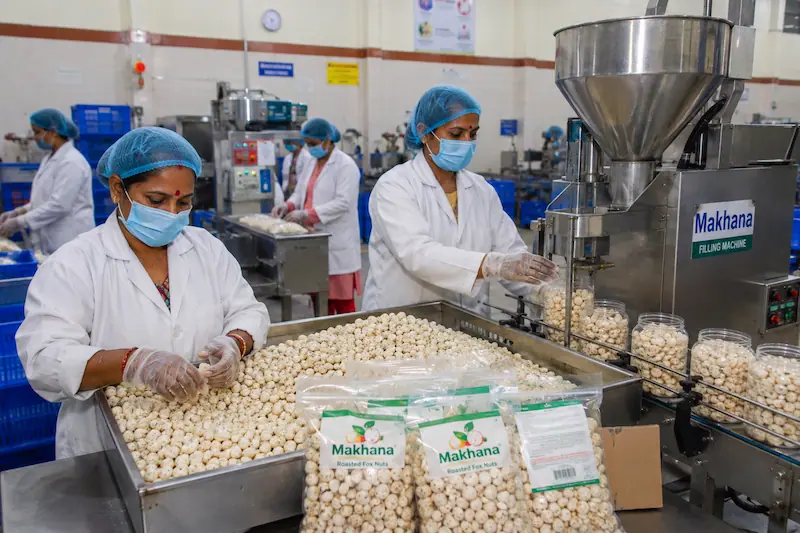
1. Makhana Processing Business: What Is It?
A makhana processing business converts raw foxnut seed or already popped makhana into cleaned, graded, roasted, flavoured and packaged food products for retail, wholesale and institutional markets.
This is not one fixed business model. A beginner can start by buying ready-popped makhana, sorting it, roasting or seasoning it, weighing it and packing it into small retail packs. A larger entrepreneur can procure raw makhana seed and add cleaning, grading, roasting, popping, polishing, seasoning and automated packaging.
The difference between these models is important because the investment, machinery, working capital, technical skill and risk are very different.
Your own Makhana Processing Business blueprint currently puts the practical micro entry point at roughly ₹25,000 to ₹75,000 when a suitable existing premises is available and the entrepreneur works with ready-popped makhana. The same blueprint places a structured small commercial setup around ₹75,000 to ₹3 lakh, a stronger semi-commercial setup around ₹3 lakh to ₹8 lakh, and larger organised operations in the higher investment range. :contentReference[oaicite:2]{index=2}
For a much more organised processing unit, the official NIFTEM-PMFME Detailed Project Report for a 21,600 kg per year makhana processing unit gives a project-cost benchmark of approximately ₹27.23 lakh, including machinery, fixed assets and working capital. That benchmark should not be confused with the minimum amount needed to start a makhana business. :contentReference[oaicite:3]{index=3}
2. Why Makhana Processing Is Getting More Attention
Makhana has moved beyond being mainly a regional food product and is increasingly being sold as a packaged snack and ingredient in domestic and international markets.
APEDA identifies makhana as an important Indian agricultural product and continues to publish market and export intelligence for the sector. APEDA market intelligence data shows expansion in Indian makhana area and production in recent years, while Bihar remains the dominant producing region. :contentReference[oaicite:4]{index=4}
The Government of India has also taken a specific policy step for the sector. The National Makhana Board was constituted in Bihar on 14 September 2025 to promote production, processing, value addition, marketing and exports. The Central Sector Scheme for Development of Makhana was approved with an outlay of ₹476.03 crore. :contentReference[oaicite:5]{index=5}
This creates a stronger long-term environment for processors, but it does not mean every makhana unit will automatically be profitable. Raw-material price, quality grade, processing recovery, breakage, packaging, selling channel and working-capital discipline still determine the actual business result.
3. Choose Your Makhana Business Model First
Before buying a machine, choose the exact model you want to build.
- Micro Ready-Popped Model: Buy ready-popped makhana, sort it, roast or flavour it, weigh it and pack it. This is the lowest-investment entry route.
- Small Processing Model: Add roasting, seasoning, grading and better packing so you can supply local retailers and distributors.
- Raw-Seed Processing Model: Purchase raw foxnut seed and perform cleaning, grading, roasting, popping, grading, seasoning and packaging in-house.
- Private-Label Model: Manufacture and pack makhana for another company under its own brand.
- Wholesale / B2B Model: Sell graded or roasted makhana in bulk to distributors, food businesses and larger brands.
For a new entrepreneur, the ready-popped model is often easier to test because it avoids the complexity and capital requirement of raw-seed popping. The linked business blueprint specifically recommends this route for low-capital entrants. :contentReference[oaicite:6]{index=6}
4. Raw Makhana vs Ready-Popped Makhana
This is one of the most important decisions in the entire business.
Ready-popped makhana lets you focus on grading, roasting, flavouring, packaging and sales. You need less machinery and can start with smaller inventory.
Raw makhana seed gives you more control over the processing chain, but popping requires specialised machinery, heating, process control and trained operators. ICAR-CIPHET has developed mechanised makhana processing technologies because traditional popping is labour-intensive, time-consuming and involves handling hot roasted seed. :contentReference[oaicite:7]{index=7}
A practical rule is simple: do not buy a popping machine merely because raw makhana is available. Buy it when the volume of raw-seed procurement and finished-product sales is large enough to justify the additional machinery and operating complexity.
5. Where to Source Makhana
Raw material is the heart of a makhana processing business. The quality and purchase price of your makhana can affect the final product more than many small operational savings.
Major procurement should generally be developed close to producing and trading regions, especially in Bihar and other established makhana markets.
- Farmers: Direct procurement can provide strong sourcing relationships when volume and quality control justify it.
- Farmer Producer Organisations: FPOs can be useful for organised procurement and aggregation.
- Local Traders: Useful for smaller processors who cannot directly aggregate large quantities.
- Wholesale Markets: Can provide multiple grades and suppliers but require stronger quality inspection.
- Processors: Ready-popped makhana can be sourced from established processors when you want to focus on branding and value addition rather than popping.
Compare suppliers on grade, moisture condition, size, breakage, popping recovery where relevant, cleanliness, delivery terms and payment conditions rather than looking only at the quoted price.
6. Understanding Makhana Grades
Size and appearance matter because buyers do not value every popped makhana piece equally.
ICAR-CIPHET has reported a popped-makhana grading machine that separates three size grades of approximately 12–15 mm, 15–19 mm and above 19 mm, along with flattened and unpopped material. The reported grader has a capacity of about 200 kg per hour, uses a 1-hp motor and requires two unskilled operators. ICAR reported a tentative machine cost of approximately ₹1.5 lakh for that technology. :contentReference[oaicite:8]{index=8}
Grading becomes commercially useful when the additional selling value or customer requirement justifies the cost of mechanical separation.
7. Complete Makhana Processing Process
The full commercial process can be understood as the following sequence:
- Raw Material Procurement: Purchase raw makhana seed or ready-popped makhana according to your business model.
- Cleaning: Remove dust, foreign material and unsuitable particles.
- Drying and Storage: Maintain suitable storage conditions and protect the material from moisture.
- Size Grading: Separate material by size and quality where required.
- Pre-Heating: Prepare the raw seed for the subsequent processing stage when working with raw makhana.
- Tempering: Follow the selected technical process before roasting and popping.
- Roasting and Popping: Process the raw seed through the appropriate popping system.
- Polishing: Perform polishing or cleaning steps where required by the product process.
- Popped Makhana Grading: Separate the popped product into suitable size and quality grades.
- Roasting: Roast ready-popped makhana when preparing a roasted snack product.
- Seasoning: Add salt, spices or other approved ingredients according to the selected product formulation.
- Quality Checking: Check appearance, crispness, flavour consistency, foreign matter, packaging and batch quality.
- Weighing and Packaging: Fill standard pack sizes and seal them properly.
- Batch Coding and Dispatch: Code and dispatch finished packs according to applicable food-labelling and traceability requirements.
The official NIFTEM-PMFME Makhana Detailed Project Report presents the organised process as harvesting and cleaning, drying and storage, size grading, pre-heating, tempering, roasting and popping, polishing, grading, seasoning and packaging. :contentReference[oaicite:9]{index=9}
8. Machinery Required for a Small Makhana Business
You do not need the complete industrial line at the beginning.
- Digital Weighing Scale: For accurate pack sizes and stock records.
- Food-Grade Storage Containers: For clean handling of makhana.
- Manual Sorting Tables: For basic cleaning and sorting.
- Small-Batch Roaster: Useful for roasted and flavoured makhana.
- Seasoning Mixer: Helps produce more consistent flavoured batches.
- Impulse or Semi-Automatic Sealer: For retail pouch packing.
- Batch Coding Equipment: Useful as the business moves toward organised retail.
- Popped Makhana Grader: Add when product volume and price differentiation justify it.
- Mechanised Roaster and Popper: Required when raw-seed processing is done in-house at commercial scale.
- Automatic Packing Machine: Useful for larger production volumes.
Your current business blueprint lists a small-batch roaster around ₹25,000 as a typical planning figure, a seasoning mixer around ₹30,000, a popped makhana grader around ₹1.50 lakh, a mechanised roaster and popper around ₹3 lakh, and a higher-capacity automatic packing machine around ₹4.90 lakh in its commercial equipment model. These are planning benchmarks, not universal market prices. :contentReference[oaicite:10]{index=10}
9. How Much Space Is Required?
A basic makhana value-addition business can work from a surprisingly small area when the entrepreneur buys ready-popped makhana and keeps operations simple.
- Micro Setup: Around 80 sq. ft. can be workable for a compact processing and packing arrangement when inventory is limited.
- Small Commercial Setup: More space should be planned for separate storage, roasting, seasoning, packing and dispatch.
- Raw-Seed Processing Unit: Additional space is required for raw-material storage, processing machinery, grading, packaging and material movement.
The business blueprint uses 80 sq. ft. as its minimum carpet-area benchmark for a compact setup and notes a 3-phase, approximately 5–10 kW connected-load planning assumption for a commercial arrangement. Actual electrical load must be confirmed from the final machine specifications. :contentReference[oaicite:11]{index=11}
10. Makhana Processing Investment: Realistic Cost Ranges
The right investment number depends on the business model.
- Micro Ready-Popped Model: Around ₹25,000 to ₹75,000 can be a practical planning range when suitable premises already exist and you focus on sorting, roasting, flavouring and packing ready-popped makhana.
- Dedicated Small Unit: Around ₹75,000 to ₹3 lakh can cover a more organised small setup depending on equipment and inventory.
- Semi-Commercial Unit: Roughly ₹3 lakh to ₹8 lakh may be required when you add better roasting, seasoning, grading or packing equipment.
- Organised Processing Unit: Larger systems can move significantly higher depending on raw-seed processing and automation.
- NIFTEM-PMFME Commercial Benchmark: The official 21,600 kg/year model gives total project cost of approximately ₹27.23 lakh, including approximately ₹16.60 lakh machinery, ₹3.50 lakh miscellaneous fixed assets and ₹7.13 lakh working capital. :contentReference[oaicite:12]{index=12}
The NIFTEM benchmark is useful for preparing a bankable project report, but it should never be presented as the minimum investment for every makhana business.
11. What Is the Biggest Cost: Machine or Raw Material?
For many makhana processors, working capital can become more important than machinery because makhana is a relatively high-value inventory item.
Your business blueprint estimates that a micro operator may rotate around ₹10,000 to ₹30,000 of stock, a small business may need roughly ₹50,000 to ₹2 lakh, while a larger processor may require several lakh rupees. The NIFTEM-PMFME benchmark allocates approximately ₹7.13 lakh to working capital for its 21,600 kg/year model. :contentReference[oaicite:13]{index=13}
Do not put your entire budget into machines and then have no money left to buy inventory, packaging or pay operating expenses.
12. Monthly Operating Expenses
A realistic monthly operating budget should include:
- Premises rent
- Electricity and processing utilities
- Labour
- Raw materials
- Packaging and labels
- Local delivery and logistics
- Maintenance and cleaning
- Sales and marketing
- Accounting and compliance
Your current business blueprint uses approximately ₹59,000 per month as a typical overhead benchmark for a commercial model, with a range from roughly ₹4,500 to ₹3.30 lakh depending on scale and operating structure. :contentReference[oaicite:14]{index=14}
13. How Much Profit Can a Makhana Processing Business Make?
This is where many online business guides become misleading. Makhana should not be presented as a guaranteed high-margin business.
Your current audited model illustrates this clearly. At a benchmark of 20 kg finished makhana per day, 26 operating days per month, an average realisation assumption of ₹450, and the stated cost structure, the model produces approximately ₹2.34 lakh monthly revenue but an estimated negative ₹7,520 monthly operating result. The model therefore indicates a break-even requirement of roughly 23 kg finished makhana per day under its assumptions. :contentReference[oaicite:15]{index=15}
This does not mean every makhana business will lose money. It means that production volume, raw-material cost and selling channel matter enormously.
The official NIFTEM-PMFME model also shows relatively modest profitability under its assumptions, with approximately 2.49% profit before tax in year one and approximately 6.07% profit after tax in year five. That is another reason to avoid publishing unrealistic universal profit margins. :contentReference[oaicite:16]{index=16}
14. How to Calculate Your Real Makhana Profit
For your own business, calculate profit from the actual batch rather than a generic internet percentage.
Net contribution per kg = selling realisation per kg - raw material cost - roasting cost - seasoning - packaging - variable labour - logistics - other variable costs
Then calculate:
- Monthly contribution = contribution per kg × monthly quantity sold
- Operating profit = monthly contribution - fixed monthly expenses
- Break-even quantity = fixed monthly expenses ÷ contribution per kg
Track this separately for plain roasted, flavoured, premium-grade and private-label products because their economics can be very different.
15. How to Build a Flavoured Makhana Brand
Flavoured makhana can give a processor more control over the customer experience than simply selling commodity-grade popped makhana.
Possible product directions include:
- Salted roasted makhana
- Masala makhana
- Chilli-based flavours
- Herb and spice blends
- Premium seasoning combinations
- Custom flavours for private-label customers
Do not make unsupported health claims simply because makhana is commonly marketed as a health-oriented snack. Focus on accurate product information, flavour, crispness, quality, grade, packaging and reliable supply.
16. Packaging Strategy
Packaging is especially important because makhana is sold on appearance, crispness, perceived quality and convenience.
- Small Retail Pouches: Useful for trial and everyday consumption.
- Medium Packs: Suitable for regular household customers.
- Large Family Packs: Can improve value perception where demand supports them.
- Bulk Packs: Useful for restaurants, distributors and institutional buyers.
- Private-Label Packs: Designed for other brands.
The package should provide the declarations required under applicable food-labelling rules. For packaged food, verify current FSSAI and Legal Metrology requirements before finalising artwork.
17. Food Safety and FSSAI Compliance
Makhana sold as a food product falls within the food-business regulatory framework. If you operate a food business, you should verify the applicable FSSAI registration or licence category for your activity and scale through FoSCoS.
The official FoSCoS system provides eligibility information and online application facilities for food-business registration and licensing. FSSAI also provides separate guidance on documentation, fees, inspections and conditions of licence. :contentReference[oaicite:17]{index=17}
Compliance requirements can differ depending on whether you are simply trading, processing, roasting, packing, exporting or manufacturing other food products.
18. Other Registrations to Check
- Udyam Registration: Useful for eligible MSME businesses and available through the official Government of India portal.
- GST: Check applicability according to the current GST law, turnover, supply type and applicable exceptions.
- FSSAI: Check the appropriate registration or licence category through FoSCoS.
- Local Trade / Establishment Requirements: Verify municipal, panchayat and local commercial permissions where applicable.
- Fire and Electrical Requirements: Check requirements based on premises, electrical load and equipment.
- Trademark: Protect your brand when building a packaged makhana business.
- Export Compliance: If you export, verify APEDA, customs, food-safety and destination-country requirements applicable to your shipment.
19. Government Support for Makhana Entrepreneurs
Makhana currently has unusually strong policy attention at both central and state level.
National Makhana Board
The National Makhana Board was constituted on 14 September 2025 with the objective of promoting production, processing, value addition, marketing and export promotion of makhana. The Central Sector Scheme for Development of Makhana has an approved outlay of ₹476.03 crore. :contentReference[oaicite:18]{index=18}
The Bihar Horticulture Department currently provides an online application pathway under the National Makhana Board for farmers, FPOs, exporters and makhana processors. Its 2026-27 programme covers areas such as post-harvest management, branding, market development, exports and certification. :contentReference[oaicite:19]{index=19}
PMFME
Makhana has been identified as an ODOP product under PMFME for several Bihar districts, including Araria, Katihar, Madhubani, Saharsa and Supaul, with Darbhanga also covered in current Government of India references. The Bihar horticulture department has documented support under PMFME including credit-linked capital subsidy and common-infrastructure support. :contentReference[oaicite:20]{index=20}
Always verify your exact district, business activity, applicant category and current scheme conditions before including subsidy in a project-financing plan.
20. Makhana Processing in Bihar: Why Location Matters
Bihar is the leading makhana-producing state in India. A recent Government of India statement based on the Second Advance Estimates for 2025-26 reported Bihar production at approximately 60,000 MT, with major producing districts including Katihar, Purnia, Madhubani, Darbhanga, Saharsa, Supaul, Araria, Madhepura and Sitamarhi. :contentReference[oaicite:21]{index=21}
This matters to processors because proximity to raw material can reduce procurement and logistics friction and improve access to local knowledge and supplier networks.
21. Sales Channels for a Makhana Processing Business
- Local Kirana Stores: Good for early testing of small retail packs.
- Premium Grocery Stores: Suitable for better-positioned branded products.
- Snack Distributors: Useful once your product and supply are consistent.
- Restaurants and Food-Service Buyers: Bulk or ingredient supply can create repeat demand.
- Offices and Institutions: Useful for snack packs, gifting and bulk supply.
- Private-Label Brands: Attractive when you can meet quality, quantity and packaging requirements consistently.
- E-Commerce: Suitable for branded retail packs after your packaging, fulfilment and customer support systems are ready.
- Export: Larger processors can explore export markets with the required food-safety and export compliance.
APEDA currently carries Makhana market intelligence and live export-trade activity, demonstrating that the product already has a meaningful domestic and international trade ecosystem. :contentReference[oaicite:22]{index=22}
22. Private Label Can Be an Attractive Starting Strategy
Building your own national brand is expensive because you have to spend on packaging, marketing, distribution and customer acquisition. A private-label model can reduce some of that burden because another company brings the brand and customer relationship.
For a small processor, private-label orders can be useful for keeping production equipment busy while the entrepreneur builds its own brand gradually.
The downside is that private-label buyers can negotiate hard on price, payment terms and quality standards. Do not accept orders that leave insufficient contribution after packaging, transport and credit costs.
23. Quality Control in Makhana Processing
Quality is not just about whether the makhana looks clean. A repeat customer notices the eating experience.
Check every batch for:
- Grade and size
- Colour and appearance
- Foreign matter
- Moisture condition
- Crispness
- Roast consistency
- Seasoning uniformity
- Breakage
- Packaging seal
- Batch consistency
Maintain supplier-wise and batch-wise records. This helps identify whether a problem came from procurement, storage, roasting, seasoning or packaging.
24. Makhana Storage and Inventory Management
Makhana is a relatively high-value inventory item, so storage and stock discipline have direct financial consequences.
- Keep raw and finished material protected from moisture.
- Use clean, food-appropriate storage containers or packaging.
- Follow FIFO principles for inventory movement.
- Do not overstock purely because a supplier offers a temporary discount.
- Track batch age and purchase price.
- Store finished products under conditions suitable for maintaining quality.
Your current business blueprint specifically identifies raw-material price volatility, moisture exposure, unsold inventory, packaging costs and customer credit as key operating risks. :contentReference[oaicite:23]{index=23}
25. Biggest Risks in Makhana Processing
- Raw-Material Price Volatility: A small change in procurement price can materially affect margins.
- Poor Quality Seed: Can reduce processing recovery and finished-product quality.
- Low Popping Recovery: Raw-seed processing becomes unattractive if recovery is poor.
- Breakage: Excess breakage can reduce the value of the finished grade.
- Moisture: Poor storage can reduce quality and shelf stability.
- Inconsistent Roasting: Different batches can taste noticeably different.
- Unsold Inventory: High-value stock can lock up cash.
- Long Credit Periods: Strong sales do not help if customers pay too slowly.
- Early Automation: Large machinery can become an expensive idle asset if production volume is not there.
26. How to Start With Only ₹25,000 to ₹75,000
A low-budget entry is possible, but it should not be described as a complete raw-seed processing factory.
The practical model is:
- Buy ready-popped makhana.
- Sort and inspect the product.
- Use small-batch roasting if required.
- Add simple flavouring.
- Use a weighing scale.
- Seal small pouches.
- Sell locally through retailers, WhatsApp and direct customers.
Your existing business blueprint specifically identifies this as the realistic micro model for the ₹25,000–₹50,000 range, with the broader practical range extending to around ₹75,000. :contentReference[oaicite:24]{index=24}
27. How to Scale From Small to Commercial
Do not scale everything at the same time.
- Stage 1: Ready-popped makhana + simple packing.
- Stage 2: Add roasting and seasoning.
- Stage 3: Add better grading and more efficient packing.
- Stage 4: Build distributor and institutional sales.
- Stage 5: Add raw-seed procurement and popping where volume justifies it.
- Stage 6: Move toward automated grading and packing.
- Stage 7: Explore private label, modern trade and export.
This sequence reduces the risk of buying machinery before proving demand.
28. 90-Day Launch Plan
- Days 1-15 — Market Survey: Visit kirana stores, premium grocery shops, snack distributors, restaurants and potential institutional buyers. Record pack sizes, prices and competitor products.
- Days 16-30 — Supplier Validation: Compare at least three sources for ready-popped or raw makhana. Check quality, grade, moisture, breakage, pricing and payment terms.
- Days 31-45 — Product Trials: Test plain roasted and selected flavoured products. Measure actual product loss and packaging cost.
- Days 46-60 — Packaging: Finalise pack sizes, brand identity, labels and basic food-compliance requirements.
- Days 61-75 — Retail Testing: Give sample packs to selected retailers and measure actual repeat demand.
- Days 76-90 — Controlled Commercial Launch: Start regular production, track every batch, monitor cash collection and increase inventory only when sales justify it.
29. Who Should Start a Makhana Processing Business?
This business can suit:
- Home-based food entrepreneurs
- Small snack brands
- Local traders
- Rural and semi-urban processors
- Private-label manufacturers
- Regional food distributors
- Established food-processing companies
It is not a good fit for someone who has no reliable source of makhana, does not want to manage food quality and inventory, or expects high margins without developing repeat customers.
30. Final Takeaway
Makhana processing is attractive because the business can be entered at several different investment levels. You can start with ready-popped makhana and simple packing, develop a local flavoured-snack business, or eventually build a more integrated processing unit with grading, roasting, popping and automated packaging.
The biggest mistake is treating all these models as one business. A ₹50,000 packing-and-value-addition operation and a ₹27 lakh organised processing plant have completely different economics, equipment and working-capital needs.
The better approach is to start with the smallest model that lets you prove demand, learn procurement and understand the real selling price. Then add machines when the additional capacity creates enough contribution to justify the investment.
In makhana processing, working capital and reliable sales can matter more than having the biggest machine.
31. Frequently Asked Questions
Can I start a makhana business with ₹25,000 to ₹50,000?
Yes, but the practical model is ready-popped makhana, small-batch roasting or seasoning, weighing and packing. It is not a full raw-seed processing factory. :contentReference[oaicite:25]{index=25}
How much does a small makhana processing business cost?
A micro ready-popped model can be planned around ₹25,000 to ₹75,000 when suitable premises are already available. A dedicated small unit can move towards ₹75,000 to ₹3 lakh, while stronger semi-commercial setups can require several lakh rupees. :contentReference[oaicite:26]{index=26}
How much does a commercial makhana processing unit cost?
The official NIFTEM-PMFME model for a 21,600 kg/year makhana processing unit gives a total project cost of approximately ₹27.23 lakh, including machinery, fixed assets and working capital. :contentReference[oaicite:27]{index=27}
Do I need a makhana popping machine from the beginning?
No. A beginner can buy ready-popped makhana and focus on grading, roasting, flavouring, packing and sales. Raw-seed popping becomes more relevant when procurement and sales volumes justify the additional machinery and process control.
What machinery is required for a small makhana business?
At micro scale, a weighing scale, food-grade containers, basic sorting equipment and an impulse sealer may be enough. Roasters, seasoning mixers, graders and automatic packers can be added as volume increases. :contentReference[oaicite:28]{index=28}
Is makhana processing profitable?
It can be, but there is no universal profit margin. Your own business blueprint currently shows that a 20 kg/day benchmark model can remain slightly loss-making after operating costs, while the official NIFTEM model also shows relatively modest margins under its assumptions. Procurement price and selling channel therefore matter greatly. :contentReference[oaicite:29]{index=29}
Is FSSAI registration required?
If your activity falls within the applicable food-business framework, you need the relevant FSSAI registration or licence. Check the current eligibility category through the official FoSCoS portal before starting commercial food processing and packing. :contentReference[oaicite:30]{index=30}
Is there government support for makhana processing?
Yes. The National Makhana Board was constituted in 2025, and the Central Sector Scheme for Development of Makhana has an approved outlay of ₹476.03 crore. Makhana is also covered under PMFME ODOP arrangements in several Bihar districts. Eligibility depends on the applicant, location, activity and current scheme rules. :contentReference[oaicite:31]{index=31}
Can I sell makhana outside Bihar?
Yes. Processed makhana can be sold through local retail, regional distributors, online channels, institutional buyers and export markets, provided the applicable food, packaging, tax and export requirements are followed.
Can I export processed makhana?
Yes, export opportunities exist and APEDA actively maintains market and trade information for makhana. Exporters must comply with the relevant food-safety, documentation, customs and destination-market requirements. :contentReference[oaicite:32]{index=32}