1. Flower Waste Incense Stick Business: What Is It?
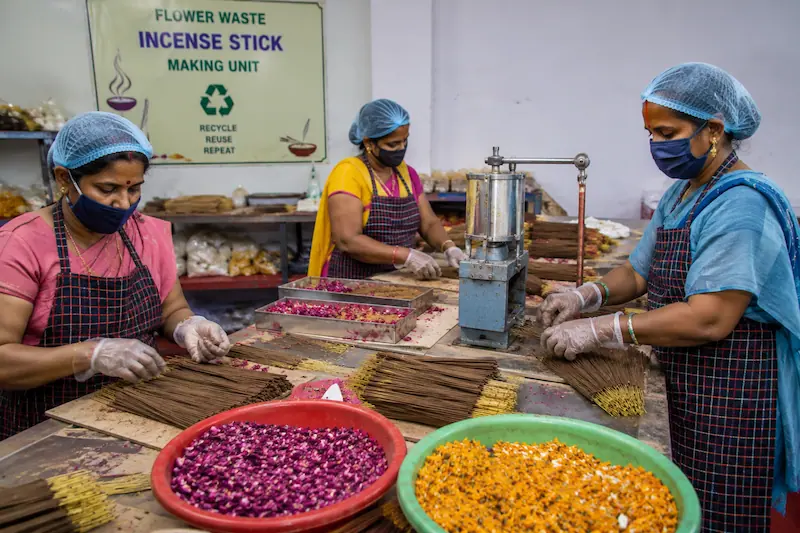
A flower waste incense stick business is a small manufacturing and waste-to-value business in which suitable discarded flowers are collected, segregated, dried, processed and converted into incense products such as agarbatti and fragrant cones.
The idea is simple: flowers that would otherwise enter a waste stream can be used as a raw material for a finished consumer product. CSIR-CIMAP, Lucknow officially lists technology for the utilization of offered flowers for making incense sticks and fragrant cones. The Government of India's Office of the Principal Scientific Adviser has also documented the flower-waste recycling technology as a livelihood-oriented value-addition opportunity.
However, this should not be treated as a business where the raw material is automatically free and the profit is automatically high. The real costs include collection, sorting, transport, drying, grinding, formulation, fragrance, labour, packaging, selling expenses and working capital.
The safest approach is to first prove three things: regular flower supply, acceptable product quality and repeat sales. Machinery should be scaled only after these three areas become reasonably stable.
2. Why This Business Can Be Interesting
Incense products have an established use in homes, temples, पूजा spaces, religious functions and several cultural settings. This gives the finished product an existing market instead of requiring the entrepreneur to create an entirely new category.
The additional opportunity comes from the raw material story. A flower-waste product can be positioned around recycling, local collection and responsible use of discarded floral material. But the sustainability story should support the product, not replace product quality.
- Existing Product Category: Incense sticks are already a familiar consumer product.
- Waste-to-Value Model: Suitable flower waste becomes a usable manufacturing input.
- Local Raw Material: Temples and flower markets can become nearby collection sources.
- Small-Scale Entry: Production can begin with a limited setup and expand later.
- Branding Opportunity: The product can be positioned as a recycled-flower, eco-conscious or temple-flower incense product where the underlying claims are accurate.
- Institutional Opportunity: Custom and private-label orders can be explored after the production process is stable.
3. First Decide Who Will Buy Your Product
Before buying a machine, decide where the finished incense will be sold. Your target market affects the product size, fragrance, packaging, price and production quantity.
- Puja Stores: Shops that already sell incense, diyas and other पूजा items.
- Temple Shops: Useful where the product has a genuine connection with locally collected temple flowers.
- General Retailers: Grocery and local convenience stores in suitable customer areas.
- Gift Stores: Suitable for better-designed packaging and premium positioning.
- Online Customers: Website, marketplaces, social media and WhatsApp Business can support direct sales.
- Institutional Buyers: Religious organisations, hotels, wellness businesses, event companies and other bulk buyers may be relevant depending on the product.
- Private-Label Customers: Other businesses can sell the product under their own brand.
A small manufacturer usually gets better clarity by starting with one core product, one or two fragrances and a small number of pack sizes rather than launching a large product catalogue immediately.
4. How to Build a Reliable Flower Waste Collection Network
The supply side is one of the biggest challenges in this business. A machine can be purchased quickly, but a dependable flower collection network needs relationships and daily operating discipline.
Possible collection sources include:
- Temples and Religious Places: Arrange fixed collection timings and provide separate collection bins where practical.
- Flower Markets: Collect suitable unsold or discarded flowers before they become mixed waste.
- Event and Wedding Decorators: Collect flower decoration waste after events where segregation is possible.
- Religious Events: Build short-term collection arrangements for festivals and large functions.
- Institutional Sources: Explore larger religious or cultural organisations with predictable floral waste.
Try to collect segregated material rather than mixed waste. Plastic, polythene, metal wire, thread, food waste, glass and other contamination can increase labour and reduce the usable portion of the incoming material.
5. Which Flowers Should Go Into Production?
Do not assume every collected flower should automatically be used in manufacturing. The usable material depends on your selected process, formulation and quality requirements.
At the collection point, create a basic sorting process:
- Remove plastic wrappers and polythene.
- Remove decorative metal wire and non-floral items.
- Remove glass, stones and other hard contamination.
- Separate heavily contaminated or unsuitable material.
- Record incoming weight and the weight rejected after sorting.
This record is important because your business should be costed on usable processed material, not simply on the gross weight of collected flowers.
6. Flower Waste Incense Stick Manufacturing Process
The exact formula and process depend on the technology and product design you choose. A practical manufacturing flow can be understood as follows:
- Collection: Receive flower waste from identified sources.
- Sorting: Remove plastic, wire, thread and other unwanted material.
- Pre-Processing: Prepare the flowers for drying according to the selected process.
- Drying: Reduce moisture using suitable drying conditions. Sun drying may be workable for very small operations when weather, hygiene and available space permit; controlled drying becomes more useful when consistent production is required.
- Grinding: Pulverise properly dried floral material into a suitable processed form.
- Mixing: Mix the processed floral material with the required base ingredients and binder according to the selected formulation.
- Incense Forming: Convert the prepared material into sticks or another selected incense format.
- Secondary Drying: Dry the formed product to the required condition before final treatment.
- Fragrance Application: Apply fragrance where the selected product requires it and follow appropriate handling practices.
- Quality Checking: Check dimensions, moisture condition, fragrance, burn behaviour, packaging and batch consistency.
- Packing: Pack the finished product into retail or bulk packs suitable for storage and transport.
CSIR-CIMAP officially lists flower-based incense stick and fragrant-cone technology, providing an important technical reference for entrepreneurs exploring this model.
7. Machines Required for a Flower Waste Incense Stick Business
The exact machine list depends on how much work you want to do manually and how much automation you need.
- Collection Bins: For receiving segregated flower waste.
- Sorting Tables: For manual removal of contamination.
- Drying System: Sun-drying arrangement at very small scale or controlled dryer for more consistent production.
- Flower Waste Pulverizer: For grinding dried floral material.
- Powder / Raw Material Mixer: For preparing a uniform incense mixture.
- Agarbatti Machine: Manual, entry-level, semi-automatic or automatic depending on production volume.
- Drying Equipment: Useful when climate or production volume makes open drying unreliable.
- Fragrance Dipping or Application Setup: For products that require fragrance treatment.
- Digital Weighing Scale: For standard pack sizes and batch control.
- Heat Sealer / Packing Equipment: For closing retail and bulk packs.
Important: Machine capacity quoted by suppliers for ordinary incense production does not automatically mean the same capacity will be achieved with every flower-waste formulation. Always test your actual processed material before finalising a machine.
8. How Much Space Is Required?
A micro unit can start from a relatively small workspace, but the area should be arranged around the production flow rather than simply fitting machines into one room.
- Micro Setup: Around 150 to 300 sq. ft. can be workable for a basic operation with manual sorting and limited production.
- Small Commercial Unit: Around 300 to 800 sq. ft. can provide more practical room for sorting, drying, processing, production, packing and storage.
- Growing Unit: Additional space becomes useful as you add machines, inventory and dedicated packing or storage areas.
Keep incoming flower waste physically separated from clean processed material and finished packaged stock. Dry storage is especially important because moisture can damage both raw material and finished incense.
9. Raw Materials Other Than Flower Waste
Flower waste is only one part of the formulation. Depending on the selected production method, additional materials may be required.
- Base Ingredients: Materials used to create the required incense composition.
- Binder: Used to give the mixture adequate binding and forming characteristics.
- Bamboo Sticks: Required for conventional stick-format agarbatti where applicable.
- Fragrance: Used to create the desired scent profile.
- Packaging Material: Pouches, boxes, labels, cartons and outer packaging.
- Cleaning and Handling Supplies: Needed to maintain the production area and equipment.
Do not finalise a formulation just because it produces a stick. The product should also have acceptable burning behaviour, fragrance performance, appearance and storage stability.
10. Investment Required to Start the Business
There is no single fixed investment figure because this business can be started at micro scale and upgraded over time. A realistic project budget should be built from actual machine quotations and your local operating costs.
For planning purposes, divide the investment into these blocks:
- Raw Material Collection and Sorting: Bins, tables, weighing equipment and basic handling tools.
- Drying: Space preparation, trays, racks or a controlled dryer depending on the scale.
- Grinding: Pulverizer or suitable grinder.
- Mixing: Manual or mechanical mixing arrangement.
- Incense Forming: Appropriate agarbatti machine based on target output.
- Fragrance: Application and storage setup.
- Packing: Weighing, sealing, labels and packaging inventory.
- Electrical and Workspace: Wiring, ventilation, lighting, storage racks and work tables.
- Working Capital: Raw materials, packaging, wages, transport and customer-credit requirements.
Instead of presenting one misleading universal cost figure, prepare three project versions: micro, small commercial and expansion. This gives a much more useful picture for a new entrepreneur.
11. Monthly Operating Costs You Should Calculate
The correct monthly cost is more important than the machine price because it tells you whether the business can sustain itself after launch.
- Workspace rent
- Flower collection and transportation
- Sorting labour
- Production labour
- Electricity
- Drying cost
- Binder and other ingredients
- Fragrance
- Packaging
- Machine maintenance
- Delivery and logistics
- Sales samples and marketing
- Administrative expenses
One useful metric is the cost per finished retail pack. Calculate it regularly rather than looking only at the cost per kilogram of flower waste.
12. How to Calculate the Cost of One Pack
A practical costing formula is:
Cost per finished pack = raw material cost + processing cost + fragrance + labour + packaging + wastage + transport allocation + fixed-cost allocation
For example, if 100 kg of collected flowers become only 25 kg of usable processed material after sorting and drying losses, your costing must account for the rejected and lost material. This is why gross collection weight and usable production weight should be recorded separately.
Once your cost per pack is known, compare it against:
- Wholesale selling price
- Distributor price
- Retail selling price
- Marketplace fees where applicable
- Promotional discounts
13. How Much Profit Can a Flower Waste Incense Stick Business Make?
There is no reliable single profit percentage for every unit. Profit depends on production volume, usable flower recovery, fragrance cost, labour productivity, selling price, packaging, distribution margins and fixed expenses.
A small plant producing very little every day can have attractive-looking product margins but weak monthly profits because fixed expenses are spread over too few units. A larger unit can improve unit economics through better utilisation, but it also carries more working-capital and operational risk.
Before investing, calculate at least these five numbers:
- Cost per kg of usable processed material
- Cost per incense pack
- Contribution per pack after variable expenses
- Monthly fixed expenses
- Break-even packs per month
This approach is far more useful than promising a fixed monthly profit figure.
14. Marketing Strategy for Flower Waste Incense Sticks
The sustainability angle can attract the first customer, but repeat sales depend on the product itself. Build your marketing around both purpose and performance.
- Tell the Flower Story Clearly: Explain where the flowers come from and how they are processed without making exaggerated environmental claims.
- Use Samples: Give small trial packs to selected puja stores, temple shops and local retailers.
- Build Local Retail Distribution: Start in the same area where your collection network is strong.
- Target Schools and Organisations Carefully: Educational institutions, NGOs and organisations may be potential bulk or gifting customers where the product fits their requirements.
- Use WhatsApp Business: Share a catalogue, pack sizes, prices and product photos with retailers and buyers.
- Sell Online: Use a website or suitable marketplaces after packaging, fulfilment and customer support are ready.
- Explore Private Label: Offer manufacturing for customers who want their own brand on the packaging.
15. Packaging and Branding Ideas
Your packaging should make the product easy to understand within a few seconds.
- Clearly mention the product name.
- Use accurate flower-waste or recycled-flower claims.
- Show fragrance clearly.
- Display net quantity.
- Provide manufacturer details required by applicable law.
- Use a clean moisture-resistant package.
- Keep the design simple enough to work at small retail sizes.
A strong brand can be built around ideas such as temple flower recycling, local collection, fragrance quality and responsible manufacturing. Avoid statements such as zero waste, chemical-free, toxin-free or completely pollution-free unless the claim can actually be substantiated for the finished product.
16. Government Schemes and MSME Support
Eligible entrepreneurs can explore MSME registration and credit-linked government schemes. The most relevant programmes should be checked against their current official guidelines before applying.
- Udyam Registration: The official Ministry of MSME portal provides free, paperless MSME registration. Current Udyam criteria shown on the official portal classify a micro enterprise at investment up to ₹2.5 crore and turnover up to ₹10 crore, subject to the applicable rules.
- PMEGP: The revised PMEGP guidelines provide a maximum eligible project cost of ₹50 lakh for the manufacturing sector for margin-money subsidy purposes. Subsidy rates vary by beneficiary category and whether the unit is in an urban or rural area. The bank finances the balance amount subject to appraisal and scheme conditions.
- Mudra / Other MSME Credit: Eligible micro businesses can also examine current institutional credit products and programmes through banks and official government channels.
- National Single Window System: NSWS can help entrepreneurs identify business approvals based on business activity and state.
Never treat a government subsidy as guaranteed funding. Eligibility, applicant category, project structure, bank appraisal, documentation and current scheme rules all matter.
17. Registrations, Licences and Compliance
The exact approvals required depend on your state, premises, workforce, manufacturing process, turnover and local authority requirements. Common areas to check include:
- Business Structure: Proprietorship, partnership, LLP or company based on your needs.
- Udyam Registration: Register as an MSME if eligible.
- GST: Check GST registration requirements under the applicable law based on turnover, supply type and other conditions.
- Local Trade or Establishment Requirements: Check municipal, panchayat or local commercial requirements.
- Factory and Labour Requirements: These can vary by employee strength, machinery and state-specific rules.
- Environmental / Pollution Approvals: Check the applicable requirements for your specific process, premises and state. The National Single Window System can be used to identify approvals.
- Trademark: Consider trademark registration when building your own brand.
- Product Standards: Check current BIS standards and government notifications relevant to your exact incense product. Do not assume that a BIS licence is automatically mandatory unless the applicable requirement says so.
18. Trademark and Brand Protection
If the goal is to create a long-term incense brand, protect the brand name early. Before printing thousands of packets, check whether the proposed name is already being used or registered.
IP India provides an official trademark search and online filing process. Registration can provide stronger statutory protection for the registered mark.
A practical sequence is:
- Choose the brand name.
- Search existing trademarks.
- Check the appropriate goods classification.
- File the application if the name is commercially suitable.
- Use consistent branding across packaging, invoices and online channels.
19. Quality Control: What Customers Actually Notice
Eco-friendly positioning may attract a customer once, but product performance determines repeat purchase.
Every production batch should be checked for:
- Uniform stick shape
- Correct weight
- Proper drying
- Fragrance consistency
- Ease of lighting
- Burning behaviour
- Ash characteristics
- Packaging seal
- Moisture during storage
- Batch-to-batch consistency
Create a simple batch record showing the incoming flower weight, usable processed weight, production quantity, rejected quantity and finished packed quantity. This will make your costing more accurate as the business grows.
20. Common Mistakes to Avoid
- Buying Machinery Before Finding Customers: A machine does not create demand.
- Depending on One Flower Supplier: A collection agreement can change, especially around seasonal fluctuations.
- Ignoring Sorting Loss: Gross flower collection should not be treated as finished raw material.
- Using Poor Drying Practices: Moisture can affect processing and storage.
- Competing Only on Price: Small manufacturers can struggle against established brands in a pure price war.
- Overusing Green Claims: Environmental claims should be specific and supportable.
- Giving Too Much Credit: Sales can grow while cash flow becomes weaker if retailers take too long to pay.
- Scaling Too Early: First prove supply, product quality and repeat sales.
21. A Practical 90-Day Launch Plan
- Days 1-15: Survey temples, flower markets, puja stores and local buyers. Record potential raw material volume and likely selling prices.
- Days 16-30: Start small flower collection trials. Measure sorting loss, drying loss and usable material recovery.
- Days 31-45: Test the manufacturing process and create trial incense batches. Evaluate burning, fragrance and appearance.
- Days 46-60: Give samples to selected shops and potential institutional customers. Collect direct feedback.
- Days 61-75: Finalise the initial product, packaging, basic equipment and working-capital requirement.
- Days 76-90: Start a controlled local launch. Track production cost, sales, repeat orders, returns and cash collection.
22. Final Takeaway
A flower waste incense stick business can be a practical small manufacturing opportunity because it combines an established consumer product with a waste-to-value concept.
But the business should not be presented as a guaranteed high-profit scheme. The strongest model is built around reliable flower collection, efficient drying and processing, consistent incense quality, disciplined costing and repeat sales.
Start with a small product range. Build your flower collection network first. Test the product with real customers. Keep detailed production and cost records. Only after repeat orders become predictable should you invest in higher-capacity machinery.
23. Frequently Asked Questions
Is flower waste really suitable for making incense sticks?
Yes, flower-waste recycling for incense products is a documented technology area. CSIR-CIMAP officially lists the utilization of offered flowers for making incense sticks and fragrant cones.
Can I start this business from a small space?
Yes. A micro unit can begin with limited equipment and manual processes, provided the workspace is organised and raw material and finished products are kept dry and clean.
Do I need a BIS licence for flower waste incense sticks?
Do not assume that a BIS licence is automatically mandatory. BIS states that certification is generally voluntary unless a product is made compulsory through an applicable Quality Control Order or other government requirement. Check the current BIS database and notifications for your exact product before making a compliance decision.
Can I get PMEGP subsidy for this business?
An eligible applicant may explore PMEGP where the proposed activity and project satisfy the current scheme requirements. The revised guidelines provide manufacturing projects with an eligible project cost ceiling of ₹50 lakh for margin-money subsidy purposes, with subsidy rates varying by category and area.
What is the biggest challenge in this business?
For a new manufacturer, the biggest practical challenges are usually consistent flower collection, proper drying, stable product quality and building repeat sales.