
Ice Cream and Dairy Products Manufacturing Business
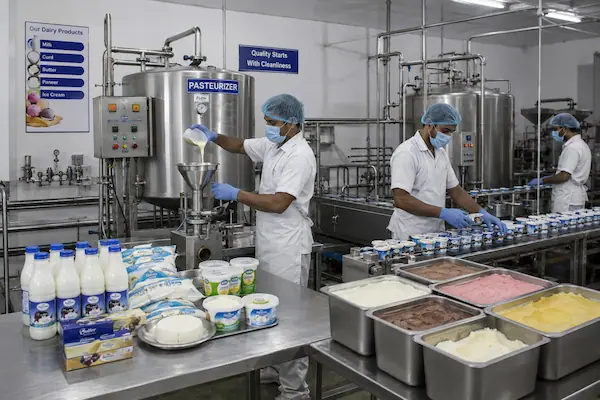
Build a dairy processing business around ice cream, frozen dairy desserts and selected dairy products, starting with a small controlled production setup and scaling into a commercial cold-chain operation.
1. Market Demand & Business Viability
2. Itemized Startup Cost Breakdown
Every line item is audited against verified vendor quotes and realistic fit-out averages.
| Cost Head & Item | Min (₹) | Typical (₹) | Max (₹) | Allocation Notes |
|---|---|---|---|---|
| Machinery & Equipment | ||||
|
Hygienic Micro Production Room Setup
|
₹15,000 | ₹50,000 | ₹1,50,000 | 1.00 setup • Includes washable work surfaces, stainless-steel tables, storage containers, hand-washing arrangements and basic sanitation. An existing suitable room can reduce the investment. |
|
Small Milk Pasteurisation System
|
₹75,000 | ₹1,50,000 | ₹3,00,000 | 1.00 unit • A current 500-litre batch pasteuriser reference is around ₹1.50 lakh. Smaller or simpler systems can cost less, while integrated systems cost more. |
|
Small Ice Cream Batch Freezer
|
₹50,000 | ₹1,50,000 | ₹3,00,000 | 1.00 unit • Small commercial batch freezers vary considerably by capacity and configuration. Select based on required daily output rather than maximum advertised capacity. |
|
Ice Cream Hardening Freezer
|
₹86,000 | ₹1,50,000 | ₹2,50,000 | 1.00 unit • A current 75-100 litre/hour hardener listing is around ₹86,000, while a 200-litre blast hardener reference is around ₹2.20 lakh. |
|
500 LPH Milk Homogeniser
|
₹1,60,000 | ₹2,45,000 | ₹3,00,000 | 1.00 unit • Current Indian references range from about ₹1.60 lakh to ₹2.89 lakh depending on automation, pressure, motor and supplier. This is generally not needed in the smallest setup. |
|
Cold Storage / Deep Freezer Capacity
|
₹30,000 | ₹1,00,000 | ₹5,00,000 | 1.00 setup • Cold storage needs are driven by finished-product inventory and distribution distance. Frozen dairy products require storage at -18°C or below for long shelf life according to NDDB. |
|
Milk and Product Cooling / Chilling System
|
₹25,000 | ₹1,00,000 | ₹5,00,000 | 1.00 system • Chilling capacity should be matched to daily milk intake and production schedule. Larger dairies need more dedicated refrigeration. |
|
Manual or Semi-Automatic Dairy Packing Equipment
|
₹5,000 | ₹30,000 | ₹1,50,000 | 1.00 set • Micro businesses can use manual filling and sealing where suitable. Higher volumes require better dosing and sealing. |
|
Automatic Ice Cream / Dairy Pouch Packing Machine
|
₹1,00,000 | ₹2,50,000 | ₹6,00,000 | 1.00 unit • Use only after stable retail volume justifies automation. Machine type varies considerably between cups, pouches, tubs and bars. |
| Interior Setup & Furnishing | ||||
|
Electrical, Drainage, Water and Ventilation Installation
|
₹10,000 | ₹50,000 | ₹2,50,000 | 1.00 setup • Food processing requires adequate water, drainage, electrical protection and ventilation. Refrigeration and heating loads can materially increase sanctioned power. |
| Licensing & Registrations | ||||
|
FSSAI and Business Compliance Setup
|
₹100 | ₹10,000 | ₹50,000 | 1.00 package • FSSAI registration or licence depends on the actual food-business activity, turnover, production and current FoSCoS eligibility. Other local approvals may apply. |
| Initial Raw Materials & Inventory | ||||
|
Milk, Ingredients, Packaging and First-Cycle Working Capital
|
₹50,000 | ₹2,00,000 | ₹10,00,000 | 1.00 working-capital • Working capital rises sharply when the unit manufactures several dairy products or distributes frozen products over longer distances. |
|
Refrigerated Delivery Equipment or Vehicle Support
|
₹0 | ₹75,000 | ₹10,00,000 | 1.00 setup • Not required at micro scale if products are sold locally through nearby retailers or third-party logistics. Larger frozen distribution needs cold-chain transport. |
| Total Setup Investment | ₹6,06,100 | ₹15,60,000 | ₹53,50,000 | |
3. Plant Machinery & Equipment Catalog
| Machine / Tool Asset | Required Qty | Estimated Unit Price | Commercial Specs & Power |
|---|---|---|---|
| 200 Litre Ice Cream Blast Hardener | 1 unit | ₹2,20,000 | Higher-capacity hardening for larger frozen-product batches |
| 500 Litre Batch Milk Pasteurizer | 1 unit | ₹1,50,000 | Core thermal-processing equipment for commercial dairy manufacturing |
| 500 LPH Milk Homogenizer | 1 unit | ₹2,45,000 | Required for ice cream and milk-product formulations where homogenisation is part of the selected process |
| 75-100 Litre per Hour Ice Cream Hardener | 1 unit | ₹86,000 | Starter commercial hardening capacity |
| Dairy Cold Storage Freezer | 1 unit | ₹1,00,000 | Frozen-product storage is necessary for maintaining the cold chain |
| Dairy Filling and Sealing Machine | 1 unit | ₹1,50,000 | Automation upgrade after retail and institutional volume becomes stable |
| Small Ice Cream Batch Freezer | 1 unit | ₹1,50,000 | Selected according to required daily ice-cream output |
4. Space, Power & Utilities
Minimum required footprint for machinery layout, raw material inventory storage, and dispatch.
Commercial power load with dedicated sub-meter and industrial earthing connection.
Adequate municipal utility inlet and local commercial/industrial zoning compliance.
5. Monthly Operating Expenses (OPEX)
Recurring operational commitments required every month to sustain full production.
| Expense Category & Head | Min / Mo | Typical / Mo | Max / Mo | Operational Notes |
|---|---|---|---|---|
| Production Premises Rent Commercial Rent | ₹0 | ₹15,000 | ₹60,000 | Owned suitable premises can reduce fixed cost. Commercial rent varies materially by city and food-processing zone. |
| Electricity and Refrigeration Staff Salaries & Wages | ₹3,000 | ₹15,000 | ₹75,000 | Refrigeration, hardening, freezers, pasteurisation and lighting contribute to power demand. Actual electricity expense depends on equipment efficiency, runtime and local tariff. |
| Production and Packing Labour Electricity & Commercial Utilities | ₹0 | ₹25,000 | ₹1,20,000 | Owner-managed micro units can keep payroll low. Commercial production needs processing, cleaning, packing and dispatch workers. |
| Milk Procurement and Inbound Transport Monthly Raw Materials | ₹5,000 | ₹25,000 | ₹1,50,000 | Cost depends on daily milk requirement, source distance and whether the unit buys milk directly from farmers, collection centres or suppliers. |
| Ingredients, Flavours, Stabiliser and Other Inputs Packaging Materials | ₹5,000 | ₹30,000 | ₹1,50,000 | Includes sugar, dairy solids, flavours, stabilisers, emulsifiers or other product-specific inputs as applicable. |
| Packaging Materials Packaging Materials | ₹3,000 | ₹15,000 | ₹1,00,000 | Cups, lids, pouches, tubs, labels, cartons and transport packaging. |
| Cleaning, Sanitisation and Quality Control Logistics & Delivery | ₹1,000 | ₹6,000 | ₹30,000 | Food-safe cleaning chemicals, sanitation materials, testing and routine quality-control costs. |
| Cold-Chain Distribution Logistics & Delivery | ₹2,000 | ₹10,000 | ₹75,000 | Frozen products require temperature-controlled handling. Local distribution is considerably cheaper than long-distance frozen distribution. |
| Maintenance and Refrigeration Service Logistics & Delivery | ₹1,000 | ₹5,000 | ₹30,000 | Includes refrigeration service, seals, pumps, minor repairs, freezer maintenance and preventive servicing. |
| Sales and Local Marketing Logistics & Delivery | ₹1,000 | ₹7,000 | ₹40,000 | Sampling, retailer visits, branded freezer support, local advertising and distributor acquisition where applicable. |
| Accounting and Compliance Administration Logistics & Delivery | ₹1,000 | ₹5,000 | ₹15,000 | Bookkeeping, applicable filings and routine administration. |
| Total Monthly Overheads | ₹22,000 | ₹1,58,000 | ₹8,45,000 |
6. Revenue Model, Profit Margin & Break-Even
Fixed monthly overheads (₹1,58,000) are 100% covered at 1,764 litre finished ice cream and frozen dairy products/month. Estimated capital payback timeline: 0 months.
7. Applicable Government Schemes & Subsidies
Government assistance programs and capital subsidies mapped for this enterprise.
Pradhan Mantri Mudra Yojana (PMMY)
Pradhan Mantri Mudra Yojana provides collateral-free institutional credit to eligible micro enterprises in non-farm income-generating activities. Loans are available under Shishu, Kishore, Tarun and Tarun Plus categories, with the maximum loan limit reaching ₹20 lakh under Tarun Plus for eligible entrepreneurs who have successfully repaid a previous Tarun loan.
Check Scheme Guidelines →Prime Minister's Employment Generation Programme (PMEGP)
PMEGP is a credit-linked subsidy scheme for setting up new micro-enterprises in the non-farm sector. Eligible applicants can receive margin money subsidy ranging from 15% to 35%, with maximum project cost of ₹50 lakh for manufacturing and ₹20 lakh for service/business activities.
Check Scheme Guidelines →8. Licences, Registrations & Compliance
Udyam MSME Registration
Free online government registration. Required to access bank priority lending, PMEGP subsidies, and delayed payment dispute resolution.
GST Registration
Mandatory if annual turnover exceeds ₹40 Lakhs (goods) or ₹20 Lakhs (services). Enables input tax credit on commercial machinery purchases.
Shop & Commercial Establishment Licence
Issued by local municipal corporation / panchayat authority for commercial premises operation and labor compliance.
Commercial Bank Current Account
Dedicated current account under business legal entity name along with trade PAN and UPI merchant QR.
9. Operational Skills Required
Dairy hygiene, milk reception and quality testing, pasteurisation, homogenisation, formulation, freezing, hardening, cold-chain management, sanitation, packaging, batch records, inventory control and food-safety compliance.
10. Customer Acquisition Strategy
Start locally with a narrow product range. Ice cream can be sold through own freezer points, retailers, cafés, restaurants, caterers and local distributors. Curd, paneer and flavoured dairy products can target kirana stores, restaurants, sweet shops, hotels and institutional buyers. Use branded freezers, sampling and retailer incentives only where unit economics support them. For a micro business, direct local distribution and repeat institutional orders are usually more practical than expensive mass advertising.
11. Interactive Profit & Expense Simulator
Adjust customer ticket sizes, daily footfall, and fixed overheads to see real-time net returns.
Adjust Financial Assumptions
Slide or type direct valuesSimulation Output
Mathematical Precision12. Founder Profile Suitability
Highly Recommended If:
Suitable for dairy entrepreneurs, existing milk vendors, sweet-shop owners, small food manufacturers, women-led enterprises, rural and semi-urban businesses, regional ice-cream brands and established food-processing companies. Best suited to entrepreneurs with reliable milk supply, hygienic processing space, refrigeration and a practical local distribution route.
Not Ideal If:
Not ideal for anyone who cannot maintain refrigeration, hygiene and daily quality control, has an unreliable electricity supply without backup, lacks a dependable milk source, or plans to launch many dairy SKUs without enough working capital and cold storage.
13. Operational Risks & Mitigation Strategy
The major risks are milk-quality variation, microbial contamination, refrigeration failure, cold-chain breaks, power outages, product melting or refreezing, inconsistent formulation, seasonal demand swings, high distribution costs, retailer freezer dependence, short shelf life for some dairy products and working-capital pressure. NDDB describes milk processing as requiring quality testing before acceptance and cold handling through processing. Maintain raw-milk testing, sanitation SOPs, temperature logs, preventive maintenance, backup power for critical refrigeration and strict stock rotation. Do not manufacture more ice cream than the sales network can move through the cold chain.
14. Step-by-Step 90-Day Launch Plan
Feasibility & Premises Lease
Finalize commercial space lease agreement, verify power load capacity, and apply for Udyam MSME certification.
Machinery Procurement & Fit-Out
Order plant machinery, complete electrical/plumbing fit-out, and setup commercial bank current account.
Trial Runs, Hiring & Licences
Install and calibrate equipment, conduct staff SOP training, and secure local municipal trade licenses.
Soft Launch & Marketing Kickoff
Initiate neighborhood promotional campaigns, setup Google Business listing, and commence commercial operations.
15. Similar Business Opportunities
Explore audited business blueprints in related sectors & investment ranges.
Packaged Drinking Water Bottle Manufacturing Plant
Comprehensive business blueprint for setting up a 2000 LPH BIS/ISI certified packaged drinking water unit, automated 20-liter jar packaging, and PET bottle bottling line.
Makhana Processing Business
Start a makhana business at the scale that fits your capital, from a low-cost home-based roasted and packed model to a commercial processing unit with grading, roasting, flavouring and automated packing.
Notebook Manufacturing Business
A scalable notebook manufacturing opportunity covering an asset-light micro start, small workshop production, semi-commercial manufacturing and organised commercial supply.
16. Data Verification & Methodology
This business profile was audited on 28 Aug 2026 with a data confidence score of 95%.
Equipment pricing and operational assumptions are cross-referenced with Indian industrial machinery suppliers, commercial lease indices, and official Ministry guidelines.
17. Frequently Asked Questions
Yes, a focused micro manufacturing setup can be possible if suitable premises already exist and the entrepreneur starts with a limited product range. The owner can use a small batch-processing arrangement, compact freezer or hardener, manual packing and local distribution. A full dairy plant with milk reception, homogenisation and automated packing cannot realistically be assumed at this budget.
A practical micro planning range is around ₹2 lakh to ₹5 lakh when suitable premises already exist and the business starts with limited capacity and manual or semi-manual operations. A stronger small commercial unit can require ₹5 lakh to ₹15 lakh, while integrated dairy and cold-chain operations can move above ₹15 lakh.
A current Indian supplier reference lists a 500-litre industrial batch milk pasteurizer around ₹1.50 lakh. Actual price varies with heating method, automation, construction and accessories. Smaller capacity equipment can cost less.
Current Indian references for 500 LPH homogenisers range roughly from ₹1.60 lakh to ₹2.89 lakh depending on motor, pressure, automation and supplier. A homogenizer should not be treated as mandatory for every micro ice-cream model because the requirement depends on the chosen process and product formulation.
Current Indian references include a 75-100 litre/hour hardener around ₹86,000 and a 200-litre blast hardener around ₹2.20 lakh. Power and refrigeration specifications also vary significantly, so purchase decisions should consider capacity, temperature performance, dimensions and actual electrical load.
Yes. Frozen dairy products require controlled low-temperature storage. NDDB states that ice cream can have long shelf life when stored at -18°C or below. Production, finished-goods storage and distribution therefore have to be designed as a cold chain rather than treating refrigeration as an optional retail expense.
Yes, a suitably designed dairy plant can manufacture multiple dairy products, but each additional product increases cleaning, scheduling, raw-material handling, packaging and cold-storage complexity. NDDB identifies milk processing as the basis for products including dahi, cream, butter, ghee and ice cream. A small entrepreneur should add products gradually rather than launch every category at once.
There is no single electricity requirement because the load depends on pasteurisation, batch freezing, hardening, cold storage, homogenisation and operating hours. For example, a current 200-litre blast-hardener reference states 15 kW power consumption, while a 500 LPH homogenizer example uses a 5 HP motor. A micro setup can therefore have much lower demand than a commercial cold-chain plant. Final electrical load should be calculated from actual equipment nameplates.
There is no reliable universal net-margin percentage. Manufacturer realisation depends on product type, ingredient cost, packaging, retailer and distributor margins, seasonal demand, freezer arrangements, product returns and cold-chain cost. Premium direct retail can have a different contribution from wholesale supply. Calculate margin product by product using realised manufacturer selling price rather than retail MRP.
Ice cream demand generally shows stronger seasonal patterns in hot weather, but the exact effect varies by geography, product range and sales channel. Diversifying into selected dairy products such as curd or paneer can potentially create more regular demand, but this also increases production and quality-control complexity. Seasonality should be incorporated into monthly cash-flow planning rather than ignored.
The business must use the appropriate FSSAI registration or licence category based on its actual food activity, turnover, production capacity and current FoSCoS eligibility. Do not select a category solely from the product name. FSSAI’s current FoSCoS system provides the applicable licence and registration framework, including food-processing activities and conditions for technically qualified production supervisors in relevant categories.
The official PMFME scheme provides eligible individual micro food-processing units with a 35% credit-linked capital subsidy on eligible project cost, subject to a maximum of ₹10 lakh and scheme conditions. Eligibility depends on the actual project and current implementation rules. The subsidy should not be deducted from the project cost until eligibility and sanction conditions are confirmed.
Applicable FSSAI licensing conditions can require a technically qualified person supervising production for relevant food-processing businesses. FSSAI’s current FoSCoS information lists qualifications including relevant science, food technology and dairy technology disciplines for applicable categories. The exact requirement should be checked against the licence category selected for the actual unit.
Yes. Outsourced or contract manufacturing can reduce initial fixed investment because the entrepreneur does not need to buy the entire processing plant. However, minimum order quantities, formula ownership, quality control, packaging, cold storage and contract terms must be evaluated. This can be a more practical entry route for a capital-constrained entrepreneur than building a factory immediately.
A micro operation can be planned around roughly 250-500 sq ft when product range and stock are limited and some functions are compact. A small commercial dairy-processing unit generally benefits from around 500-1,500 sq ft, while integrated milk reception, processing, cold storage, packing and dispatch can require several thousand square feet. The correct figure must follow the actual equipment layout and storage cycle, not a generic area number.
First prove one or two products and local distribution. Then add cold-storage capacity, improve packing and introduce additional dairy products. Add homogenisation, automated packing and larger freezing or hardening systems only when production volume justifies them. For frozen products, distribution density and cold-chain utilisation can be more important than simply buying a larger machine.