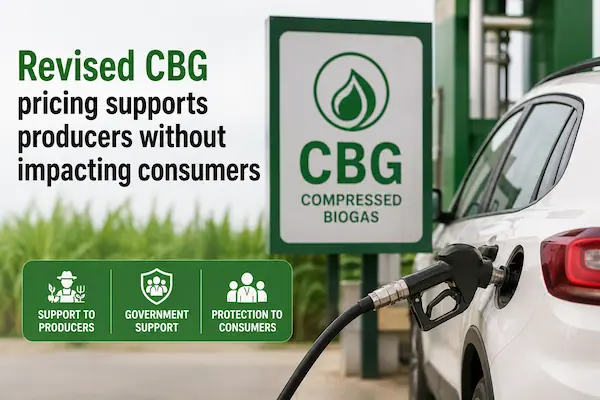
Government clarifies the impact of revised CBG pricing
The Ministry of Petroleum & Natural Gas has clarified that the revised pricing framework for Compressed Biogas (CBG) under the GOBARdhan Scheme is intended to support producers while keeping the impact on individual CNG and household PNG consumers negligible.
The clarification follows a newspaper report that suggested the revised CBG price could create a significant additional burden for gas consumers. The Ministry has explained that such an assessment does not take into account the government support and the wider domestic gas pooling mechanism included in the revised framework.
CBG procurement price revised to ₹2,110 per MMBtu
Under the earlier system, the price paid to CBG producers was linked to 85% of the retail selling price of CNG. Based on the latest revision, that benchmark worked out to approximately ₹1,478 per MMBtu.
Under the GOBARdhan framework, the CBG price has been fixed at ₹2,110 per MMBtu. Compared with the earlier level, the procurement price is approximately 43% higher.
The Ministry has stressed that this ₹2,110 per MMBtu figure is the procurement price paid to CBG producers. It is not the retail price directly paid by CNG vehicle users or household PNG consumers.
Government support lowers the effective CBG cost
The full procurement price will not be recovered directly from gas consumers. The Government will provide affordability support of ₹10 per kg of CBG.
For CBG containing 95% methane, this support is equivalent to approximately ₹215 per MMBtu. After deducting this support, the effective CBG cost to be recovered through the wider gas system works out to approximately:
₹2,110 per MMBtu minus ₹215 per MMBtu = ₹1,895 per MMBtu
Against the earlier benchmark of approximately ₹1,478 per MMBtu, the effective increase is therefore around 28%.
CBG cost will be spread across a larger domestic gas pool
Another key point in the government clarification is that CBG is not sold to City Gas Distribution entities to consumers at the standalone procurement price.
Instead, CBG is pooled with other domestically produced natural gas. Its cost is distributed across the applicable domestic gas pool rather than being passed directly to individual CNG and household PNG consumers.
Earlier, the cost of CBG was spread across the limited quantity of APM gas allocated to the CNG Transport and PNG Domestic segments. Under the revised framework, the net cost of CBG will be spread across a domestic gas base approximately 2.5 to 3 times larger than the earlier base.
Why the revised framework matters for CBG producers
The revised pricing structure is intended to provide producers with a more stable and predictable revenue framework. Better visibility on procurement prices can help CBG projects assess operating economics, financing requirements and long term investment decisions.
This is particularly relevant for projects that convert agricultural residue, cattle dung and other organic waste into compressed biogas. A predictable pricing structure can improve the commercial case for developing and expanding such projects.
What does the policy mean for CNG and PNG consumers?
The government position is that the impact on an individual gas consumer will remain negligible because the net CBG cost will be distributed across a significantly larger domestic gas pool.
Therefore, the increase from ₹1,478 to ₹2,110 per MMBtu should not be interpreted as a direct increase of ₹632 per MMBtu in the retail price paid by every CNG or PNG consumer. The final consumer impact depends on government support and the broader pooled gas mechanism.
Why GOBARdhan is important for the CBG industry
The GOBARdhan framework is designed to create a stronger national market for compressed biogas by combining stable pricing with assured offtake and other forms of support.
The policy framework also seeks to encourage investment in waste to energy projects, create opportunities for rural entrepreneurs and improve the use of agricultural and organic waste as a domestic energy resource.
What businesses should watch
Entrepreneurs and investors evaluating CBG projects should consider the approved procurement price, government support, feedstock availability, plant efficiency, financing costs, pipeline connectivity and the applicable offtake arrangements before making investment decisions.
The revised pricing framework can improve revenue visibility, but project profitability will still depend on operating costs, plant capacity utilisation, feedstock economics and financing conditions.
Key takeaway
The Ministry of Petroleum & Natural Gas has clarified that the revised CBG pricing under the GOBARdhan Scheme is designed to support producers without materially increasing the burden on individual gas consumers. The administered CBG price is ₹2,110 per MMBtu, while government affordability support of approximately ₹215 per MMBtu reduces the effective cost to around ₹1,895 per MMBtu. The remaining cost will be spread across a domestic gas base that is approximately 2.5 to 3 times larger than the earlier base, limiting the impact on individual CNG and PNG consumers.