RBI Report Highlights Strong Start for Private Corporate Sector
The Reserve Bank of India (RBI) has released its latest assessment of the private corporate business sector for the first quarter of financial year 2026-27. The analysis is based on abridged quarterly financial results of 3,247 listed non-government non-financial companies and compares their performance with the previous quarter as well as the corresponding quarter of the previous year.
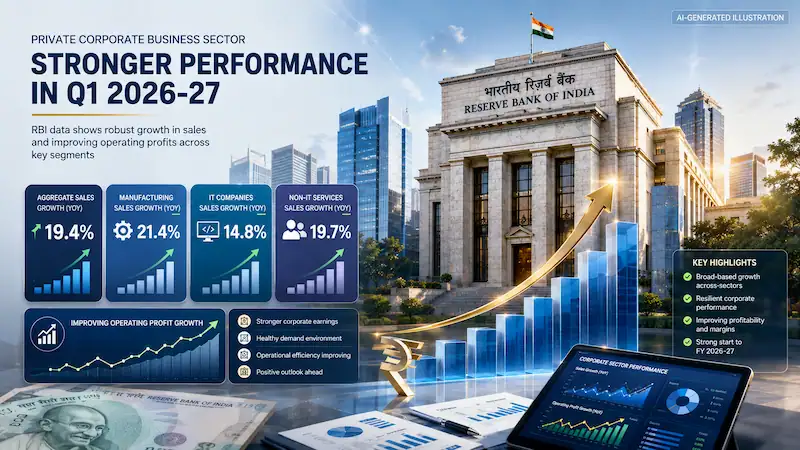
The data points to a stronger revenue-growth momentum at the aggregate level. Sales growth of listed private non-financial companies accelerated to 19.4% year-on-year in Q1 FY2026-27, compared with 13.9% in the previous quarter.
Manufacturing sector records 21.4% sales growth
Manufacturing remained one of the major drivers of the overall improvement. RBI’s data covering 1,827 listed private manufacturing companies shows that sales increased 21.4% year-on-year during Q1 FY2026-27, compared with 14.5% in Q4 FY2025-26.
The RBI said the acceleration was mainly supported by industries such as automobiles, petroleum and electrical machinery. This indicates that the improvement was not limited to a single manufacturing segment.
IT and non-IT services also maintain double-digit growth
Information Technology companies continued to strengthen their sales performance. IT-sector sales growth rose to 14.8% year-on-year in Q1 FY2026-27 from 9.9% in the previous quarter.
Non-IT services companies also maintained double-digit growth at 19.7%, although this was slightly lower than the 20.3% growth recorded in the previous quarter. Wholesale and retail trade were among the key contributors to this performance.
Input costs increased, especially for manufacturers
The improvement in sales was accompanied by significant cost pressure. Raw-material expenses of manufacturing companies increased 27.5% year-on-year during Q1 FY2026-27 amid global supply-chain disruptions.
Despite the sharp increase in raw-material expenses, the raw-material-to-sales ratio edged down to 58.1% in Q1 from 58.5% in the previous quarter.
Staff costs also increased across the major sectors. Staff costs rose 12.4% for manufacturing companies, 7.6% for IT companies and 11.2% for non-IT services companies during the quarter.
Operating profit growth improves across major sectors
Higher input costs did not prevent operating profitability from improving across the major sectors covered in the RBI assessment.
- Manufacturing: Operating profit growth increased to 21.3% year-on-year from 9.4% in the previous quarter.
- IT services: Operating profit growth reached 19.9%.
- Non-IT services: Operating profit growth stood at 12.7%.
RBI also reported that operating profit margins improved sequentially across all major sectors during Q1 FY2026-27.
Interest coverage improves for manufacturing companies
The RBI data also provides an indication of companies’ ability to service their interest obligations. The interest coverage ratio of manufacturing companies improved to 10.2 in Q1 FY2026-27, as gross profits increased faster sequentially than interest expenses.
For non-IT services companies, the interest coverage ratio increased to 2.6. The RBI noted that the ratio for IT companies remained at an elevated level.
The interest coverage ratio is calculated as earnings before interest and tax divided by interest expenses. RBI notes that a value of 1 represents the minimum level for a company to remain viable on this particular measure.
What the RBI data means for businesses
The latest numbers provide a useful sector-level benchmark for businesses, investors, finance teams and analysts reviewing corporate performance in the opening quarter of FY2026-27.
The combination of faster sales growth and stronger operating-profit growth is notable, but the data also shows that companies continue to face cost pressures. Manufacturing businesses in particular experienced a substantial rise in raw-material expenses.
For individual companies, however, sector-level data should be treated as a benchmark rather than a substitute for company-specific financial analysis. Performance can vary significantly depending on product mix, pricing, debt levels, procurement costs and market conditions.
RBI data coverage and comparison
The RBI has provided comparable information for Q4 FY2025-26 and Q1 FY2025-26, enabling both sequential and year-on-year analysis. The central bank also cautioned that company coverage can vary across quarters depending on when companies declare their financial results, although this is not expected to materially alter the aggregate position.
Key takeaway
RBI’s Q1 FY2026-27 data shows that listed private non-financial companies entered the new financial year with stronger sales momentum. Manufacturing recorded 21.4% sales growth, IT companies reported 14.8% growth and non-IT services maintained 19.7% growth. At the same time, rising input and staff costs remain important factors for corporate profitability.