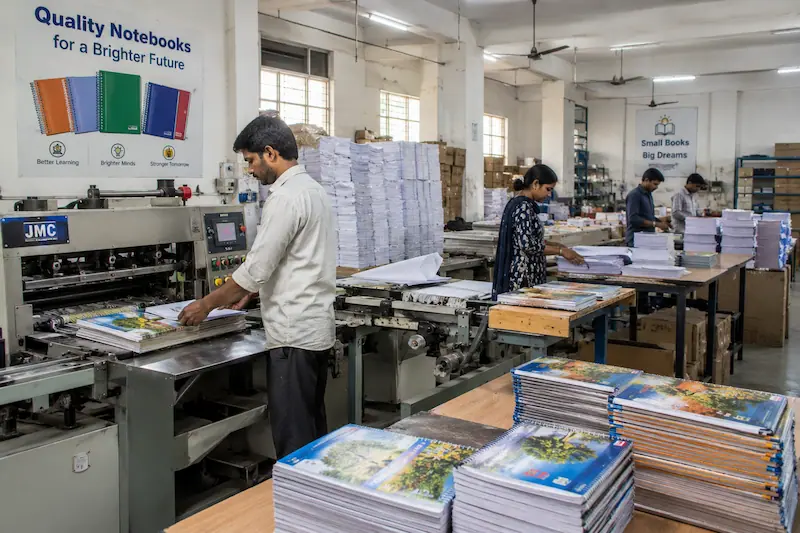
1. Notebook Manufacturing Business: Market & Opportunity in India
Notebooks are a simple product, but the demand is steady because schools, colleges, coaching centres, offices, shops, and households use them every day. This makes notebook manufacturing an attractive small manufacturing business for entrepreneurs who want to build a repeat-sales product instead of depending on one-time customers.
You do not have to start with a large factory. A small unit can begin with popular products such as school notebooks, long notebooks, practical notebooks, drawing books, registers, office notebooks, and customised notebooks. Once local demand becomes stable, you can add more sizes, better covers, printing, and higher-speed machinery.
The most important thing to understand is that notebook manufacturing is not only about buying a cutting or binding machine. Your actual business depends on three things: getting paper at the right price, maintaining consistent product quality, and selling enough finished notebooks every month.
2. Choose the Right Notebook Products Before Buying Machinery
A common mistake is to purchase machines first and decide the products later. Start the other way around. First decide what type of notebooks you want to sell, who will buy them, and what size and page count they need.
- School Notebooks: Commonly used by primary and secondary school students. Demand can be strong during the school season.
- Long Notebooks: Popular with school and college students and usually available in multiple page counts.
- Practical Notebooks: Used by students for laboratory and practical work.
- Registers: Useful for offices, shops, coaching centres, warehouses, and small businesses.
- Drawing & Art Books: Suitable for schools, hobby stores, and stationery retailers.
- Customised Notebooks: Can carry a school logo, company branding, coaching institute name, or special cover design.
For a new manufacturer, it is usually better to begin with a small range of fast-moving sizes rather than producing ten or fifteen varieties from day one.
3. Location, Factory Space & Basic Setup
A notebook unit does not necessarily need a large industrial factory in the beginning. The space requirement depends mainly on the production capacity, machinery layout, paper stock, and finished-goods storage.
- Small Unit: Around 800 to 1,500 sq. ft. can work for a basic semi-automatic setup when raw material and finished stock are carefully managed.
- Growing Unit: Around 1,500 to 3,000 sq. ft. gives more room for paper storage, production, packing, and finished inventory.
- Flooring: Keep the production floor clean, dry, level, and easy to sweep. Paper should never be stored directly on a damp floor.
- Electricity: Machinery load depends on the selected equipment, so final electrical requirements should be confirmed with the machine supplier before taking the connection.
- Storage: Keep paper in a dry place away from moisture, leakage, direct rain exposure, and unnecessary heat.
A practical layout should ideally have separate areas for paper storage, cutting and ruling, sheet handling, printing or cover work, binding, quality checking, and final packing.
4. Raw Materials Required for Notebook Manufacturing
Paper is the biggest raw material in most notebook manufacturing setups, so purchasing decisions have a major impact on your final product cost.
- Writing Paper: Used for the inner pages. GSM and paper quality should match the notebook category.
- Cover Paper / Cover Board: Used for front and back covers depending on the notebook type.
- Printing Ink: Required when you print ruling, branding, covers, or customised pages in-house.
- Binding Wire: Commonly required for spiral or wire-bound products.
- Staples: Used in centre-stitch notebooks.
- Glue: Required for perfect binding or certain finishing processes.
- Plastic / Lamination Film: Optional for selected cover designs where extra surface protection is required.
- Packaging Material: Cartons, shrink film, labels, bundles, and other packing materials used for dispatch.
Do not focus only on the lowest paper price. A cheaper paper may create problems such as poor writing feel, excessive dust, weak binding, uneven cutting, or customer complaints. Compare price, GSM, whiteness, smoothness, strength, and supplier consistency before finalising a paper source.
5. Notebook Manufacturing Process: Step-by-Step
The exact process changes with the type of notebook, but a typical manufacturing flow looks like this:
- Paper Procurement: Purchase paper in the required GSM and size based on your planned notebook range.
- Paper Cutting: Large paper sheets or reels are converted into the required sheet size using a paper cutting machine.
- Ruling / Printing: Lines, margins, page designs, branding, or other printing can be added depending on the product.
- Sheet Counting & Gathering: Required numbers of pages are counted and arranged into notebook sets.
- Cover Preparation: Covers are printed, laminated if needed, cut, and prepared for binding.
- Binding: Pages and covers are joined using stitching, stapling, spiral binding, glue binding, or another suitable method.
- Edge Cutting & Finishing: The finished notebook is trimmed to give clean and uniform edges.
- Quality Checking: Check page count, ruling, print quality, cover alignment, binding strength, cutting, and overall appearance.
- Packing: Finished notebooks are bundled or packed into cartons for distributors, retailers, schools, and institutional customers.
6. Machinery Required for a Notebook Manufacturing Unit
You do not necessarily need every machine at the beginning. The right machinery depends on whether you want a basic semi-automatic unit or a higher-capacity production line.
- Paper Cutting Machine: Cuts paper accurately into the required notebook size.
- Paper Ruling Machine: Prints standard ruling lines and other page formats on inner sheets.
- Printing Machine: Useful for notebook covers, logos, designs, labels, and customised products.
- Paper Folding Machine: Helps fold and prepare sheets where the selected production method requires folding.
- Gathering Machine: Arranges multiple printed or folded sheets in the correct sequence.
- Stitching / Stapling Machine: Used for centre-stitched notebooks.
- Spiral Binding Machine: Required for spiral notebooks and certain premium products.
- Gluing / Perfect Binding Machine: Used when notebooks are produced with adhesive binding.
- Corner Rounding / Finishing Equipment: Optional depending on the notebook design and target market.
- Shrink Wrapping / Packing Equipment: Helps standardise final packaging and dispatch preparation.
For a small entrepreneur, a semi-automatic setup can be a practical starting point because it reduces the initial investment. Automation can then be added when order volume becomes predictable.
7. Estimated Investment for a Notebook Manufacturing Business
The total investment depends heavily on production capacity, whether machines are new or used, the amount of paper inventory you maintain, and whether printing and binding are done in-house.
A practical starting budget for a small or semi-automatic notebook unit can be planned roughly as follows:
- Paper Cutting Machine: ₹2,00,000 - ₹5,00,000
- Basic Paper Ruling Machine: ₹1,50,000 - ₹4,00,000
- Basic Printing / Cover Printing Setup: ₹2,00,000 - ₹6,00,000
- Binding / Stitching Equipment: ₹1,00,000 - ₹4,00,000
- Spiral Binding Equipment (Optional): ₹40,000 - ₹1,50,000
- Tables, Racks, Tools & Material Handling: ₹75,000 - ₹1,50,000
- Electrical Work & Shed Preparation: ₹75,000 - ₹2,00,000
- Initial Paper & Raw Material Stock: ₹2,00,000 - ₹5,00,000
- Packaging & Initial Operating Expenses: ₹50,000 - ₹1,50,000
- Working Capital Reserve: ₹1,50,000 - ₹4,00,000
Indicative starting investment: A small semi-automatic notebook unit may require roughly ₹12 lakh to ₹30 lakh depending on the machinery mix and working-capital requirement. Actual machine prices vary by brand, capacity, automation level, and supplier, so quotations should be collected before finalising the project budget.
8. Government Registrations, Licenses & Basic Compliance
Notebook manufacturing is different from food manufacturing because it does not normally involve food-specific approvals. However, the actual registrations required can vary based on your state, premises, workforce, turnover, electricity connection, and business structure.
Common registrations and approvals that may apply include:
- Business Constitution: Proprietorship, Partnership, LLP, or Private Limited Company as suitable for the business.
- Udyam Registration: Useful for establishing MSME status and accessing applicable government and financial benefits.
- GST Registration: Applicable where registration is required under GST rules based on turnover, supply type, and other conditions.
- Local Trade License: May be required by the municipal body, panchayat, or other local authority depending on the location.
- Factory / Labour Compliance: Applicable requirements depend on the nature of the unit, employee strength, machinery, and state rules.
- Pollution / Local Environmental Requirements: Requirements may apply depending on the processes used, especially where printing, solvent use, waste generation, or other industrial activities are involved.
- Trademark Registration: Recommended when building your own notebook brand and protecting the brand name or logo.
Before starting production, confirm the applicable registrations with a local professional or the relevant government department because compliance requirements can change depending on the exact factory setup.
9. How to Keep Notebook Manufacturing Cost Under Control
The notebook business can look profitable on paper but margins can disappear quickly if paper wastage, rejected covers, incorrect page counts, slow production, or poor purchasing control are ignored.
- Control Paper Wastage: Plan sheet sizes carefully so that the cutting pattern uses paper efficiently.
- Buy Smart: Compare quotations from multiple paper suppliers instead of depending on a single vendor.
- Standardise Products: Keep a manageable number of sizes and page counts in the beginning.
- Reduce Rejections: Quality problems found after binding are much more expensive to fix than problems caught during production.
- Track Production: Record how many sheets enter production and how many finished notebooks come out.
- Protect Paper Stock: Moisture can damage paper and increase wastage, so storage conditions matter.
10. Marketing & Sales Strategy for Notebook Manufacturers
Manufacturing the notebook is only half the business. The real challenge is creating a distribution network that keeps your machines running.
- Stationery Retailers: Build relationships with local stationery shops and offer a clear retailer margin.
- Distributors: Appoint area-wise distributors once you have consistent supply and competitive products.
- Schools: Approach schools with customised notebooks carrying school names, logos, or specific page formats.
- Coaching Institutes: Offer branded notebooks for coaching centres that want their name and contact details printed on covers.
- Corporate Customers: Supply branded notebooks for offices, training programmes, events, conferences, and promotional use.
- Local Wholesale Markets: Wholesale stationery markets can help move volume faster, although pricing pressure may be higher.
- Online B2B Sales: Product catalogues, WhatsApp Business, B2B marketplaces, and your own website can help reach buyers beyond your immediate area.
11. Customised Notebooks Can Improve Your Business Model
Standard notebooks are often sold mainly on price. Customised notebooks give you another way to compete.
You can produce notebooks for schools, coaching institutes, companies, NGOs, events, restaurants, hospitals, and other organisations with their branding printed on the cover.
This model can be particularly useful because a customer buying customised notebooks may place a larger bulk order instead of purchasing only a few pieces from a retail shop.
12. How Much Profit Can a Notebook Manufacturing Business Make?
There is no single profit figure that applies to every notebook manufacturer. Profit depends on paper prices, product mix, production efficiency, selling price, wastage, labour, electricity, distributor margins, credit period, and monthly sales volume.
A manufacturer who sells directly to institutions or builds a strong local brand may achieve better economics than a manufacturer who sells only through price-sensitive wholesalers. At the same time, giving long credit periods or holding too much inventory can create cash-flow problems even when the business appears profitable.
Before investing, prepare a unit-level calculation covering:
- Cost of paper per notebook
- Cover and printing cost
- Binding and labour cost
- Packaging cost
- Electricity and factory expenses
- Wastage and rejection allowance
- Distributor / retailer margin
- Monthly fixed expenses
- Working-capital requirement
- Expected selling price
This calculation will give you a much more realistic picture of profitability than using a fixed percentage margin from the start.
13. A Practical Way to Start Small
You do not need to build a large notebook factory on day one. A safer approach is to start with a limited product range and build customers before increasing machinery capacity.
- Choose 3 to 5 fast-moving notebook products.
- Find two or three dependable paper suppliers.
- Collect quotations for both semi-automatic and automatic machinery.
- Visit existing notebook manufacturers and understand their production flow.
- Prepare a detailed project report and working-capital calculation.
- Start selling samples to stationery shops, schools, and institutions.
- Increase machinery capacity only after demand becomes repeatable.
14. Final Takeaway
Notebook manufacturing is a practical manufacturing business because the product has regular demand and can be sold through multiple channels. However, the business becomes sustainable only when purchasing, production quality, wastage, distribution, and cash flow are controlled together.
Start with a focused product range, avoid unnecessary machinery in the beginning, build strong paper-sourcing relationships, and concentrate on repeat customers such as stationery dealers, schools, coaching institutes, offices, and distributors. Once your monthly orders become predictable, you can move toward higher automation and a wider product range.