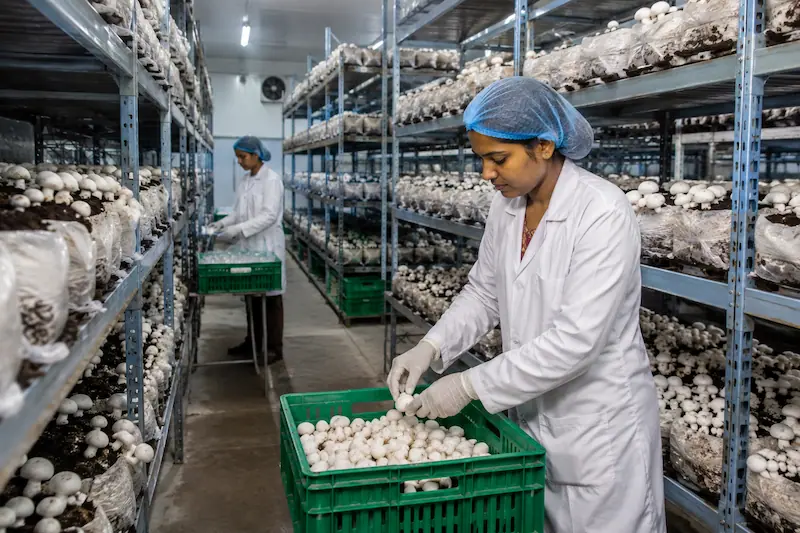
1. Mushroom Farming Business: What Is It?
Mushroom farming is a controlled crop-production business in which edible mushrooms are grown on a suitable substrate under conditions that support healthy mycelial growth and fruiting. Unlike conventional field farming, mushrooms can be cultivated in rooms, sheds, huts, racks or other protected structures, depending on the mushroom variety and production method.
India has established research and training capabilities in mushroom cultivation. ICAR works on mushroom production technologies and has developed and standardized production technologies for oyster and other mushroom species. ICAR-Directorate of Mushroom Research, Solan is specifically engaged in research, technology transfer, spawn production and capacity building in mushrooms.
For a new entrepreneur, the important question is not simply whether mushroom farming is profitable. The better question is: Which mushroom should you grow, in which season, at what scale, and who will buy it after harvest?
Those decisions should come before investing heavily in a controlled growing room or large number of bags.
2. Which Mushroom Is Best for a New Farmer?
There is no single mushroom that is best for every location. Temperature, humidity, availability of substrate, technical skill, local demand and access to buyers all matter.
- Oyster Mushroom: Often considered suitable for small-scale cultivation because it can be grown on agricultural residues such as straw using relatively simple production methods. ICAR has demonstrated oyster mushroom cultivation with farmers and documented its potential as an additional income activity.
- Button Mushroom: A major commercial mushroom category but generally more demanding in terms of compost preparation, environmental control and infrastructure than a basic oyster setup.
- Milky Mushroom: Can be suitable in warmer conditions, subject to the appropriate production technology and local climate.
- Specialty Mushrooms: Species such as shiitake or king oyster can target premium markets but generally require more specialised production knowledge and market development.
ICAR continues to demonstrate mushroom cultivation technologies under different agro-climatic conditions. In January 2026, ICAR documented successful king oyster mushroom cultivation under controlled conditions in Arunachal Pradesh, showing that environmental conditions are critical to production.
3. Oyster Mushroom vs Button Mushroom: Which Should You Start With?
For many first-time entrepreneurs, oyster mushroom can be easier to test at small scale because its cultivation can use agricultural residues such as paddy straw and does not necessarily require the same composting infrastructure as commercial button mushroom production.
ICAR has documented oyster mushroom cultivation using straw and has conducted farmer training and demonstrations focused on substrate preparation, spawning, incubation, crop management, harvesting, hygiene and marketing.
Button mushroom can be attractive where there is established technical knowledge, suitable environmental control and dependable market access, but the setup should not be treated as identical to oyster mushroom farming.
For this reason, start with the variety that matches your local climate and market rather than choosing the mushroom with the highest advertised selling price.
4. How Mushroom Farming Actually Works
The basic cultivation cycle includes preparing or sourcing a suitable growing substrate, adding quality spawn, allowing mycelium to colonise the substrate, creating the right fruiting conditions, harvesting mature mushrooms and quickly moving the product into the market.
- Choose the Mushroom Variety: Select oyster, button, milky or another suitable species based on your climate and market.
- Prepare the Growing Area: Clean the room, shed, hut or growing chamber and create conditions suitable for the selected crop.
- Prepare the Substrate: Depending on the mushroom, materials such as paddy straw or another suitable substrate may be used.
- Pasteurization / Treatment: Treat the substrate using the method recommended for the selected mushroom and production technology.
- Spawning: Mix or introduce good-quality spawn into the prepared substrate under hygienic conditions.
- Incubation: Keep the bags or growing units under suitable conditions while the mushroom mycelium colonises the substrate.
- Fruiting: Provide the temperature, humidity, ventilation and light conditions required by the selected mushroom.
- Harvesting: Harvest mushrooms at the appropriate stage to maintain quality and shelf life.
- Sorting and Packing: Remove damaged produce and pack mushrooms carefully.
- Fast Marketing: Sell or dispatch the harvested mushrooms quickly because fresh mushrooms are highly perishable.
5. Where Can You Grow Mushrooms?
Mushroom cultivation does not necessarily require agricultural land in the same way as traditional field crops. Depending on the mushroom and production model, cultivation can be carried out in a clean room, shed, hut or protected structure.
- Vacant Room: Suitable for small-scale trials where environmental conditions can be managed.
- Farm Shed: Can be adapted for larger bag-based production.
- Bamboo or Low-Cost Hut: Low-cost protected structures have been used in ICAR-documented mushroom cultivation examples.
- Controlled Growing Room: Useful where temperature and humidity need tighter control.
- Commercial Mushroom House: Suitable for larger production once market demand is established.
ICAR has documented examples of farmers beginning with simple structures and later increasing production after gaining practical experience. This supports a gradual approach rather than investing heavily before learning the crop.
6. Basic Requirements for Mushroom Farming
- Clean Growing Space: The area should be maintained properly to reduce contamination risk.
- Quality Spawn: Spawn quality can directly affect crop performance, so reliable sourcing is important.
- Suitable Substrate: Use the substrate recommended for the selected mushroom and local production method.
- Water: Clean water is required for substrate preparation, humidity management and sanitation.
- Ventilation: Fresh air management is important during fruiting and varies by species.
- Temperature & Humidity Control: Requirements vary significantly between mushroom species and production stages.
- Harvesting Equipment: Clean crates, knives, trays and weighing equipment help maintain product quality.
- Packaging: Fresh mushrooms require suitable packaging and careful handling.
7. Spawn: One of the Most Important Inputs
Spawn is the planting material used to establish mushroom mycelium in the substrate. Poor-quality or contaminated spawn can cause production failures even when the growing room is otherwise well managed.
For a beginner, buying spawn from a reliable agricultural research institution, recognised laboratory or experienced commercial supplier may be more practical than trying to establish a spawn laboratory immediately.
ICAR-Directorate of Mushroom Research has a specific mandate covering spawn production technology and capacity building. ICAR case studies also show that availability of spawn close to the production area can affect cultivation costs and convenience.
8. Substrate Selection for Mushroom Farming
The substrate provides the material on which the mushroom grows. The correct substrate depends on the mushroom species and technology.
- Paddy Straw: Commonly used for oyster mushroom cultivation.
- Wheat Straw: Can be suitable for certain mushroom production systems.
- Sawdust: Used for selected species and production methods.
- Other Agricultural Residues: Certain crop residues may also be usable when the cultivation technology has been properly validated.
ICAR has documented oyster mushroom production on agricultural residues and has also demonstrated the use of alternative crop residues for mushroom cultivation in specific locations. Do not change the substrate simply because it is cheap; test whether it actually supports the selected mushroom under your production conditions.
9. Mushroom Farm Hygiene and Contamination Control
Contamination is one of the biggest risks in mushroom farming. A clean production area alone is not enough; hygiene has to be followed through substrate preparation, spawning, incubation, fruiting and harvesting.
- Clean the growing room before starting a new cycle.
- Keep contaminated bags away from healthy production.
- Use clean tools and containers.
- Do not allow unnecessary visitors into production areas.
- Keep drainage and water management under control.
- Monitor bags regularly for abnormal growth.
- Dispose of contaminated material safely and away from active production.
10. Equipment Needed for a Small Mushroom Farm
The equipment list depends on the mushroom variety and level of automation. A small oyster mushroom unit may need relatively simple equipment, while button mushroom farming can require substantially more infrastructure.
- Growing Racks: To use vertical space efficiently.
- Drums / Containers: For substrate treatment or hot-water preparation where applicable.
- Water Sprayer / Humidification Setup: For maintaining required moisture conditions.
- Thermometer and Hygrometer: To monitor temperature and relative humidity.
- Exhaust / Ventilation Equipment: Where required for air exchange.
- Room Cooling or Heating: Required only where the selected variety and local climate demand environmental control.
- Weighing Scale: For production records and packing.
- Harvesting Crates: For hygienic movement of fresh mushrooms.
- Sealing / Packing Equipment: For retail-ready packaging.
11. How Much Space Is Needed?
There is no single ideal farm size. It depends on the number of bags or growing units, mushroom variety, rack arrangement, incubation requirements, storage, packing and environmental control.
Instead of asking only how many square feet you need, calculate how many production bags you can manage without losing control over temperature, humidity, hygiene and harvesting.
A small entrepreneur can begin with one room or a simple growing structure, learn the crop cycle and gradually add another room when the first production cycle is working consistently.
12. Mushroom Farming Investment: What Should Your Budget Include?
The investment changes significantly according to the mushroom variety and production method. A small oyster mushroom unit can be relatively low-cost compared with a temperature-controlled commercial button mushroom farm.
Your project budget should include:
- Growing room or shed preparation
- Racks or hanging system
- Spawn
- Substrate
- Substrate treatment equipment
- Humidification and ventilation
- Temperature control where required
- Electricity and water connection
- Harvest crates and tools
- Packaging material
- Working capital for at least the initial production cycles
Do not copy an online machine package and call it the total project cost. The same mushroom business can have very different investment requirements depending on whether the entrepreneur already has a room, whether drying or cooling is needed, and whether production is seasonal or year-round.
13. Working Capital Is More Important Than Many Beginners Expect
Mushroom cultivation involves repeated production cycles. You need money not only for construction and equipment but also for every new batch.
Working capital may be required for:
- Spawn purchases
- Straw or other substrate
- Packaging
- Electricity
- Water
- Labour
- Transport
- Market commissions where applicable
- Cleaning and sanitation
- Unexpected crop losses
Keep enough cash available to complete multiple production cycles rather than spending the entire budget on infrastructure.
14. How Long Does Mushroom Cultivation Take?
The production period varies by mushroom species, strain, production technology and environmental conditions. Oyster mushrooms can have relatively short production cycles, but the exact number of days should be determined from the production method and spawn used.
Do not build a business plan around one fixed harvest date. Maintain a production calendar showing spawning, incubation, fruiting and expected harvest windows.
15. How to Sell Fresh Mushrooms
Fresh mushroom production and fresh mushroom marketing should be planned together. A farmer who produces successfully but has no buyer can still lose money because fresh mushrooms are highly perishable.
- Local Vegetable Shops: Approach retailers who already sell fresh vegetables.
- Hotels and Restaurants: Restaurants can become repeat buyers when quality and supply are consistent.
- Supermarkets: Suitable when you can supply consistent quality and packaging.
- Local Wholesale Markets: Useful for moving volume but can put pressure on price.
- Direct Home Delivery: Suitable for premium local markets where customers value freshness.
- Online Orders: Local digital marketing can help find customers before expanding production.
- Value-Added Products: Dry mushrooms, powders, pickles or other products can extend the market where food-processing capability and compliance requirements are properly addressed.
ICAR has documented farmers selling fresh oyster mushrooms in local markets and also highlighted mushroom-based value-added products as an additional business opportunity.
16. How to Get Better Prices for Mushrooms
The highest market price is not always the best business model. A buyer who takes regular quantities at a predictable price can sometimes be more valuable than a buyer who occasionally offers a higher price.
Focus on:
- Consistent quality
- Reliable supply
- Clean packaging
- Correct weighing
- On-time delivery
- Low rejection
- Repeat orders
Before scaling production, talk to buyers and find out how much they can purchase each week. Your production plan should follow realistic demand rather than optimistic assumptions.
17. Mushroom Farming Profit: How to Calculate It Properly
There is no single profit figure that applies to every mushroom farm. Profit depends on mushroom variety, yield, biological efficiency, contamination, substrate cost, spawn price, labour, electricity, packaging, selling price and market access.
ICAR has published a useful field example from Jharkhand where 57 farmers produced 3,081 kg of oyster mushrooms, with biological efficiency ranging from 76.4% to 85.3%, and generated total sales of ₹3,96,720 at local selling prices of ₹120 to ₹150 per kg during the documented project period. This is a field example from a particular project and period, not a guaranteed current market return.
For your own farm, calculate:
- Yield per bag
- Usable harvest percentage
- Cost per production bag
- Average selling price per kg
- Packaging and delivery cost
- Monthly fixed expenses
- Contamination and crop-loss percentage
Your practical profit can then be calculated from the actual farm data rather than a generic percentage found online.
18. Seasonality Matters in Mushroom Farming
Mushrooms respond strongly to temperature and humidity, and the ideal production conditions vary between species. This means your location and season should influence the crop you choose.
ICAR has documented farmers using seasonal cultivation and rotating mushroom types according to suitable temperature before moving towards more controlled, year-round production. This is a useful model for beginners: first learn how the crop behaves naturally in your area and then invest in environmental control where the economics justify it.
19. Government Support, Training and Subsidy Options
Mushroom entrepreneurs should check current agriculture, horticulture, food-processing and MSME support programmes rather than relying on old subsidy lists circulating online.
- ICAR / KVK Training: Krishi Vigyan Kendras and ICAR institutions periodically conduct mushroom cultivation training and demonstrations. ICAR has documented training programmes specifically covering oyster mushroom cultivation and entrepreneurship.
- PMFME: The Ministry of Food Processing Industries currently lists PMFME as a programme supporting micro food-processing enterprises, including credit-linked capital subsidy and training support. Eligibility and availability should be checked for the specific activity, applicant and district.
- Horticulture / State Schemes: Agriculture and horticulture departments can have location-specific support programmes. Check your state department and current guidelines rather than assuming that a subsidy available in one state applies everywhere.
- Udyam Registration: Eligible businesses can register as MSMEs through the official Udyam portal.
20. Is FSSAI Registration Required?
If you sell mushrooms as food or operate a business that falls within the definition of a food business operator, applicable FSSAI registration or licensing requirements need to be followed.
FSSAI states that every Food Business Operator in India is required to be licensed or registered, with registration intended for petty food businesses under the applicable regulations. The current threshold and licensing category should be verified on FoSCoS before applying.
This becomes especially important if you move beyond farm-gate fresh mushroom sales into processed or packaged mushroom products.
21. Basic Registrations and Business Compliance
The exact requirements vary according to whether you are operating as an individual farmer, proprietorship, partnership, company, food processor, local establishment or larger commercial unit.
- Business Structure: Select the appropriate structure for your scale and tax requirements.
- Udyam Registration: Consider MSME registration where eligible.
- GST: Check current GST applicability based on your product, turnover and supply conditions.
- FSSAI: Check registration or licensing requirements if your activity is covered as a food business.
- Local Requirements: Check panchayat, municipal, commercial electricity, premises and local establishment rules where applicable.
- Environmental / Waste Rules: Review applicable requirements when operating a larger commercial unit, processing waste or using significant water and energy resources.
22. Can Spent Mushroom Substrate Be Reused?
Yes, spent mushroom substrate can have value after cultivation. It may be used or processed for composting, vermicomposting or other agricultural applications where appropriate.
ICAR has documented mushroom growers recycling spent mushroom media through vermicomposting and using the resulting vermicompost in vegetable cultivation. This can turn what would otherwise be a disposal problem into an additional resource.
23. Common Problems in Mushroom Farming
- Contamination: One of the most common production problems.
- Poor Spawn: Low-quality spawn can affect colonisation and yield.
- Wrong Temperature: The crop may stop growing or fruit poorly when environmental conditions are unsuitable.
- Improper Humidity: Excessive or insufficient humidity can affect fruiting and quality.
- Poor Ventilation: Inadequate air management can affect crop development.
- Weak Market: Fresh mushrooms cannot be stored indefinitely, so buyers should be developed before production gets large.
- Seasonal Production Errors: Growing a variety in unsuitable weather without adequate environmental control can increase losses.
- Overproduction: More bags do not automatically mean more profit if harvest cannot be sold quickly.
24. A Practical Beginner Strategy
A new farmer does not need to start with a huge mushroom farm. A pilot cycle can teach you more than an expensive machine package.
- Choose one mushroom variety.
- Get practical training from an ICAR institution, KVK or another credible technical source.
- Start with a manageable number of bags.
- Measure contamination and yield.
- Sell the first batches locally.
- Record actual costs and selling prices.
- Repeat the cycle before expanding.
This approach lets you discover the real production economics of your own location before taking a large loan or investing in expensive environmental-control equipment.
25. 90-Day Mushroom Farming Launch Plan
- Days 1-15 — Training & Market Survey: Learn the selected mushroom cultivation method and talk to local buyers.
- Days 16-30 — Room Preparation: Clean and prepare the growing area, racks, water supply, ventilation and basic monitoring equipment.
- Days 31-45 — First Production Batch: Prepare substrate, procure good-quality spawn and begin the first controlled batch.
- Days 46-60 — Crop Monitoring: Track temperature, humidity, contamination, colonisation and fruiting.
- Days 61-75 — Harvest & Sales: Harvest carefully, pack the produce and sell through local buyers.
- Days 76-90 — Review: Calculate actual cost per bag, yield, rejection, selling price, total revenue and net contribution before planning the next cycle.
26. Final Takeaway
Mushroom farming can be a practical agriculture business for entrepreneurs who are ready to treat it as a controlled production system rather than a simple crop that can be grown without technical knowledge.
The best starting point is not the biggest farm. It is a small production cycle in which you learn the correct variety, spawn, substrate, environmental conditions, hygiene practices and local market.
Once you can produce consistent quality and sell the crop reliably, scale the number of bags, add growing rooms, improve environmental control and explore value-added mushroom products.
Start with the crop and market, not the machinery. That single decision can reduce unnecessary investment and help you build a mushroom business around real demand.
27. Frequently Asked Questions
Which mushroom is easiest for beginners in India?
Oyster mushroom is often a practical starting point for small-scale cultivation because it can be grown on suitable agricultural residues such as straw and has established cultivation technologies. However, the best choice still depends on local climate, spawn availability and market demand.
Can mushroom farming be started from home?
A small pilot can be started in a suitable clean room or protected structure, provided the required environmental and hygiene conditions can be maintained.
Is mushroom farming profitable?
It can be profitable, but profit varies significantly by mushroom type, yield, cost structure and selling price. Use your actual production data rather than a fixed online profit claim.
What is the biggest risk in mushroom farming?
Contamination, unsuitable environmental conditions and lack of a reliable buyer can all cause significant losses.
Can mushroom farming be done throughout the year?
Yes, year-round production may be possible when the selected mushroom and production system can maintain suitable environmental conditions. Some farmers begin with seasonal cultivation and add environmental control as they scale.
Can I sell processed mushroom products?
Yes, products such as dried mushrooms or other value-added foods can create additional opportunities, but food-processing, labelling, packaging and applicable FSSAI requirements should be checked before commercial sale.