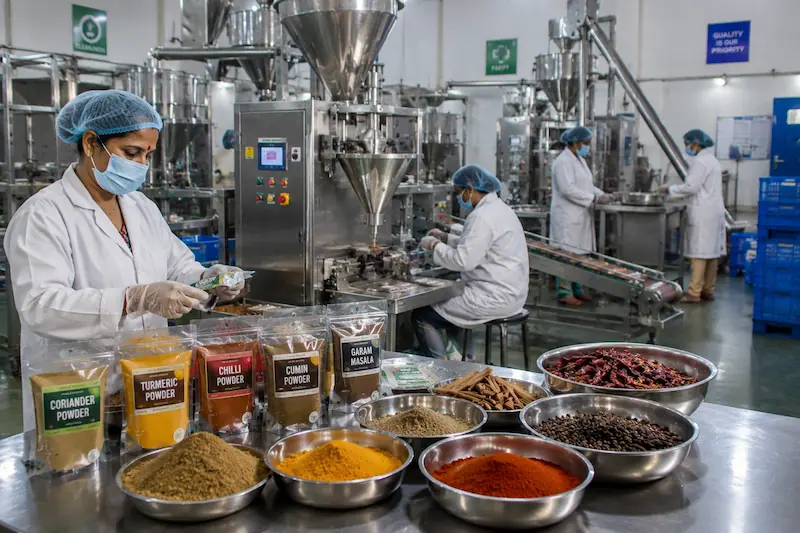
1. Honey Processing and Bottling Business: What Is It?
A honey processing and bottling business buys raw honey from beekeepers, producer groups, aggregators or other reliable sources, then performs suitable processing such as filtration, conditioning where required, quality checking, storage, filling and packaging before selling the finished product.
You do not need to become a beekeeper to start a honey processing business. A processing-only business can purchase honey from beekeepers and focus on quality control, traceability, packaging, branding and sales.
At the other end, an integrated business can combine beekeeping, honey extraction, processing, bottling and direct sales. The right model depends on capital, technical ability, raw-honey access and market demand.
The current UnicornVeda business blueprint places a practical micro model around ₹60,000 to ₹1.5 lakh when suitable premises already exist and the operation uses manual or small-batch equipment. A small dedicated unit can move towards roughly ₹1.5 lakh to ₹5 lakh, while a stronger semi-commercial setup can require around ₹5 lakh to ₹10 lakh. ([unicornveda.com](https://unicornveda.com/businesses/honey-processing-bottling-business))
For a substantially larger commercial operation, the official NIFTEM-PMFME Honey Processing Business Detailed Project Report uses a benchmark project cost of approximately ₹20.56 lakh, including machinery, miscellaneous fixed assets and working capital. The NIFTEM model is designed for much higher production capacity and should not be treated as the minimum investment for a small honey business. ([niftem.ac.in](https://niftem.ac.in/newsite/pmfme/wp-content/uploads/2022/08/honeyprocessingdpr.pdf))
2. Is Honey Processing the Same as Beekeeping?
No. They are related businesses but they are not the same.
- Beekeeping: You maintain bee colonies, manage apiaries, collect honey and handle seasonal colony management.
- Honey Processing: You buy harvested honey and prepare it for quality-controlled storage, filtration, packaging and sale.
- Honey Brand: You may outsource or purchase processing-grade honey, then build a packaged-food brand around quality, sourcing, packaging and distribution.
- Integrated Model: You combine your own beekeeping with honey purchased from other producers.
Owning bee colonies is therefore not mandatory for a processing-only business. Your current business blueprint also identifies beekeepers, farmer groups, aggregators and producer networks as possible sourcing channels. ([unicornveda.com](https://unicornveda.com/businesses/honey-processing-bottling-business))
3. Why Honey Quality Control Is the Core of the Business
Honey is not a product where appearance alone can tell you whether a batch is acceptable. Incoming honey can differ in moisture, floral source, sugar profile, acidity, HMF and other characteristics.
FSSAI standards specify requirements for honey, including a maximum moisture level of 20 percent and a maximum HMF level of 80 mg/kg. The standard also includes requirements relating to sugars, acidity, diastase, water-insoluble matter and other parameters. ([fssai.gov.in](https://fssai.gov.in/standards/list-of-standards?utm_source=web_search))
FSSAI issued a November 2025 advisory stating that HMF is to be treated as a quality parameter for honey and that samples above the prescribed limit are to be categorised as substandard under the applicable framework. ([fssai.gov.in](https://www.fssai.gov.in/upload/advisories/2025/11/690dd80e5809fHMF%20to%20be%20considered%20as%20quality%20parameter%20in%20honey.pdf?utm_source=web_search))
This makes one point very clear: honey processing is a quality business first and a bottling business second.
4. Where Can You Source Raw Honey?
Reliable sourcing should be established before you spend heavily on processing machinery.
- Beekeepers: Direct sourcing can improve traceability and supplier relationships.
- Farmer Producer Organisations: Useful where multiple beekeepers are aggregated.
- Producer Groups: Can provide larger and more organised procurement.
- Aggregators: Useful for businesses that require larger volumes.
- Regional Honey Traders: Can support smaller processors, although stronger incoming testing is important.
Do not select suppliers only because they offer the lowest rate. Compare floral source, moisture, sugar profile, cleanliness, testing reports, consistency, transport, lot size and payment terms.
5. Build Honey Traceability From Day One
Traceability simply means you should be able to identify where a honey lot came from and what happened to it before the finished bottle reached the customer.
A basic traceability system can record:
- Supplier name
- Supplier location
- Honey type or floral source where applicable
- Purchase date
- Incoming quantity
- Lot or batch number
- Incoming quality checks
- Processing date
- Processing conditions
- Finished batch quantity
- Packaging lot
This makes it easier to investigate quality complaints, supplier problems or batch-level variation.
6. Honey Processing and Bottling Process
The exact processing flow depends on the condition of incoming honey and your chosen production system. A practical commercial workflow can include:
- Honey Receiving: Receive and identify each incoming lot.
- Inspection: Check appearance, packaging condition and basic incoming parameters.
- Sampling: Take representative samples for appropriate quality checks.
- Filtration: Remove suitable foreign particles and wax-related impurities using food-grade filtration equipment.
- Conditioning: Where technically justified, control temperature or viscosity to support filtration and filling.
- Moisture Check: Measure incoming honey moisture using an appropriate instrument and verify through suitable laboratory testing where required.
- Quality Testing: Test the relevant parameters using competent laboratories or appropriate methods.
- Storage: Store processed honey in clean, food-grade containers or tanks under suitable conditions.
- Filling: Fill jars or bottles accurately according to the intended net quantity.
- Sealing: Apply suitable closures and tamper-evident or other required packaging features.
- Labelling: Apply compliant food labels with required declarations.
- Batch Coding: Add batch or lot information for traceability.
- Finished Product Inspection: Check bottle integrity, fill quantity, appearance and packaging quality.
- Dispatch: Store and transport finished honey under suitable conditions.
The official NIFTEM-PMFME Honey Processing DPR includes commercial equipment for water treatment, heating, stainless-steel storage, filtration, filling, bottling and testing in its larger reference model. ([niftem.ac.in](https://niftem.ac.in/newsite/pmfme/wp-content/uploads/2022/08/honeyprocessingdpr.pdf))
7. What Is Honey Filtration?
Filtration is used to remove suitable foreign particles and suspended material from honey before storage or filling. The exact filtration level depends on the honey, the intended product and the processing system.
Do not confuse filtration with purification that changes the identity of the product. Honey sold as honey has to comply with the applicable food standard and cannot simply be diluted or modified with added food ingredients.
FSSAI specifies that honey sold as such should not have food ingredients or additives added to it. ([fssai.gov.in](https://www.fssai.gov.in/upload/uploadfiles/files/Compendium_Food_Additives_Regulations_06_06_2022.pdf?utm_source=web_search))
8. What Is Honey Conditioning?
Some honey becomes more viscous or crystallised depending on temperature and natural characteristics. Controlled warming or conditioning can help with handling, filtration and filling.
But heating should not be treated as a free manufacturing trick. Excessive or unsuitable heating can affect quality characteristics including HMF.
That is why the goal should be controlled processing, not simply heating the honey until it becomes liquid.
9. Honey Crystallisation: Is It a Defect?
No. Honey can naturally crystallise, and crystallisation by itself does not automatically mean the product is spoiled or adulterated.
The rate and appearance of crystallisation can differ depending on the floral source and sugar composition. A processor should understand the expected behaviour of its honey rather than treating every crystallised batch as defective.
For commercial handling, temperature management, packaging choice and customer education can all reduce unnecessary complaints.
10. Machinery Required for a Small Honey Processing Business
You do not need an industrial bottling plant on day one.
- Food-Grade Storage Containers: For safe handling of raw and processed honey.
- Honey Strainers / Filters: For appropriate filtration.
- Honey Moisture Refractometer: Useful for incoming-lot moisture screening.
- Digital Weighing Scale: For inventory and accurate filling.
- Manual Filling Setup: Suitable for very small production volumes.
- Manual or Semi-Automatic Sealer: For closing retail packs.
- Batch Coding Equipment: Useful for organised packaging and traceability.
- Stainless-Steel Storage Tank: Useful as production volume increases.
- Semi-Automatic Filling Machine: Useful once manual filling becomes a bottleneck.
- Honey Conditioning Tank: Useful where controlled conditioning is genuinely required.
Your current UnicornVeda blueprint lists planning references such as approximately ₹25,000 for a manual filling and sealing set, ₹30,000 for a typical small filter reference, ₹7,000 for a moisture refractometer, ₹1.20 lakh for a semi-automatic filling machine and ₹25,000 for a stainless-steel storage tank. These are planning benchmarks, not fixed market prices. ([unicornveda.com](https://unicornveda.com/businesses/honey-processing-bottling-business))
11. How Much Does a Honey Processing Machine Cost?
The phrase honey processing machine can refer to very different equipment.
- Small Filters: Can start at relatively low cost for manual operations.
- Honey Filter Machine: The current UnicornVeda blueprint uses approximately ₹1.05 lakh as a planning reference for one filter machine.
- Semi-Automatic Filling Machine: Approximately ₹1.20 lakh in the current blueprint reference.
- Honey Bottling Plant: Approximately ₹3 lakh in the current NIFTEM-linked planning model.
- Honey Conditioning System: Can range significantly based on tank size and heating design.
- Full Commercial Processing Line: Can move into several lakhs and beyond depending on filtration, storage, heating, filling, testing and automation.
The correct question is not simply how much the machine costs. Ask whether your expected honey volume will keep the equipment sufficiently utilised to justify the investment.
12. Space Required for Honey Processing
A micro honey packing and light-processing business can operate from a compact clean food-processing area when inventory is limited.
- Micro Setup: Roughly 120 to 250 sq. ft. can be workable for a compact manual or small-batch operation.
- Small Dedicated Unit: Around 250 to 700 sq. ft. provides more practical room for receiving, storage, filtration, filling and packing.
- Larger Processing Plant: The NIFTEM-PMFME benchmark uses approximately 3,000 to 4,000 sq. ft. for its much larger commercial model.
The current UnicornVeda blueprint uses a minimum benchmark of 120 sq. ft. for its compact model. The NIFTEM project is much larger and should not be copied as the minimum floor-space requirement. ([unicornveda.com](https://unicornveda.com/businesses/honey-processing-bottling-business))
13. Electricity and Utility Requirements
A micro manual-packing operation can have modest power requirements. Commercial plants using heating, pumps, water treatment, conditioning tanks and automated filling naturally need more power.
The NIFTEM-PMFME commercial project uses a 25 kW power connection in its project model. That figure should not be applied to a micro unit. Actual power requirement must be based on your final machinery list. ([niftem.ac.in](https://niftem.ac.in/newsite/pmfme/wp-content/uploads/2022/08/honeyprocessingdpr.pdf))
14. Investment Required to Start a Honey Processing Business
Your investment depends on whether you are packing ready-processed honey or integrating filtration, conditioning and bottling.
- Micro Manual Model: Approximately ₹60,000 to ₹1.5 lakh when suitable premises already exist.
- Small Dedicated Unit: Approximately ₹1.5 lakh to ₹5 lakh.
- Semi-Commercial Setup: Approximately ₹5 lakh to ₹10 lakh.
- Organised Processing and Bottling: Approximately ₹10 lakh to ₹25 lakh or more depending on automation and working capital.
- NIFTEM Benchmark: Approximately ₹20.56 lakh total project cost for its specific larger project model, including approximately ₹8.36 lakh machinery and equipment, ₹2.20 lakh miscellaneous fixed assets and ₹10 lakh working capital. ([niftem.ac.in](https://niftem.ac.in/newsite/pmfme/wp-content/uploads/2022/08/honeyprocessingdpr.pdf))
15. Why Working Capital Matters So Much
Honey inventory can consume a large portion of your available cash. The machine may be a one-time purchase, but honey, bottles, labels and packaging have to be purchased repeatedly.
Your current business blueprint identifies initial honey inventory as one of the biggest working-capital items and uses approximately ₹1.50 lakh as a typical small-business planning figure. ([unicornveda.com](https://unicornveda.com/businesses/honey-processing-bottling-business))
The NIFTEM commercial model allocates approximately ₹10 lakh to working capital, demonstrating how quickly inventory requirements can rise with production scale. ([niftem.ac.in](https://niftem.ac.in/newsite/pmfme/wp-content/uploads/2022/08/honeyprocessingdpr.pdf))
16. Monthly Operating Costs
Your monthly budget should include:
- Honey purchase
- Packaging
- Labour
- Electricity and heating
- Inbound transport
- Laboratory testing
- Cleaning and maintenance
- Delivery
- Sales and marketing
- Accounting and compliance
The current UnicornVeda blueprint uses ₹1.86 lakh per month as the typical overhead benchmark in its commercial model. It also shows a much broader range, depending on scale, from roughly ₹20,300 to ₹11.50 lakh per month. ([unicornveda.com](https://unicornveda.com/businesses/honey-processing-bottling-business))
This should not be confused with the cost of a micro home-scale packing operation, which can be dramatically lower.
17. Honey Purchase Cost
There is no single national purchase price for raw honey.
Your current business blueprint cites trade references showing bulk honey examples around ₹140 to ₹250 per kg, but also explicitly notes that procurement depends on floral source, grade, moisture, testing, season, geography and order size. ([unicornveda.com](https://unicornveda.com/businesses/honey-processing-bottling-business))
For your business plan, use actual supplier quotations for the specific honey type you intend to buy rather than using one national average.
18. How to Calculate the Cost of One Honey Bottle
Do not calculate margin simply by subtracting the honey purchase price from the retail price.
Cost per bottle = honey cost + bottle + cap + seal + label + processing + testing allocation + labour + electricity + wastage + transport + packaging + fixed-cost allocation
Then compare this against the actual selling price through each channel.
- Direct-to-consumer price
- Retailer price
- Distributor price
- Online marketplace realisation
- Private-label price
19. Honey Processing Profit: What Is Realistic?
There is no universal net-profit percentage for honey processing.
The current UnicornVeda commercial benchmark is deliberately conservative. At 30 kg finished packaged honey per day, 26 working days, ₹320 average realisation and the stated cost assumptions, the model generates approximately ₹2.50 lakh monthly revenue but approximately ₹1.41 lakh monthly operating loss. Its stated break-even target is around 125 kg finished packaged honey per day. ([unicornveda.com](https://unicornveda.com/businesses/honey-processing-bottling-business))
This is not a claim that every honey business loses money. It demonstrates that a processor carrying large fixed costs cannot depend on small production volumes.
The better way to improve economics is to increase sold volume, improve procurement, reduce waste, maintain quality, improve packaging contribution and build higher-value direct or branded sales without making unsupported claims.
20. Break-Even Calculation
A simple break-even model is:
Break-even quantity = monthly fixed expenses ÷ contribution per kg
Where:
Contribution per kg = selling realisation per kg - variable cost per kg
Calculate this separately for wholesale, retail and direct-to-consumer channels because their selling prices and selling costs are different.
21. What Honey Should You Sell?
A new processor can keep the product range simple.
- Multi-Flower Honey: Suitable where the sourcing and product characteristics support this description.
- Floral-Source Honey: Can be positioned according to the genuine floral source when the product meets the applicable requirements.
- Regional Honey: Useful where the geographical sourcing story is genuine and traceable.
- Bulk Honey: Suitable for B2B buyers and food businesses.
- Private-Label Honey: Produced and packed for another brand.
Do not label a product as a specific floral-source honey merely because that description sounds more premium. FSSAI states that honey may be labelled by floral or plant source only where it essentially comes from that indicated source and possesses corresponding organoleptic, physicochemical and microscopic characteristics. ([fssai.gov.in](https://www.fssai.gov.in/upload/uploadfiles/files/Gazette_Notification/Press_Note_Gazette_Notification_Pulses_Grains_Maize_14_08_2018.pdf?utm_source=web_search))
22. Packaging Options
Packaging can strongly influence the economics of a honey business.
- Glass Jars: Premium appearance but heavier logistics.
- Food-Grade Plastic / PET Packs: Lighter and convenient for certain market segments.
- Squeeze Bottles: Convenient consumer format where the packaging is suitable.
- Bulk Containers: Useful for B2B customers.
- Gift Packs: Can support premium positioning.
Use food-contact-safe packaging and ensure the final label complies with applicable food-labelling requirements.
23. Honey Bottling and Filling
Manual filling is enough for very small production. As volume increases, filling consistency and labour productivity become more important.
The NIFTEM-PMFME model includes a semi-automatic single-head filling machine with an indicated speed of up to approximately 20 bottles per minute at a benchmark price of about ₹1.20 lakh. It also includes a larger bottling plant reference at approximately ₹3 lakh. ([niftem.ac.in](https://niftem.ac.in/newsite/pmfme/wp-content/uploads/2022/08/honeyprocessingdpr.pdf))
Do not buy a high-speed filling machine until your honey volume is large enough to keep it meaningfully utilised.
24. Food Safety and Hygiene
Honey is a food product, so your processing room should be designed around food hygiene rather than ordinary warehouse practices.
- Keep food-contact surfaces clean.
- Protect honey from dust and foreign material.
- Use food-grade containers and equipment.
- Keep packaging materials protected from contamination.
- Maintain pest-control measures appropriate to the premises.
- Clean filters, tanks, hoses and filling equipment regularly.
- Maintain traceability records.
- Train workers on hygiene and handling procedures.
FSSAI identifies good manufacturing and hygiene practices as part of the food-safety management framework for licensed food businesses. ([fssai.gov.in](https://fssai.gov.in/inspection/hygiene-requirements?utm_source=web_search))
25. FSSAI Registration or Licence
Honey processing and bottling is a food business, so the applicable FSSAI registration or licence must be obtained.
From 1 April 2026, FSSAI revised the general turnover framework to:
- Registration: Annual turnover up to ₹1.5 crore.
- State Licence: Annual turnover above ₹1.5 crore and up to ₹50 crore.
- Central Licence: Annual turnover above ₹50 crore.
The exact category still depends on the nature of the food business and applicable activity classification. Verify the correct Kind of Business through FoSCoS before applying. ([fssai.gov.in](https://www.fssai.gov.in/upload/advisories/2026/03/69b4054bb6cd6Order%20dated%2013thMarch2026_Revised%20Turnover%20threshold.pdf?utm_source=web_search))
26. FSSAI Honey Standard
The current FSSAI honey standard includes a number of important parameters, including:
- Moisture: Maximum 20.0 percent.
- Total Reducing Sugars: Minimum requirements apply depending on honey category.
- Sucrose: Maximum limits apply according to the specified honey category.
- Fructose to Glucose Ratio: 0.95–1.50 under the cited standard.
- Total Ash: Maximum 0.50 percent.
- Acidity: Specified limits apply.
- HMF: Maximum 80 mg/kg.
- Diastase: Minimum 3.0 Schade units per gram.
These are food-quality requirements, not numbers to estimate informally. Appropriate testing should be carried out using competent methods and laboratories. ([fssai.gov.in](https://fssai.gov.in/upload/uploadfiles/files/Compendium_Food_Additives_Regulations_03_03_2022.pdf?utm_source=web_search))
27. Why HMF Matters in Honey
Hydroxymethylfurfural, commonly called HMF, is a quality parameter in honey. FSSAI currently specifies a maximum limit of 80 mg/kg under the applicable standard.
FSSAI's November 2025 advisory specifically reminded food businesses that HMF should be considered as a quality parameter and that honey above the prescribed limit is categorised as substandard. ([fssai.gov.in](https://www.fssai.gov.in/upload/advisories/2025/11/690dd80e5809fHMF%20to%20be%20considered%20as%20quality%20parameter%20in%20honey.pdf?utm_source=web_search))
This is why heating should be controlled rather than treated as a simple step to liquefy every batch.
28. Can You Add Sugar or Other Ingredients to Honey?
Not when the product is sold simply as honey under the applicable standard. FSSAI specifies that honey sold as such should not have food ingredients, including additives, added to it.
If you develop a different honey-based food product with additional ingredients, the product may fall under a different regulatory and labelling framework. Verify the applicable category before commercial sale. ([fssai.gov.in](https://www.fssai.gov.in/upload/uploadfiles/files/Compendium_Food_Additives_Regulations_06_06_2022.pdf?utm_source=web_search))
29. BIS and Honey
BIS maintains Indian Standards related to honey, including IS 4941:1994 for Extracted Honey. The standard covers requirements, sampling and testing and includes provisions relating to quality, packaging and labelling. ([bis.gov.in](https://www.services.bis.gov.in/tmp/tbl5_2024-12-18-01-01.pdf?utm_source=web_search))
However, do not tell readers that a BIS licence is automatically mandatory for every honey business. BIS states that certification is generally voluntary unless the Central Government makes compliance compulsory for the relevant product through an applicable Quality Control Order or other legal mechanism. Check the current BIS status for your exact product before making certification claims. ([bis.gov.in](https://www.bis.gov.in/product-certification/products-under-compulsory-certification/?lang=en&utm_source=web_search))
30. Udyam MSME Registration
Eligible honey-processing businesses can obtain Udyam registration through the official Ministry of MSME portal.
The current MSME classification framework provides:
- Micro: Investment up to ₹2.5 crore and turnover up to ₹10 crore.
- Small: Investment up to ₹25 crore and turnover up to ₹100 crore.
- Medium: Investment up to ₹125 crore and turnover up to ₹500 crore.
Use the official Udyam portal for registration and current classification information.
31. GST Registration
GST applicability depends on turnover, type of supply, state and the specific nature of the business. Do not use an old fixed threshold copied from another article.
Check the current GST rules and applicable exemptions or exceptions before deciding whether registration is required.
32. PMFME Support for Honey Processing
Honey processing is relevant to food-processing support programmes, but scheme eligibility must be checked carefully.
The PMFME framework provides eligible micro food-processing enterprises with a 35 percent credit-linked capital subsidy subject to a maximum of ₹10 lakh per eligible unit under the individual micro-enterprise component, along with beneficiary contribution and other scheme conditions.
The exact activity, applicant, project structure, ODOP status and state-level implementation should be checked before using subsidy in a financial plan.
NIFTEM-PMFME itself publishes a Honey Processing Business DPR, making it a particularly useful official reference when preparing a project report. ([niftem.ac.in](https://niftem.ac.in/newsite/pmfme/wp-content/uploads/2022/08/honeyprocessingdpr.pdf))
33. PMEGP as Another Financing Route
Eligible new micro-enterprises can also explore PMEGP. The current revised guidelines provide margin-money subsidy generally ranging from 15 percent to 35 percent, depending on beneficiary category and location, with a maximum eligible project cost of ₹50 lakh for manufacturing and ₹20 lakh for business/service activities.
Eligibility conditions, beneficiary contribution, bank appraisal and other scheme rules apply. Do not treat the subsidy percentage as guaranteed cash in advance. ([msme.gov.in](https://www.msme.gov.in/sites/default/files/Revisedguidelines07.12.2023.pdf?utm_source=web_search))
34. How to Market a Honey Brand
Honey is a trust-based food product. Your branding should therefore focus on sourcing transparency, product quality, packaging and consistency rather than exaggerated health promises.
- Local Retailers: Start with nearby grocery and premium food stores.
- Natural-Food Shops: Useful where customers actively look for honey products.
- Direct Customers: Sell through WhatsApp, website and local delivery.
- Online Marketplaces: Useful after packaging, fulfilment and customer support are ready.
- Restaurants and Food Businesses: Explore B2B supply where appropriate.
- Private-Label: Supply honey to another brand that handles retail marketing.
- Institutional and Gift Orders: Explore suitable bulk and gifting opportunities.
35. Honey Branding: What Builds Trust?
- Clear source information where accurate
- Clean packaging
- Visible batch information
- Accurate net quantity
- Compliant labelling
- Responsive customer support
- Consistent taste and appearance
- Transparent quality information
Avoid claims such as diabetes cure, immunity cure, medicinal honey or guaranteed disease treatment unless such claims are legally permissible and properly substantiated. Honey should not be marketed as medicine merely to increase its selling price.
36. Private-Label Honey Business
Private-label processing can be an effective B2B model. Another company brings the brand and market while you handle processing and packing.
The advantage is that your own customer-acquisition cost can be lower. The disadvantage is that private-label buyers often negotiate hard on price and payment periods.
Before accepting a private-label order, calculate the contribution after:
- Honey cost
- Packaging
- Labels
- Testing
- Labour
- Transport
- Credit-period cost
- Customer-specific packaging requirements
37. Quality Testing: What Should Be Checked?
A basic moisture refractometer is useful for quick screening, but it does not replace complete laboratory testing.
Depending on your product, sourcing model and regulatory or buyer requirements, testing may include:
- Moisture
- HMF
- Sugar profile
- Diastase activity
- Acidity
- Foreign matter
- Adulteration indicators
- Other parameters required by the applicable standard or buyer
FSSAI maintains a dedicated Manual of Methods of Analysis for honey and other beehive products, providing official analytical methods and guidance. ([fssai.gov.in](https://fssai.gov.in/food-testing/manuals-methods-analysis?utm_source=web_search))
38. Main Operational Risks
- Adulteration in Supply Chain: Poor incoming material can damage the brand.
- High Moisture: Can increase quality and storage risks.
- Unsuitable Heating: Can increase HMF and affect quality.
- Supplier Dependence: One supplier can create major sourcing risk.
- Price Volatility: Honey procurement cost can change.
- Crystallisation Complaints: Customers may wrongly interpret natural crystallisation as spoilage.
- Packaging Leakage: Can lead to returns and damaged products.
- Inventory Blockage: Honey stock can tie up significant working capital.
- Weak Sales: A processing plant without sufficient sales volume can remain underutilised.
39. How to Reduce These Risks
- Build a supplier qualification process.
- Test incoming lots appropriately.
- Maintain lot-level traceability.
- Use food-grade storage.
- Control processing temperatures.
- Keep packaging tightly sealed.
- Do periodic external laboratory testing.
- Track purchase price and batch profitability.
- Do not hold excessive honey inventory without confirmed demand.
40. Who Should Start a Honey Processing Business?
This business can suit:
- Beekeepers who want to add processing and branding
- Honey traders wanting to move into value addition
- Rural food-processing entrepreneurs
- FPOs and producer groups
- Private-label food manufacturers
- Regional food brands
- Small packaged-food entrepreneurs
It is not a good fit for someone who has no reliable honey source, has no willingness to test incoming material, wants to make medicinal claims without proper basis, or plans to stock large quantities of honey without enough working capital.
41. A Practical Way to Start Small
You can begin without a full bottling plant.
- Find two or three reliable honey suppliers.
- Start with a limited number of honey variants.
- Buy small quantities for testing.
- Set up clean food-grade storage.
- Use basic filtration.
- Measure incoming moisture.
- Use manual filling and sealing initially.
- Test your product through competent laboratories.
- Launch a small local product range.
- Track repeat sales before buying larger machinery.
42. When Should You Buy a Semi-Automatic Filling Machine?
Upgrade when manual filling becomes a genuine production bottleneck.
Good signals include:
- Regular daily order volume
- Repeat retailer orders
- Stable honey supply
- Predictable packaging demand
- Enough working capital
- Manual filling consuming too much labour time
Do not purchase automation simply because the machine has a higher theoretical speed. The machine needs enough real orders to earn back its cost.
43. 90-Day Launch Plan
- Days 1-15 — Market and Supplier Survey: Identify local retailers, online competitors, honey suppliers, beekeepers and possible B2B buyers.
- Days 16-30 — Raw Honey Testing: Collect small samples from multiple suppliers and compare moisture, taste, appearance, consistency and laboratory results where appropriate.
- Days 31-45 — Setup: Prepare the food-safe workspace, storage, filtration, weighing and filling arrangement.
- Days 46-60 — Product Development: Finalise the initial honey varieties, bottle sizes, label design and packaging.
- Days 61-75 — Trial Sales: Sell small batches through selected local shops and direct customers. Measure actual repeat demand.
- Days 76-90 — Controlled Commercial Launch: Expand only the products and channels that show repeat orders and acceptable contribution margins.
44. Final Takeaway
Honey processing and bottling can be started as a small food business and gradually expanded into a branded regional or national operation. But the core advantage is not the bottling machine.
The real business is built on reliable honey sourcing, incoming-lot testing, controlled processing, traceability, compliant packaging and repeat sales.
A micro entrepreneur can begin around ₹60,000 to ₹1.5 lakh where suitable premises already exist, while a larger NIFTEM-PMFME reference model reaches approximately ₹20.56 lakh for a substantially higher-capacity operation. ([unicornveda.com](https://unicornveda.com/businesses/honey-processing-bottling-business); [niftem.ac.in](https://niftem.ac.in/newsite/pmfme/wp-content/uploads/2022/08/honeyprocessingdpr.pdf))
Start small enough to learn your suppliers and customers. Spend on testing and quality before spending heavily on automation. Scale processing only when sales volume justifies it.
In honey processing, trust and quality control are the real assets.
45. Frequently Asked Questions
Can I start a honey processing business with ₹60,000 to ₹1 lakh?
Yes, a micro packing and light-processing model can be possible when suitable premises already exist. The setup can use food-grade storage, basic filtration, weighing equipment, a moisture refractometer and manual filling and sealing. A full automated honey plant cannot realistically be built at this budget. ([unicornveda.com](https://unicornveda.com/businesses/honey-processing-bottling-business))
What is the minimum investment for a honey processing business?
A practical planning range is roughly ₹60,000 to ₹1.5 lakh for a micro model using an existing suitable space. A dedicated small unit can move towards ₹1.5 lakh to ₹5 lakh. ([unicornveda.com](https://unicornveda.com/businesses/honey-processing-bottling-business))
How much does a commercial honey processing plant cost?
The official NIFTEM-PMFME benchmark gives approximately ₹20.56 lakh total project cost for its 176,640 kg/year project model, including machinery, fixed assets and working capital. This is a larger reference project, not the minimum startup cost. ([niftem.ac.in](https://niftem.ac.in/newsite/pmfme/wp-content/uploads/2022/08/honeyprocessingdpr.pdf))
Do I need to own bee colonies?
No. A processing-only business can buy honey from beekeepers, FPOs, producer groups and aggregators. Owning bee colonies is an optional integrated-business model.
What is the maximum moisture allowed in honey?
Under the cited FSSAI honey standard, the maximum moisture is 20 percent by mass. ([fssai.gov.in](https://fssai.gov.in/upload/uploadfiles/files/Compendium_Food_Additives_Regulations_03_03_2022.pdf?utm_source=web_search))
What is the HMF limit for honey?
The cited FSSAI standard specifies a maximum HMF level of 80 mg/kg. FSSAI also issued a November 2025 advisory emphasising HMF as a honey quality parameter. ([fssai.gov.in](https://www.fssai.gov.in/upload/advisories/2025/11/690dd80e5809fHMF%20to%20be%20considered%20as%20quality%20parameter%20in%20honey.pdf?utm_source=web_search))
Can I heat honey to make it liquid?
Controlled conditioning may be part of processing, but excessive or unsuitable heating can affect quality parameters such as HMF. Processing temperature should therefore be controlled rather than treating strong heating as a routine solution.
Can sugar or syrup be added to honey?
Honey sold as honey under the applicable FSSAI standard should not have food ingredients or additives added to it. ([fssai.gov.in](https://www.fssai.gov.in/upload/uploadfiles/files/Compendium_Food_Additives_Regulations_06_06_2022.pdf?utm_source=web_search))
Is FSSAI registration required?
Yes, honey processing and bottling is a food business and the appropriate FSSAI registration or licence must be obtained. From 1 April 2026, the general turnover framework is registration up to ₹1.5 crore, State Licence above ₹1.5 crore up to ₹50 crore and Central Licence above ₹50 crore, subject to the applicable category. ([fssai.gov.in](https://www.fssai.gov.in/upload/advisories/2026/03/69b4054bb6cd6Order%20dated%2013thMarch2026_Revised%20Turnover%20threshold.pdf?utm_source=web_search))
Is BIS certification mandatory for honey?
Do not assume that a BIS licence is automatically mandatory. BIS certification is generally voluntary unless the relevant product is covered by a government-mandated requirement such as a Quality Control Order. Verify the current requirement for your exact product directly with BIS. ([bis.gov.in](https://www.bis.gov.in/product-certification/products-under-compulsory-certification/?lang=en&utm_source=web_search))
Can I get PMFME subsidy for honey processing?
Eligible micro food-processing enterprises can explore PMFME. The individual micro-enterprise component provides a 35 percent credit-linked capital subsidy subject to a maximum of ₹10 lakh and other scheme conditions. Current eligibility and implementation rules should be checked before applying.
Can honey processing be a profitable business?
It can be, but profit depends heavily on honey procurement cost, testing, packaging, labour, selling channel, working capital and production volume. The current UnicornVeda benchmark shows why a low-volume plant with high fixed costs can be loss-making, so profit should be calculated from actual batch economics rather than a fixed percentage. ([unicornveda.com](https://unicornveda.com/businesses/honey-processing-bottling-business))
What is the safest way to scale a honey business?
Secure reliable beekeeper or producer supply, build incoming-lot testing and traceability, start with manual or small-batch processing, prove repeat demand and then invest in semi-automatic filling, larger tanks, conditioning and automated bottling.