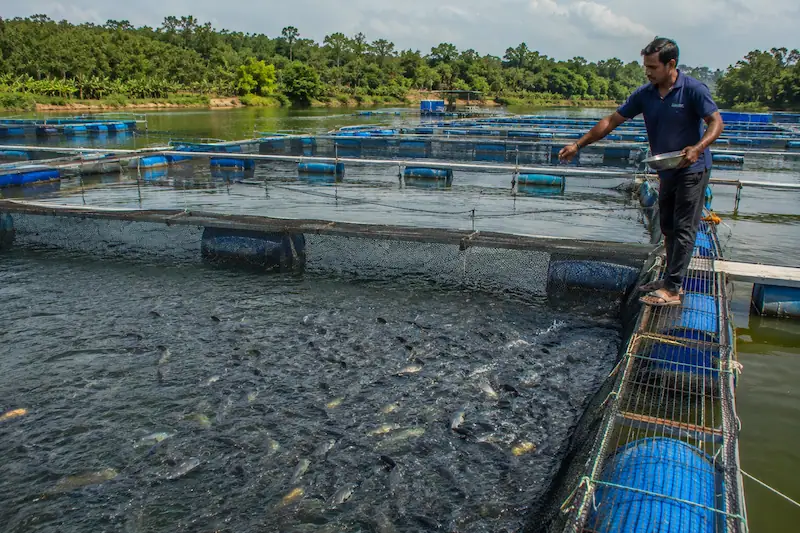
1. Freshwater Fish Farming Business: What Is It?
Freshwater fish farming is an aquaculture business in which edible freshwater fish are raised in ponds or other suitable production systems under managed conditions. The farmer controls stocking, feeding, water quality, fish health, growth and harvesting with the aim of producing marketable fish.
Unlike a normal shop or factory, a fish farm does not generate the same amount of revenue every day. Money is generally invested throughout the culture cycle and recovered when fish are harvested and sold. This makes working capital, survival rate, feed management and harvest planning especially important.
For a small entrepreneur, there are several ways to enter the business:
- Existing Pond Farming: Use your own suitable pond and invest mainly in preparation, seed, feed, water management and routine operations.
- Leased Pond Farming: Lease a suitable pond and operate it commercially.
- New Grow-Out Pond: Construct a new pond and develop it specifically for fish culture.
- Intensive Aquaculture: Increase production through stronger feeding, aeration, water-quality management and stocking control.
- Biofloc or RAS: Use more controlled production systems where technical knowledge, water management and market economics justify them.
- Integrated Fish Farming: Combine fish culture with suitable crops or other compatible activities where technically and legally appropriate.
The current UnicornVeda business blueprint puts its typical setup benchmark at about ₹5.5 lakh, with a broad range of approximately ₹1.14 lakh to ₹22.8 lakh. However, a farmer who already owns a suitable pond can start with much less incremental capital. The blueprint estimates roughly ₹40,000 to ₹1.5 lakh for a very small owner-operated operation depending on pond size, stocking and management requirements. ([unicornveda.com](https://unicornveda.com/businesses/freshwater-fish-farming-business))
2. Is Freshwater Fish Farming Profitable?
Fish farming can be profitable, but there is no single profit percentage that applies to every pond.
Your economics depend on:
- Pond ownership or lease cost
- Pond preparation cost
- Species selected
- Fingerling price and quality
- Stocking density
- Fish survival rate
- Feed cost and feed conversion
- Water quality
- Labour
- Electricity and aeration
- Harvest timing
- Local fish selling price
The current UnicornVeda benchmark is deliberately conservative. It models 15 kg harvested freshwater fish per day across 26 operating days, with average realisation of ₹180 and 72% variable cost. That produces approximately ₹70,200 gross monthly revenue against ₹57,500 fixed monthly overheads, leaving an estimated operating loss of approximately ₹37,844 per month. The stated break-even target is about 44 kg harvested fish per day. ([unicornveda.com](https://unicornveda.com/businesses/freshwater-fish-farming-business))
This does not mean fish farming is a loss-making business. It means that a small commercial operation with high fixed costs and low harvest volume can struggle. Farm scale and utilisation must be planned carefully.
3. Which Freshwater Fish Should You Farm?
Species selection should depend on your local climate, water conditions, seed availability, customer preference and the production system you plan to use.
Indian Major Carps
Rohu, Catla and Mrigal are widely used in composite carp culture in India. They occupy different feeding zones in the pond and can be cultured together when the stocking combination and management system are appropriate.
ICAR identifies composite carp culture as one of the major freshwater grow-out technologies used in India. ([icar.gov.in](https://icar.gov.in/en/fisheries-science/milestone-achievements-fisheries-science))
Other Compatible Species
Depending on state recommendations and the specific production system, other species such as common carp, grass carp, silver carp and selected freshwater species can also be considered.
Do not copy another farmer's stocking ratio without checking whether the same species combination works in your pond and local market.
4. What Is Composite Carp Culture?
Composite carp culture means growing compatible fish species together so that the available food resources in different parts of the pond can be used more efficiently.
The traditional composite culture system is based primarily on combinations of Indian major carps such as catla, rohu and mrigal. ICAR research also developed combinations incorporating exotic carps such as silver carp, common carp and grass carp, although the commercial use of particular species can vary by region and consumer preference. ([icar.gov.in](https://icar.gov.in/en/fisheries-science/milestone-achievements-fisheries-science))
The goal is not simply to put more fish into the pond. The stocking combination should match the pond, available natural food, supplementary feeding programme, water quality and target market.
5. How Much Fish Can One Hectare Produce?
There is no universal production figure for one hectare because pond fertility, stocking, survival, feed, water management, aeration and farmer skill can change the result significantly.
ICAR reports that 4–5 tonnes per hectare per year is a common production level for carp polyculture in many areas, while several farmers in Andhra Pradesh, Punjab and Haryana have achieved approximately 8–12 tonnes per hectare per year under improved practices. ICAR-CIFA research has also demonstrated intensive carp culture at approximately 10–15 tonnes per hectare per year under stronger management, supplementary feeding and aeration. ([icar.gov.in](https://icar.gov.in/en/fisheries-science/milestone-achievements-fisheries-science))
These should be treated as reference production levels, not guaranteed yields for a new fish farmer.
6. Choose Between an Existing Pond, Leased Pond and New Pond
Existing Pond
This is often the lowest-capital route because you avoid new pond construction. Initial expenses can focus on pond preparation, fingerlings, feed, water-quality inputs, nets and routine management.
Leased Pond
A leased pond can allow an entrepreneur without land to enter the business, but the lease period should be long enough to cover the culture cycle and provide reasonable business security. Lease agreements, water rights and land-use conditions should be verified before investment.
New Pond
Building a commercial pond requires earthwork, bund development, water management and site planning. It should not be done simply because a government subsidy is available. First check soil, water source, drainage, flooding risk, access and long-term economics.
7. PMMSY Benchmark for New Freshwater Grow-Out Pond
Under the Department of Fisheries PMMSY framework, the benchmark unit cost for construction of a new freshwater grow-out pond is ₹7 lakh per hectare. The same framework provides a benchmark of ₹4 lakh per hectare for freshwater aquaculture inputs including composite fish culture.
Under the beneficiary-oriented funding pattern in the cited PMMSY guidelines, government assistance is structured at 40% for general-category beneficiaries and 60% for eligible SC/ST and women beneficiaries, subject to scheme conditions and state-level implementation. ([dof.gov.in](https://www.dof.gov.in/sites/default/files/2021-12/PMMSY-Guidelines24-June2020.pdf))
These are scheme benchmark costs, not guaranteed market construction prices or guaranteed subsidy amounts. The actual approved project, beneficiary contribution, state implementation and applicable guidelines must be checked before construction.
8. Pond Selection: What Should You Check?
Do not select a pond only because it is cheap.
- Water Availability: The pond should have dependable water suitable for the selected farming system.
- Flood Risk: Check whether monsoon flooding can cause fish escape or contamination.
- Drainage: The site should allow practical water management.
- Soil: Soil characteristics influence pond construction and water retention.
- Road Access: Feed delivery and fish harvest transportation require practical access.
- Electricity: Important when pumps or aerators are used.
- Security: Fencing, lighting and regular supervision can reduce theft risk.
- Market Distance: Shorter transport can reduce harvest handling cost and stress.
9. Pond Preparation Before Stocking
A fish farm should not be stocked immediately after selecting a pond. Proper preparation creates the conditions required for healthy fish growth.
- Remove Unwanted Material: Clear excessive weeds, debris and unsuitable material.
- Repair Bunds: Check embankments for leakage, erosion and weak sections.
- Check Water Depth: Maintain a suitable water level for the selected production system.
- Manage Predators: Reduce the risk of predatory fish and other animals entering the pond.
- Apply Lime Where Recommended: Use liming according to soil and water conditions and fisheries guidance rather than applying a fixed quantity blindly.
- Develop Natural Productivity: Follow a suitable fertilisation or pond-preparation programme where required.
- Install Aeration if Needed: Aeration becomes more important as biomass and feeding intensity increase.
10. Fingerlings: The Quality of Seed Matters
Fingerlings are one of the most important starting inputs. Cheap seed is not necessarily cheap if survival is poor.
Buy seed from a reliable hatchery or recognised source and check:
- Species identity
- Fish size
- General health
- Activity and swimming behaviour
- Transport condition
- Supplier reliability
Before releasing the fish, acclimatise the seed carefully to the pond water conditions. Avoid immediately releasing fish that have been transported under stressful conditions without allowing appropriate adjustment.
11. Stocking Density: More Fish Does Not Always Mean More Profit
This is one of the easiest mistakes to make in fish farming.
Higher stocking can increase theoretical production, but it also increases oxygen demand, feed requirements, water-quality risk and the consequences of disease or management failure.
Stocking should be decided using:
- Pond size and depth
- Species combination
- Expected fish size
- Feed availability
- Aeration capacity
- Water-quality management
- Target harvest size
- Farmer experience
Do not increase stocking density until the farm can consistently control water quality, feeding and mortality.
12. Fish Feeding: Where a Large Part of Your Money Goes
Feed is often one of the largest recurring variable costs in intensive fish farming. Poor feed management can hurt the business in two ways: it wastes money and can degrade water quality.
Feed quantity should be adjusted according to actual fish biomass, species, growth stage, temperature, feeding response and feed quality rather than blindly following a fixed daily quantity.
Keep a simple feed record showing:
- Date
- Feed quantity
- Feed type
- Pond
- Fish response
- Approximate biomass
Regular sampling helps the farmer understand whether fish are actually growing as expected.
13. Water Quality Management
Good water is the foundation of freshwater aquaculture. Fish may survive for some time under poor conditions, but growth, feed utilisation and survival can deteriorate quickly.
Basic monitoring should normally include:
- Temperature
- pH
- Dissolved Oxygen
- Water Transparency
- Other Parameters Relevant to the Production System
Regular records are more useful than checking water only after fish begin behaving abnormally.
ICAR-CIFE has recently conducted farmer training covering water-quality management, feeding, disease management, carp culture, biofloc, RAS and practical water testing. ([icar.gov.in](https://icar.gov.in/en/fish-farmers-east-champaran-bihar-received-training-scientific-aquaculture-icar-cife-kolkata-centre))
14. Does Every Fish Pond Need an Aerator?
No.
Traditional low-density pond culture may operate without mechanical aeration. As stocking density and feeding intensity increase, oxygen demand rises and aeration can become increasingly important.
The correct aerator capacity depends on pond area, water depth, biomass, stocking density, feeding intensity, dissolved oxygen and production system.
Do not buy an aerator solely because another farmer uses one. First understand your pond's oxygen requirement and production target.
15. Equipment Required for a Small Fish Farm
- Fish Nets: For sampling and harvesting.
- Harvest Crates: For moving fish with less handling damage.
- Digital Weighing Scale: For weighing harvests and maintaining records.
- Water Quality Testing Kit: For pH, dissolved oxygen and other relevant parameters.
- Water Pump: Where water transfer is actually required and legally permitted.
- Paddlewheel or Other Aerator: Where oxygen management requires mechanical aeration.
- Feed Storage: Keep feed dry and protected from contamination.
- Small Feed Dispenser: Optional for larger or more automated operations.
The current UnicornVeda equipment benchmark includes a fish harvesting net and crate set around ₹15,000, a pond water-quality testing kit around ₹10,000, a paddlewheel aerator around ₹35,000 and a pond pump/water-transfer system around ₹20,000. These are planning benchmarks and can vary by supplier and capacity. ([unicornveda.com](https://unicornveda.com/businesses/freshwater-fish-farming-business))
16. How Much Does Freshwater Fish Farming Cost?
There is no single startup cost because pond ownership changes the economics dramatically.
- Existing Pond: Roughly ₹40,000–₹1.5 lakh of incremental setup and working expenditure can be possible for a very small owner-operated operation, depending on stocking and pond condition.
- Small Commercial Farm: A larger budget is required for pond preparation, seed, feed, aeration, equipment and working capital.
- New Pond: Construction adds significant capital requirements.
- Commercial Multi-Pond Farm: Can require many lakhs of rupees depending on land, pond construction, equipment, stocking and working capital.
The current UnicornVeda business blueprint gives a typical setup benchmark of approximately ₹5.5 lakh with a range of approximately ₹1.14 lakh to ₹22.8 lakh. ([unicornveda.com](https://unicornveda.com/businesses/freshwater-fish-farming-business))
17. Monthly Fish Farming Expenses
Fish farming usually has a mixture of fixed and cycle-dependent expenses.
- Pond lease or land allocation
- Farm labour
- Electricity and pumping
- Aeration
- Fish feed
- Fish health and water-management inputs
- Transport
- Harvesting cost
- Ice or cooling material where required
- Record keeping and administration
The current UnicornVeda benchmark places typical monthly operating expenses around ₹57,500, with a broad range depending on whether the pond is owned or leased and how intensively it is operated. ([unicornveda.com](https://unicornveda.com/businesses/freshwater-fish-farming-business))
18. How to Calculate Fish Farming Profit
For a fish farm, profit should normally be calculated per culture cycle rather than pretending that every month has the same production.
Gross harvest revenue = total saleable fish harvested × average realised price per kg
Then:
Cycle profit = gross harvest revenue - seed - feed - labour - electricity - water-management inputs - lease allocation - health costs - harvesting - transport - other operating expenses
For a business with multiple ponds, calculate the results pond by pond before combining them. This helps identify which pond, species or production method is actually making money.
19. Break-Even and the Importance of Harvest Volume
The current UnicornVeda benchmark shows why harvest volume matters. At 15 kg/day harvested volume, the model is below break-even. The stated target is around 44 kg/day, equivalent to approximately 1,141 kg/month under the model assumptions. ([unicornveda.com](https://unicornveda.com/businesses/freshwater-fish-farming-business))
Your actual break-even should be recalculated using your own:
- Average fish selling price
- Feed cost
- Seed cost
- Survival rate
- Harvest weight
- Lease or land cost
- Labour cost
- Electricity cost
20. How to Reduce Feed Cost Without Hurting Fish Growth
Feed cost cannot simply be reduced by feeding less. The goal is efficient feeding, not minimum feeding.
- Use feed appropriate for the fish species and growth stage.
- Measure fish biomass regularly.
- Feed according to observed consumption.
- Avoid large amounts of uneaten feed.
- Store feed correctly.
- Track feed used per pond.
- Compare growth with feed expenditure.
Feed conversion and survival should be monitored together. Cheap feed that produces poor growth may be more expensive in the long run.
21. Fish Health and Disease Management
Fish health problems are often linked with water quality, poor seed, overcrowding, nutrition, handling stress or biosecurity failures.
Warning signs can include:
- Fish coming repeatedly to the surface
- Unusual swimming
- Reduced feeding response
- Unexplained mortality
- Visible lesions or abnormal appearance
- Sudden changes in behaviour
Do not randomly use medicines or chemicals when mortality occurs. First assess water quality, oxygen, recent feeding, stocking, handling and other basic causes and seek guidance from the fisheries department or qualified fish-health professional when necessary.
22. Biosecurity in Freshwater Fish Farming
Biosecurity does not have to mean an expensive laboratory setup. Basic discipline can reduce avoidable risks.
- Source healthy seed.
- Do not move fish between ponds without a reason and proper assessment.
- Keep nets and equipment clean.
- Remove dead fish promptly.
- Control unwanted visitors and animals.
- Avoid introducing untreated water from questionable sources.
- Monitor new stocking batches carefully.
23. How to Sell Freshwater Fish
Fish marketing should be arranged before the fish reach harvest size.
- Local Fish Wholesalers: Useful for moving larger harvest volumes.
- Fish Retailers: Can provide recurring local demand.
- Restaurants: Useful where a restaurant can consistently take the required species and size.
- Institutional Kitchens: Hostels, canteens and other institutions can be potential buyers.
- Direct Consumer Sales: Can potentially improve realisation but requires more delivery and customer-management effort.
- Local Fish Markets: Useful for price discovery and volume movement.
The current UnicornVeda model recommends building relationships with wholesalers, retailers, restaurants and institutional kitchens before harvest rather than waiting until fish are already ready to sell. ([unicornveda.com](https://unicornveda.com/businesses/freshwater-fish-farming-business))
24. Why Multiple Buyers Are Better Than One Buyer
A farmer who depends on one buyer can become highly exposed to sudden price negotiation or delayed collection.
Maintain multiple sales channels where practical:
- One or more local wholesalers
- Retail fish sellers
- Restaurants
- Direct consumers
- Institutional buyers
This gives you more options when a harvest is larger than expected or one customer offers an unattractive price.
25. What Is Biofloc Fish Farming?
Biofloc is a different aquaculture production approach that relies on managing microbial communities in the culture water and requires more controlled management than a conventional pond.
It can reduce the dependence on conventional pond area in certain applications, but it is not simply a cheaper replacement for pond farming. Electricity, aeration, water chemistry, operator skill and round-the-clock monitoring can become critical.
ICAR-CIFE continues to train farmers in biofloc, RAS and conventional carp culture as different aquaculture technologies. ([icar.gov.in](https://icar.gov.in/en/fish-farmers-east-champaran-bihar-received-training-scientific-aquaculture-icar-cife-kolkata-centre))
26. Should a Beginner Start With Biofloc or a Pond?
Do not choose biofloc simply because online advertisements claim that it produces more fish in less land.
A conventional pond can be a simpler starting point for an entrepreneur who has access to a suitable pond, dependable water and a nearby market. Biofloc can become attractive when land is limited and the entrepreneur has the technical ability and reliable electricity required for intensive management.
For a beginner, practical training is more valuable than choosing a technology because of a high production number printed in an advertisement.
27. Government Support: PMMSY
The Pradhan Mantri Matsya Sampada Yojana is the key central fisheries programme to examine for eligible aquaculture projects.
The Department of Fisheries PMMSY framework covers activities including construction of new freshwater grow-out ponds and freshwater aquaculture inputs. The cited scheme guidelines list a benchmark unit cost of ₹7 lakh per hectare for a new grow-out pond and ₹4 lakh per hectare for freshwater aquaculture inputs including composite fish culture. The beneficiary-oriented assistance pattern cited in the guidelines is 40% for general beneficiaries and 60% for eligible SC/ST and women beneficiaries. ([dof.gov.in](https://www.dof.gov.in/sites/default/files/2021-12/PMMSY-Guidelines24-June2020.pdf))
The Department of Fisheries continues to maintain the official PMMSY portal, which was updated as recently as 1 August 2026. Current state implementation and programme availability should therefore be checked before submitting a project. ([pmmsy.dof.gov.in](https://pmmsy.dof.gov.in/))
28. Lease and Land Documents Can Matter for Subsidy Projects
For beneficiary-oriented PMMSY proposals, the cited guidelines require documentary evidence of the availability of the required land, including ownership or registered lease documentation. The cited guidelines also state that a leased land agreement should have a lease period of at least seven years from the date of submission for the relevant proposal framework. ([dof.gov.in](https://www.dof.gov.in/sites/default/files/2021-12/PMMSY-Guidelines24-June2020.pdf))
This is an important practical point: do not take a short informal pond lease and assume it will automatically be acceptable for subsidy-backed infrastructure.
29. Udyam MSME Registration
Udyam is the official MSME registration system operated by the Ministry of MSME.
For an aquaculture business with a formal enterprise structure, Udyam can be useful when accessing applicable institutional finance and MSME-linked programmes.
The current Udyam classification framework provides:
- Micro: Investment up to ₹2.5 crore and turnover up to ₹10 crore.
- Small: Investment up to ₹25 crore and turnover up to ₹100 crore.
- Medium: Investment up to ₹125 crore and turnover up to ₹500 crore.
Verify current classification and registration requirements through the official Udyam portal before filing. ([udyamregistration.gov.in](https://www.udyamregistration.gov.in/))
30. PMEGP and Fish Farming
PMEGP primarily targets new micro-enterprises in the non-farm sector. Fish farming should not automatically be treated as eligible simply because an entrepreneur wants to use a PMEGP loan.
For fisheries-specific pond and aquaculture support, PMMSY is the more directly relevant central fisheries programme. PMEGP can be considered only where the proposed activity satisfies the scheme's current eligibility framework and the financing institution accepts the activity.
Always verify the current scheme rules before putting subsidy into your project report.
31. Water Rights and Local Permissions
Before developing a pond, verify the legal status of the land and water source. Requirements can vary depending on whether the pond is privately owned, leased, community-owned or connected with other water resources.
Check the relevant state fisheries department, local authority and other applicable departments before excavation, water abstraction or infrastructure installation.
Do not assume that a PMMSY subsidy approval automatically gives permission to construct a pond or extract groundwater.
32. Minimum Equipment for a Small Fish Farm
A small pond farm can start with relatively simple tools.
- Fish nets
- Harvest crates
- Digital weighing scale
- Water-quality testing kit
- Feed storage containers
- Pump where required
- Aerator where required
- Basic farm record book
Do not buy sophisticated automated equipment until the farm has enough production volume to justify it.
33. Record Keeping: The Difference Between Farming and Guessing
Every pond should have a simple production record.
Record:
- Stocking date
- Species
- Number of fingerlings
- Fingerling purchase price
- Feed quantity
- Feed cost
- Water-quality observations
- Mortality
- Sampling weights
- Harvest quantity
- Selling price
- Transport cost
After harvest, calculate the actual cost per kilogram and compare it with your selling realisation. This tells you whether the farm model is really improving.
34. Integrated Fish Farming
Fish can sometimes be combined with compatible agricultural or aquatic activities. Examples include suitable crop integration, freshwater mussels, or other compatible systems.
ICAR has documented an integrated multi-trophic aquaculture demonstration combining Indian major carps with freshwater pearl mussels and chestnut, with farmers harvesting fish and other outputs from the same production system. ([icar.gov.in](https://icar.gov.in/en/integrated-multi-trophic-aquaculture-viable-model-scheduled-tribe-farmers-empowerment))
However, integration should be based on an actual technical fit. Adding more species just because they provide another possible revenue stream can complicate water management and increase risk.
35. Biggest Risks in Freshwater Fish Farming
- Poor Water Quality: Can reduce growth and cause mortality.
- Low Dissolved Oxygen: Particularly dangerous in heavily stocked ponds.
- Weak Fingerlings: Poor seed quality can reduce survival and growth.
- Overfeeding: Increases costs and can deteriorate water quality.
- Floods: Fish can escape and ponds can become contaminated.
- Drought: Water shortage can disrupt the production cycle.
- Disease: Health problems can spread quickly if not identified early.
- Theft: Larger fish near harvest can become a target.
- Market-Price Changes: Selling at the wrong time can reduce revenue.
- High Stocking Density: Can increase production risk faster than it increases profit.
The current UnicornVeda blueprint recommends water-quality monitoring, acclimatisation, stocking discipline, aeration where necessary, feeding records, mortality records, biosecurity and multiple market channels as key risk controls. ([unicornveda.com](https://unicornveda.com/businesses/freshwater-fish-farming-business))
36. Who Should Start Freshwater Fish Farming?
The business can suit:
- Farmers with an existing pond
- Entrepreneurs able to lease suitable water bodies
- Rural and semi-urban operators
- Small aquaculture businesses
- Integrated-farming entrepreneurs
- Commercial fish farmers
It is a poor fit where dependable water is unavailable, severe flooding or water-quality problems are common, local fish markets are weak, or the operator is unwilling to monitor fish, feed and water conditions regularly. ([unicornveda.com](https://unicornveda.com/businesses/freshwater-fish-farming-business))
37. A Practical Way to Start Small
Do not begin with maximum stocking or maximum pond area. Start with a manageable production cycle.
- Identify the pond.
- Test basic water and soil conditions.
- Select a suitable species combination.
- Arrange reliable fingerlings.
- Prepare the pond properly.
- Stock at a density that matches your management capacity.
- Monitor water quality.
- Record feeding and fish growth.
- Build buyers before harvest.
- Calculate the real economics after harvest.
38. When Should You Scale?
Scale only after the first cycles show that your production system works.
Good reasons to scale include:
- High survival rate
- Consistent fish growth
- Predictable feed management
- Stable water quality
- Repeat buyers
- Positive cycle-level contribution
- Enough working capital for the next cycle
Increasing pond size before solving a water-quality or market problem simply multiplies the same problem.
39. 90-Day Launch Plan
- Days 1-15 — Feasibility: Identify a suitable pond or land, check water availability, flood risk, access and local fish-market demand.
- Days 16-30 — Technical Planning: Choose species, stocking approach, feed plan and water-management system. Obtain practical guidance from the fisheries department, KVK or qualified aquaculture professionals.
- Days 31-45 — Pond Preparation: Repair bunds, remove unwanted material, prepare water and install basic equipment.
- Days 46-60 — Seed and Feed: Purchase quality fingerlings and arrange the initial feed supply.
- Days 61-75 — Stocking and Monitoring: Acclimatise and stock fish, then start regular water-quality and feeding records.
- Days 76-90 — Market Development: Build relationships with wholesalers, retailers, restaurants and institutional buyers well before the expected harvest.
40. Final Takeaway
Freshwater fish farming can be a practical agriculture business, especially for entrepreneurs who already have access to a suitable pond, dependable water and a nearby market.
But it is not a business where putting more fish into a pond automatically creates more profit. The relationship between stocking, survival, feed, water quality, harvest size and selling price determines the real outcome.
ICAR's documented production levels demonstrate that improved management can significantly increase carp productivity, but those results come from specific systems and conditions and should not be treated as guarantees for a new farmer. ([icar.gov.in](https://icar.gov.in/en/fisheries-science/milestone-achievements-fisheries-science))
Start with a pond you can manage properly. Learn the species and feeding system. Keep records. Build buyers before harvest. Then scale only when the numbers from your own farm support the decision.
In fish farming, water quality and survival are often more important than simply adding more fish.
41. Frequently Asked Questions
Can I start fish farming with an existing pond?
Yes. This can be one of the lowest-capital entry routes because the cost of constructing a new pond is avoided. The initial spending can focus on pond preparation, fingerlings, feed, water-quality inputs, nets and routine management. ([unicornveda.com](https://unicornveda.com/businesses/freshwater-fish-farming-business))
What is the minimum investment for freshwater fish farming?
If a suitable pond already exists, a very small owner-operated setup can potentially start with roughly ₹40,000 to ₹1.5 lakh in incremental setup and working expenditure, depending on pond condition, stocking level and management. This does not include purchasing land or constructing a new pond. ([unicornveda.com](https://unicornveda.com/businesses/freshwater-fish-farming-business))
How much does a new fish pond cost?
Under the cited PMMSY framework, the benchmark unit cost for a new freshwater grow-out pond is ₹7 lakh per hectare. Therefore, the scheme benchmark equivalent for 0.1 hectare is ₹70,000 and for 0.5 hectare is ₹3.5 lakh. Actual construction can differ significantly by soil, excavation, embankment, water source, location and labour cost. ([dof.gov.in](https://www.dof.gov.in/sites/default/files/2021-12/PMMSY-Guidelines24-June2020.pdf))
Which fish are commonly farmed in freshwater ponds?
Rohu, catla and mrigal are widely used in composite carp culture. Depending on the local production system and fisheries recommendations, other compatible species may also be used. ([icar.gov.in](https://icar.gov.in/en/fisheries-science/milestone-achievements-fisheries-science))
How much fish can be produced from one hectare?
ICAR reports approximately 4–5 tonnes per hectare per year as a common carp-polyculture production level in many areas, while several farmers have achieved 8–12 tonnes per hectare per year under improved practices. Intensive research systems have demonstrated 10–15 tonnes per hectare per year. These are reference figures, not guaranteed yields. ([icar.gov.in](https://icar.gov.in/en/fisheries-science/milestone-achievements-fisheries-science))
How much fish feed is required?
Feed requirement depends on species, fish biomass, growth stage, feed quality, temperature and feed-conversion performance. Use actual biomass and feeding response rather than blindly following one fixed kg/day number.
Does every pond need an aerator?
No. Low-density traditional ponds may not require mechanical aeration, while intensive ponds with higher stocking and feeding can require it. Aerator size should be matched to biomass, pond conditions and production targets.
What water quality should I monitor?
Basic monitoring should normally include temperature, pH and dissolved oxygen along with other parameters relevant to the production system. Regular records are useful because sudden changes can matter greatly. ([icar.gov.in](https://icar.gov.in/en/fish-farmers-east-champaran-bihar-received-training-scientific-aquaculture-icar-cife-kolkata-centre))
Is freshwater fish farming profitable?
It can be, but there is no universal profit margin. Pond ownership, survival, feed conversion, fish price, labour, electricity, disease losses and harvest timing all affect the result. Calculate profitability per culture cycle rather than applying a generic 20%, 30% or 40% margin. ([unicornveda.com](https://unicornveda.com/businesses/freshwater-fish-farming-business))
Can PMMSY help with fish farming?
Yes. The PMMSY framework includes freshwater grow-out pond construction and freshwater aquaculture inputs. The cited benchmark costs are ₹7 lakh per hectare for a new grow-out pond and ₹4 lakh per hectare for freshwater aquaculture inputs including composite fish culture, with beneficiary assistance structured at 40% for general beneficiaries and 60% for eligible SC/ST and women beneficiaries under the cited framework, subject to eligibility and state implementation. ([dof.gov.in](https://www.dof.gov.in/sites/default/files/2021-12/PMMSY-Guidelines24-June2020.pdf))
Can I do fish farming without owning land?
Yes, leasing a suitable pond can be an entry route. For subsidy-linked infrastructure, however, the lease and land documentation must satisfy the applicable scheme requirements. The cited PMMSY guidelines include specific requirements for land availability and lease documentation. ([dof.gov.in](https://www.dof.gov.in/sites/default/files/2021-12/PMMSY-Guidelines24-June2020.pdf))
Can fish farming be combined with other farming activities?
Yes, integrated aquaculture models can combine fish with compatible crops or aquatic species. ICAR has documented integrated models involving Indian major carps, freshwater pearl mussels and chestnut. The combination should be technically suitable for the pond and local conditions. ([icar.gov.in](https://icar.gov.in/en/integrated-multi-trophic-aquaculture-viable-model-scheduled-tribe-farmers-empowerment))