1. Atta Chakki Flour Mill Business: What Is It?
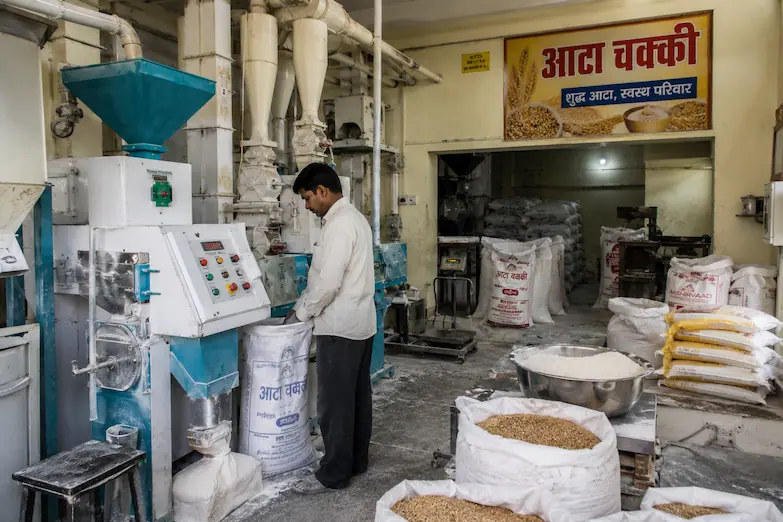
An atta chakki flour mill business can be much smaller than a full-scale commercial flour factory. At one end, a local shop can simply grind wheat brought by customers and charge a grinding fee. At the other end, a commercial flour mill can buy wheat, clean and process it, manufacture atta, pack it under its own brand and supply retailers, restaurants and institutions.
Your business model matters because the two models have very different economics.
- Customer-Wheat Grinding: The customer brings wheat and pays you for grinding. This keeps inventory requirements low.
- Retail Flour Selling: You buy wheat, grind it and sell your own loose or packaged atta. This requires more working capital.
- Branded Packaged Atta: You manufacture, pack and sell branded flour through retailers and distributors. This requires stronger quality control, packaging, marketing and distribution.
- B2B Flour Supply: Supply flour to restaurants, hostels, caterers, bakeries or institutional buyers where the product and applicable requirements fit.
The current UnicornVeda blueprint places the typical overall setup around ₹7.3 lakh, with a broad project range of approximately ₹2.75 lakh to ₹16.45 lakh. But that headline number should not be treated as the minimum needed to open a customer-grinding shop. The blueprint separately identifies a micro customer-grinding model of roughly ₹50,000 to ₹1 lakh when suitable premises are already available. ([unicornveda.com](https://unicornveda.com/businesses/atta-chakki-flour-mill-business))
2. Is an Atta Chakki Business Profitable?
It can be, but the answer depends heavily on what you are selling and how you earn.
A customer-grinding shop has low raw-material risk because customers bring their own wheat. Your revenue mainly comes from grinding charges. A branded flour business can generate much larger revenue, but it also requires wheat inventory, packaging, quality control, working capital and sales distribution.
The current UnicornVeda benchmark is a useful warning against assuming that every chakki shop is automatically profitable. At 100 kg of customer wheat grinding per day, 26 operating days per month and an assumed average charge of ₹8 per kg, gross monthly revenue is approximately ₹20,800. Against the blueprint's ₹40,000 fixed monthly overhead assumption, the model shows an estimated monthly operating loss of approximately ₹21,696. Its break-even target is around 219 kg/day under those assumptions. ([unicornveda.com](https://unicornveda.com/businesses/atta-chakki-flour-mill-business))
This does not mean every local chakki loses money. It means footfall, grinding volume, pricing and fixed costs matter more than simply owning a machine.
3. Customer Grinding vs Selling Your Own Atta
For a first-time entrepreneur, this is the most important decision.
Customer Wheat Grinding
The customer brings wheat, you clean or inspect it as required, grind it and return the flour. You earn a service charge per kilogram or according to your local pricing model.
The advantage is simple: you do not have to invest heavily in wheat inventory. The disadvantage is that your revenue depends directly on local footfall and daily grinding volume.
Own Flour Manufacturing
You purchase wheat, process it and sell atta. This opens opportunities to build your own product, but now you carry inventory and market risk.
Branded Packaged Atta
This is a different business again. Packaging, food labelling, brand promotion, distribution, retailer margins and working capital all become important.
Do not compare the selling price of branded packaged atta with a grinding-shop service charge. They are different revenue models.
4. Why Freshly Ground Atta Can Be a Selling Point
A local atta chakki can compete with packaged flour by offering freshness, transparent grinding, local convenience and custom grinding.
Customers may value:
- Grinding their own wheat.
- Choice of flour fineness.
- Small-batch service.
- Quick turnaround.
- Home pickup and delivery where viable.
- Freshly ground atta.
However, these benefits do not automatically justify a higher price. The business still needs convenient location, dependable service and consistent product quality.
5. Location Selection for an Atta Chakki
Location is especially important for a customer-grinding model because customers need a reason to visit your shop regularly.
- Residential Areas: High-density neighbourhoods can provide recurring household demand.
- Apartment Clusters: Useful where home grinding is no longer common and customers want nearby service.
- Local Grocery Markets: Can help combine grinding services with packaged flour sales.
- Near Housing Colonies: Convenience and visibility can matter more than a prestigious commercial location.
- Rural and Semi-Urban Areas: Local wheat availability and lower premises costs can support the business.
Before taking a shop, count the nearby households, competitors, average customer traffic and current grinding charges. A cheap shop with no demand can be more expensive than a slightly costlier location with reliable daily footfall.
6. Space Required
The required area depends on whether you are simply grinding customer wheat or running a packaged-flour operation.
- Micro Customer-Grinding Shop: Around 80 sq. ft. can be workable for a compact layout according to the current UnicornVeda blueprint.
- Small Retail Flour Unit: More space is needed for wheat storage, cleaning, grinding, sieving, packing and dispatch.
- Commercial Flour Mill: A larger layout is required for raw-material storage, cleaning systems, milling, sifting, packaging and material movement.
The current blueprint uses a minimum 80 sq. ft. carpet area benchmark for its compact model and a planning assumption of approximately 5–10 kW, three-phase connected power for a commercial setup. Actual electrical requirements must be checked against the selected motor and equipment. ([unicornveda.com](https://unicornveda.com/businesses/atta-chakki-flour-mill-business))
7. Wheat as the Main Raw Material
Wheat quality directly affects atta quality. Before buying large quantities, understand the wheat varieties available in your market and the flour characteristics customers expect.
Factors worth checking include:
- Wheat variety
- Moisture condition
- Foreign matter
- Grain cleanliness
- Grain size
- Protein characteristics
- Storage condition
- Purchase price
The official NIFTEM-PMFME Wheat Flour Mill DPR describes grain inspection and cleaning as important parts of flour production and notes cleaning processes such as magnetic separation, screening, aspiration, de-stoning, disc separation and scouring in larger milling systems. ([niftem.ac.in](https://niftem.ac.in/newsite/pmfme/wp-content/uploads/2022/07/wheatdpr.pdf?utm_source=web_search))
8. Atta Manufacturing Process
The process depends on the type and scale of mill. A basic chakki is simpler than an integrated commercial wheat flour plant.
- Wheat Receiving: Receive and record incoming wheat.
- Inspection: Check the incoming grain for visible foreign material and general quality.
- Cleaning: Remove stones, dust, straw, metal and other unwanted matter using manual or mechanical cleaning appropriate to the scale.
- Conditioning / Moisture Adjustment: Apply the suitable process required by the milling system before grinding where applicable.
- Milling: Grind the wheat through the atta chakki or flour-milling system.
- Sifting: Separate or standardise flour particle size where the product requires it.
- Quality Check: Check fineness, appearance, moisture condition and other relevant characteristics.
- Weighing: Measure loose or packaged flour accurately.
- Packing: Pack the flour in suitable food-grade packaging where sold as a packaged product.
- Storage and Dispatch: Protect finished flour from moisture, pests and contamination before sale.
9. What Is Chakki Atta?
Atta is a finely milled whole-wheat flour made from the grain, including the bran, germ and endosperm. BIS currently lists IS 1155:2022, Atta - Specification, which covers requirements relating to atta quality.
The standard includes requirements relating to matters such as moisture, granularity and other quality parameters. BIS also updated the standard so that packaged atta marking includes net quantity and best-before information among the relevant provisions. ([bis.gov.in](https://www.services.bis.gov.in/tmp/tbl5_2024-11-14-07-55.pdf?utm_source=web_search))
For a commercial packaged-atta business, the current applicable BIS standard and any mandatory certification requirement should be checked directly through BIS before finalising product claims or licence decisions. BIS provides its Know Your Standard system for checking current standards, amendments, notifications and related information. ([bis.gov.in](https://www.bis.gov.in/know-your-standard/?lang=en&utm_source=web_search))
10. Machinery Required for an Atta Chakki
A small shop does not need the same machinery as a commercial flour mill.
- Small Commercial Atta Chakki: Core machine for customer-wheat grinding.
- Digital Weighing Scale: For weighing customer wheat and finished flour.
- Grain Cleaning Equipment: Basic cleaning tools for small shops or mechanical cleaning equipment for larger units.
- Flour Sifter: Useful for consistent particle size and packaged flour production.
- Vibro Sifter: Suitable for larger or more consistent flour screening requirements.
- Roasting / Dalia / Multigrain Equipment: Optional products can be added later if there is demand.
- Packaging Machine: Useful once packaged-flour sales justify automation.
- Batch Coding Equipment: Useful for organised packaged-food sales.
The current UnicornVeda equipment benchmarks include a small commercial chakki around ₹60,000, a 10 HP commercial atta chakki reference around ₹83,100, a 150 kg/hour automatic atta chakki reference around ₹3.50 lakh, a commercial vibro sifter around ₹35,000 and an automatic flour packing machine around ₹2.50 lakh. These are planning references, not fixed market prices. ([unicornveda.com](https://unicornveda.com/businesses/atta-chakki-flour-mill-business))
11. How Much Does an Atta Chakki Machine Cost?
Machine prices vary substantially by motor size, output, construction, automation, grinding mechanism and included accessories.
- 3–5 HP Commercial Chakki: Current market references can fall roughly in the ₹33,500–₹72,000 range.
- 7.5–10 HP Commercial Machines: Current references can broadly fall around ₹58,000–₹1.18 lakh.
- Higher-Capacity Automatic System: A current 150 kg/hour, 10 HP, three-phase reference is around ₹3.50 lakh.
The same business blueprint also cites a current 10 HP machine reference showing approximately 100 kg/hour output at ₹83,100. Compare warranty, motor, grinding mechanism, actual throughput, electrical configuration and service support rather than choosing only by price. ([unicornveda.com](https://unicornveda.com/businesses/atta-chakki-flour-mill-business))
12. Investment Required to Start
Your investment depends on the business model.
- Micro Customer-Grinding Shop: Approximately ₹50,000–₹1 lakh can be possible where suitable premises are already available.
- Small Flour Retail Business: Approximately ₹1.5 lakh–₹4 lakh can be a more realistic planning range when you buy wheat, sell your own flour and maintain inventory.
- Stronger Commercial Unit: Approximately ₹5 lakh–₹15 lakh may be required depending on capacity, cleaning, sifting, packing, premises and working capital.
- Current Blueprint Typical: Approximately ₹7.3 lakh, with a broader benchmark from ₹2.75 lakh to ₹16.45 lakh. ([unicornveda.com](https://unicornveda.com/businesses/atta-chakki-flour-mill-business))
These should be treated as planning ranges rather than quotations. Actual project cost should be built from machine quotations, premises cost and your expected inventory.
13. Official Flour Mill Project Benchmark
The NIFTEM-PMFME Wheat Flour Mill Detailed Project Report provides a useful benchmark for an organised flour-milling project. Its model lists approximately ₹24.40 lakh for plant and machinery, ₹1.20 lakh for miscellaneous fixed assets and ₹9.44 lakh for working capital, resulting in a total project cost of approximately ₹35.04 lakh. ([niftem.ac.in](https://niftem.ac.in/newsite/pmfme/wp-content/uploads/2022/07/wheatdpr.pdf?utm_source=web_search))
The same DPR models a financing structure that includes promoter contribution, subsidy and term-loan financing. This is a benchmark project report, not a mandatory investment level for every flour mill.
14. Monthly Operating Expenses
Typical expenses include:
- Shop or factory rent
- Electricity
- Operator and helper wages
- Wheat procurement
- Packaging
- Transport and delivery
- Machine maintenance
- Cleaning and hygiene
- Marketing
- Accounting and compliance
The current UnicornVeda benchmark uses approximately ₹40,000/month as a typical overhead assumption, while the total monthly range varies from roughly ₹2,300 to ₹1.63 lakh depending on the business model and scale. ([unicornveda.com](https://unicornveda.com/businesses/atta-chakki-flour-mill-business))
15. How to Calculate Atta Chakki Profit
Profit should be calculated differently for a customer-grinding shop and a flour-selling business.
Customer-Grinding Model
Monthly revenue = grinding volume × grinding charge
Your profit then depends on rent, labour, electricity, maintenance and other fixed costs.
Packaged Flour Model
Gross contribution = selling revenue - wheat cost - processing cost - packaging - delivery - other variable costs
Then:
Operating profit = gross contribution - monthly fixed expenses
This distinction matters because a customer-grinding shop can have very low variable material cost but still lose money if daily volume is too low.
16. Break-Even for a Customer-Grinding Shop
The current UnicornVeda benchmark uses 100 kg/day, ₹8/kg grinding revenue and ₹40,000 fixed monthly overheads. Under that model, revenue is approximately ₹20,800/month and the business is below break-even.
The benchmark break-even point is approximately 219 kg/day at the stated assumptions. ([unicornveda.com](https://unicornveda.com/businesses/atta-chakki-flour-mill-business))
This is why location and daily volume are more important than buying a higher-capacity machine simply because it looks impressive.
17. Ways to Increase Revenue Beyond Grinding Charges
A local atta chakki can diversify its revenue once the core grinding service becomes stable.
- Fresh Atta Sales: Sell your own freshly ground flour.
- Multigrain Flour: Add tested flour blends where customers demand them.
- Besan: Add gram-flour grinding if the machinery and hygiene setup support it.
- Masala Grinding: A separate product line can use some milling equipment, subject to food-safety and cross-contamination controls.
- Dalia: Offer broken wheat or similar products where viable.
- Home Pickup: Collect customer wheat and deliver the finished flour locally.
- Subscription Service: Offer scheduled fresh-atta deliveries to repeat households.
- B2B Supply: Approach restaurants, caterers, hostels and other buyers.
18. Marketing Strategy for a Local Atta Chakki
A small chakki does not need expensive advertising to start. The first objective is to become known within the surrounding neighbourhood.
- Google Business Profile: Make your shop easy to find on Google Maps and search.
- Local Signboard: Clearly mention grinding, fresh atta, wheat grinding charges and any pickup service.
- WhatsApp: Take orders and communicate pickup times.
- Housing Society Promotion: Distribute a simple rate card to nearby households.
- Referral Offers: Reward existing customers for introducing nearby households.
- Home Pickup: Offer collection and delivery when the route economics work.
- Retail Partnerships: Work with grocery shops and local stores for packaged flour sales.
19. How to Build a Packaged Atta Brand
A packaged flour brand is more difficult than a grinding shop because customers can compare your packet directly with established brands.
Your differentiation can come from:
- Consistent flour quality
- Fresh production
- Local wheat sourcing where genuinely applicable
- Clear packaging
- Reliable supply
- Retailer relationships
- Suitable pack sizes
- Local brand recognition
Avoid unsupported claims such as organic, chemical-free, pesticide-free or superior nutrition unless you have the evidence and approvals needed to make those claims.
20. FSSAI Registration and Licence: Current 2026 Rules
Flour milling and packaged atta are food-business activities, so applicable FSSAI registration or licensing requirements must be followed.
FSSAI revised its turnover thresholds with effect from 1 April 2026. Under the current framework:
- Registration: Annual turnover up to ₹1.5 crore.
- State Licence: Annual turnover above ₹1.5 crore and up to ₹50 crore.
- Central Licence: Annual turnover above ₹50 crore.
These thresholds superseded the older ₹12 lakh registration threshold. FSSAI published the revised order on 13 March 2026 and the implementation took effect from 1 April 2026. ([fssai.gov.in](https://www.fssai.gov.in/upload/advisories/2026/03/69b4054bb6cd6Order%20dated%2013thMarch2026_Revised%20Turnover%20threshold.pdf?utm_source=web_search))
Always check the specific Kind of Business and current FoSCoS eligibility criteria for your exact premises and activity. ([foscos.fssai.gov.in](https://foscos.fssai.gov.in/business-eligibilty?utm_source=web_search))
21. Documents for a Larger Flour Processing Licence
For a State licence application involving manufacturing or processing, FoSCoS lists documents such as the completed application form, processing-unit layout, machinery and equipment list with installed capacity and horsepower, identity/address documents, and the food categories proposed to be manufactured. ([foscos.fssai.gov.in](https://foscos.fssai.gov.in/document-required/SL?utm_source=web_search))
This is another reason to finalise your factory layout and machinery before submitting a larger processing licence application.
22. Udyam MSME Registration
Udyam registration is the official MSME registration system operated by the Ministry of MSME. The current portal states that registration is free and paperless.
Current MSME classification limits are:
- Micro: Investment up to ₹2.5 crore and turnover up to ₹10 crore.
- Small: Investment up to ₹25 crore and turnover up to ₹100 crore.
- Medium: Investment up to ₹125 crore and turnover up to ₹500 crore.
These revised limits apply from 1 April 2025 under the current classification framework. ([udyamregistration.gov.in](https://udyamregistration.gov.in/default.aspx/UdyamRegistration.aspx?utm_source=web_search))
23. GST Registration
GST applicability should be checked based on your business model, taxable supplies, turnover, state and applicable exceptions.
For suppliers of goods, the commonly applicable threshold can be ₹40 lakh in many states, while lower thresholds apply in specified states and exceptions can alter the result. Businesses making only exempt supplies can have different registration consequences.
Do not copy a universal GST number from an old business article. Confirm your position under the current GST rules or with a qualified tax professional. ([cbic-gst.gov.in](https://cbic-gst.gov.in/pdf/01062019-GST-An-Update.pdf?utm_source=web_search))
24. BIS Standard for Atta
BIS currently identifies IS 1155:2022 as the specification for Atta. The standard covers quality requirements and includes provisions relating to moisture, granularity and packaging/marking requirements.
BIS also operates a current Know Your Standard portal where you can search by product name or IS number and view applicable standards, amendments and related information. ([bis.gov.in](https://www.bis.gov.in/know-your-standard/?lang=en&utm_source=web_search))
Do not tell customers that BIS certification is mandatory for every flour product unless the applicable government requirement makes it compulsory for your exact product. Verify the current certification status directly through BIS.
25. PMFME Support for Flour Processing
The NIFTEM-PMFME Wheat Flour Mill DPR provides a specific project model for a wheat flour mill. Its example uses a total project cost of approximately ₹35.04 lakh, including machinery, fixed assets and working capital.
The report's financing example includes a subsidy assumption of 35% with a maximum of ₹10 lakh under the model, alongside promoter contribution and bank finance. This is a project-report financing illustration and should not be treated as a guaranteed subsidy for every applicant. ([niftem.ac.in](https://niftem.ac.in/newsite/pmfme/wp-content/uploads/2022/07/wheatdpr.pdf?utm_source=web_search))
Check the current PMFME guidelines, applicant eligibility and state-level implementation before including subsidy in your business plan.
26. PMEGP Loan and Subsidy Option
PMEGP is another financing route worth checking for eligible new micro-enterprises. The current revised guidelines provide margin-money subsidy in the range of 15% to 35% depending on beneficiary category and location, with maximum project cost of ₹50 lakh for manufacturing and ₹20 lakh for business/service activities.
The scheme has additional eligibility conditions. For example, the revised guidelines require at least VIII-standard educational qualification for projects above ₹10 lakh in manufacturing and above ₹5 lakh in business/service. Existing units and projects already receiving government subsidy can also face eligibility restrictions. ([msme.gov.in](https://www.msme.gov.in/sites/default/files/Revisedguidelines07.12.2023.pdf?utm_source=web_search))
27. How to Keep Flour Quality Consistent
Customers notice atta quality quickly. A good flour mill should control the raw material and the milling process rather than relying only on the machine.
- Buy consistent wheat grades.
- Keep wheat protected from moisture.
- Clean grain before milling.
- Maintain the grinding mechanism properly.
- Keep flour fineness consistent.
- Clean the machine between incompatible products.
- Maintain clean bins and food-contact surfaces.
- Record batch and supplier information for packaged production.
28. Dust, Hygiene and Worker Safety
Flour dust should not be treated as just a cleanliness issue. Dust management, ventilation, electrical safety and housekeeping become increasingly important as grinding volume increases.
Keep the milling area clean, minimise airborne dust where practical, maintain proper electrical earthing and protect operators from moving machinery. Follow the applicable workplace, electrical and local safety requirements for your premises.
29. Customer Grinding: How to Get More Daily Volume
For a service-based chakki, the key metric is kilograms ground per day, not machine capacity on paper.
You can increase daily volume through:
- Better local visibility
- Fast service
- Transparent weighing
- Consistent grinding quality
- Home pickup and delivery
- Monthly household subscriptions
- Referral programmes
- Partnerships with nearby grocery stores
Do not buy a 150 kg/hour machine when the shop is only receiving 50–70 kg/day. Extra capacity does not solve a demand problem.
30. B2B Opportunity for a Flour Mill
Once production becomes consistent, the business can approach restaurants, hostels, caterers, food-service businesses, local grocery stores and institutional buyers.
B2B sales can increase volume, but buyers may negotiate lower prices and longer payment periods. Calculate the contribution after delivery and credit costs before accepting large orders.
31. Common Risks in an Atta Chakki Business
- Low Footfall: A poor location can leave the machine underutilised.
- High Fixed Costs: Rent and wages can become larger than grinding revenue.
- Machine Wear: Stones, burrs, belts, bearings and motors need maintenance.
- Inconsistent Fineness: Customers may stop returning if flour quality changes frequently.
- Wheat Price Volatility: Own-brand flour businesses are exposed to inventory price changes.
- Moisture: Poor wheat or flour storage can reduce quality.
- Dust: Poor housekeeping can create hygiene and workplace problems.
- Credit Sales: B2B customers can increase turnover while delaying cash collection.
- Over-Investment: Buying industrial equipment before demand is proven can lock up capital.
32. A Better Way to Start With Limited Capital
If your capital is limited, a practical path is to start as a customer-grinding shop rather than purchasing a complete flour-processing line.
- Take a suitable neighbourhood location.
- Install a reliable commercial atta chakki.
- Add accurate weighing equipment.
- Maintain clean grain handling.
- Start with customer-provided wheat.
- Build a local customer base.
- Add home pickup and delivery if the economics work.
- Introduce your own fresh atta only after demand is established.
33. When Should You Upgrade to a Larger Flour Mill?
Upgrade when your current operation has a clear capacity constraint and the additional production can be sold profitably.
Good reasons to upgrade include:
- Regular daily grinding demand exceeds your practical machine capacity.
- You have repeat bulk customers.
- You have sufficient working capital for wheat inventory.
- You have a viable packaged-flour distribution plan.
- You can justify the cost of cleaning, sifting and packing equipment.
34. 90-Day Launch Plan
- Days 1-15 — Market Survey: Count nearby competitors, estimate household demand, compare grinding charges and identify the best customer catchment area.
- Days 16-30 — Premises and Compliance Planning: Finalise the premises, verify electrical requirements and identify applicable local and food-business registrations.
- Days 31-45 — Machinery Procurement: Compare multiple machine suppliers on capacity, motor, warranty, service and actual tested output.
- Days 46-60 — Installation: Complete electrical work, earthing, dust management, weighing area and machine installation.
- Days 61-75 — Trial Production: Test different wheat inputs, fineness settings, cleaning procedures and operating routines.
- Days 76-90 — Commercial Launch: Start local marketing, Google Business visibility, WhatsApp ordering and customer pickup/delivery where viable.
35. Final Takeaway
An atta chakki business can be a low-investment neighbourhood service or a much larger branded food-processing business. The mistake is treating them as the same business.
A customer-grinding shop can potentially start around ₹50,000–₹1 lakh when suitable premises are already available, while an organised flour-processing project can require tens of lakhs of rupees. The official NIFTEM-PMFME wheat flour mill model illustrates a project cost of approximately ₹35.04 lakh for its specific configuration. ([unicornveda.com](https://unicornveda.com/businesses/atta-chakki-flour-mill-business))
The most important metric for a small chakki is not the machine's advertised capacity. It is daily paid grinding volume.
Start with demand. Keep fixed costs under control. Maintain clean and consistent flour quality. Add packaged atta, multigrain flour, B2B supply or delivery only after the core operation is working.
In a flour mill business, utilisation matters more than machine size.
36. Frequently Asked Questions
Can I start an atta chakki business with ₹50,000?
A micro customer-grinding shop can potentially start around this level when suitable premises already exist and the entrepreneur chooses a small commercial machine. The business should focus on customer-provided wheat at the beginning rather than carrying large wheat inventory. ([unicornveda.com](https://unicornveda.com/businesses/atta-chakki-flour-mill-business))
What is the minimum investment for a small atta chakki?
A practical planning range for a micro customer-grinding setup is roughly ₹50,000–₹1 lakh when premises are already available. A flour-selling business that buys wheat and carries inventory generally needs more capital. ([unicornveda.com](https://unicornveda.com/businesses/atta-chakki-flour-mill-business))
How much does a commercial atta chakki machine cost?
Current references show substantial variation. Smaller 3–5 HP commercial machines may be around ₹33,500–₹72,000, while 7.5–10 HP machines can broadly fall around ₹58,000–₹1.18 lakh. Higher-capacity automatic systems can cost several lakh rupees. ([unicornveda.com](https://unicornveda.com/businesses/atta-chakki-flour-mill-business))
Is atta chakki business profitable?
It can be, but daily utilisation is critical. The current UnicornVeda benchmark shows the 100 kg/day customer-grinding model operating below break-even at the stated ₹8/kg charge and ₹40,000 monthly overhead assumption. ([unicornveda.com](https://unicornveda.com/businesses/atta-chakki-flour-mill-business))
What is the break-even volume for a customer-grinding shop?
Under the current benchmark assumptions, approximately 219 kg of customer wheat grinding per day is required to reach break-even. Your actual figure will depend on your local grinding charge and fixed monthly costs. ([unicornveda.com](https://unicornveda.com/businesses/atta-chakki-flour-mill-business))
Is FSSAI registration required for an atta chakki?
Applicable food-business registration or licensing is required. From 1 April 2026, FSSAI uses a revised turnover framework of up to ₹1.5 crore for registration, above ₹1.5 crore to ₹50 crore for State licensing, and above ₹50 crore for Central licensing, subject to the applicable category and activity rules. ([fssai.gov.in](https://www.fssai.gov.in/upload/advisories/2026/03/69b4054bb6cd6Order%20dated%2013thMarch2026_Revised%20Turnover%20threshold.pdf?utm_source=web_search))
What is the BIS standard for atta?
BIS currently lists IS 1155:2022 as the specification for Atta. Check the current BIS standard and certification requirements for your exact product before making compliance claims. ([bis.gov.in](https://www.services.bis.gov.in/tmp/tbl5_2024-11-14-07-55.pdf?utm_source=web_search))
Can I start a branded atta business after running a chakki shop?
Yes. A local grinding operation can later expand into own-brand fresh atta, multigrain flour or packaged products, but this adds inventory, food-safety, packaging, labelling, marketing and distribution requirements.
Can I get a government subsidy for a flour mill?
Eligible projects can explore schemes such as PMFME and PMEGP. The official NIFTEM-PMFME wheat-flour project report contains a specific financing example, while PMEGP currently provides eligible new manufacturing projects with margin-money subsidy in the 15%–35% range subject to category and scheme conditions. ([niftem.ac.in](https://niftem.ac.in/newsite/pmfme/wp-content/uploads/2022/07/wheatdpr.pdf?utm_source=web_search))