
Flower Waste Incense Stick Business
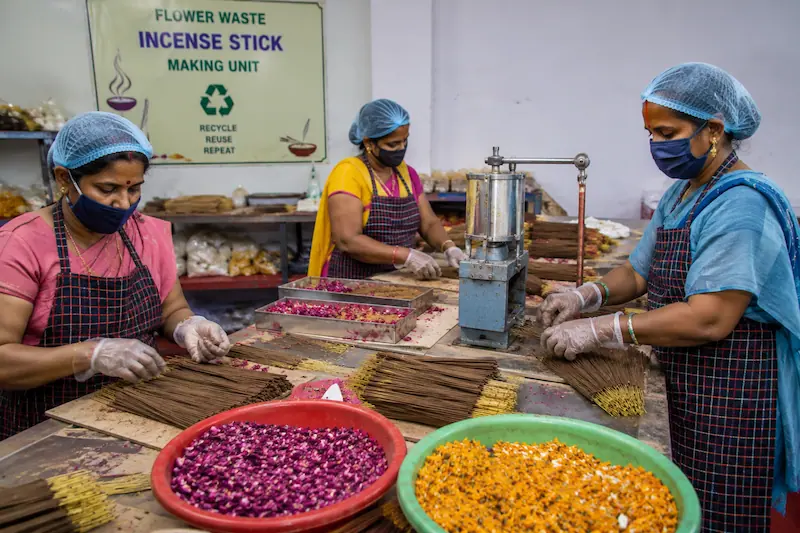
Turn segregated temple and floral-market waste into value-added incense products through drying, grinding, formulation, incense forming, drying and packaging. The business can start at micro scale and expand into a mechanised eco-friendly incense manufacturing unit.
1. Market Demand & Business Viability
2. Itemized Startup Cost Breakdown
Every line item is audited against verified vendor quotes and realistic fit-out averages.
| Cost Head & Item | Min (₹) | Typical (₹) | Max (₹) | Allocation Notes |
|---|---|---|---|---|
| Machinery & Equipment | ||||
|
Floral Waste Collection and Sorting Equipment
|
₹3,000 | ₹10,000 | ₹50,000 | 1.00 set • Crates, sorting trays, gloves, bins and basic weighing equipment. Micro operators can start with one or two collection points. |
|
Floral Waste Drying Setup
|
₹0 | ₹10,000 | ₹1,50,000 | 1.00 setup • Sun drying may be used at micro scale where weather, hygiene and space allow. Controlled electric or hot-air drying becomes useful for consistent year-round production. |
|
Floral Waste Pulverizer
|
₹8,000 | ₹25,000 | ₹1,50,000 | 1.00 unit • Used to grind thoroughly dried floral waste into material suitable for formulation. Capacity should match actual dried-waste throughput. |
|
Incense Powder Mixer
|
₹0 | ₹20,000 | ₹1,00,000 | 1.00 unit • Manual mixing is possible at micro scale. Current Indian supplier references show small incense mixers around ₹16,000 to ₹30,000. |
|
Manual or Entry-Level Agarbatti Machine
|
₹19,000 | ₹25,000 | ₹40,000 | 1.00 unit • Current Indian supplier listings show entry machines around ₹19,000 to ₹25,000. One current listing states approximately 4 to 5 kg/hour capacity. Floral formulation must be tested for machine compatibility. |
|
Semi-Automatic Incense Stick Machine
|
₹35,000 | ₹65,000 | ₹90,000 | 1.00 unit • Current Indian supplier references show semi-automatic machines around ₹35,000 to ₹65,000. Actual capacity depends on formulation and operator. |
|
Automatic Agarbatti Forming Machine
|
₹75,000 | ₹1,10,000 | ₹2,50,000 | 1.00 unit • Current Indian supplier references broadly show automatic machines around ₹75,000 to ₹1.5 lakh or more. Use only after stable sales and formulation have been established. |
|
Agarbatti Drying Machine
|
₹17,000 | ₹26,550 | ₹1,00,000 | 1.00 unit • A current Indian listing shows approximately ₹26,550 for a dryer with a stated 20 kg/hour capacity. Supplier specifications are not uniform, so verify actual drying capacity and electrical consumption. |
|
Fragrance Dipping and Blending Setup
|
₹3,000 | ₹12,000 | ₹50,000 | 1.00 set • Manual trays or tanks can be used at micro scale. Controlled dipping and blending equipment is useful as production grows. |
|
Manual Weighing and Impulse Sealing Equipment
|
₹2,500 | ₹8,000 | ₹30,000 | 1.00 set • Basic equipment for weighing and sealing retail packs. |
| Premises & Advance Deposit | ||||
|
Workspace Deposit and Basic Fit-Out
|
₹0 | ₹30,000 | ₹1,50,000 | 1.00 setup • A home or existing suitable room may avoid deposit. Dedicated units need workspace, storage, ventilation and cleanable surfaces. |
| Interior Setup & Furnishing | ||||
|
Electrical, Ventilation and Dust-Control Installation
|
₹2,000 | ₹15,000 | ₹1,00,000 | 1.00 setup • Low-power starter equipment needs limited infrastructure. Larger grinders and dryers may require dedicated circuits and dust control. |
| Licensing & Registrations | ||||
|
Udyam and Local Compliance Budget
|
₹0 | ₹5,000 | ₹30,000 | 1.00 package • Udyam registration is officially free and paperless. Local trade, fire, pollution or premises-related requirements depend on state, municipality, process and scale. Check the local authority before commercial production. |
| Initial Raw Materials & Inventory | ||||
|
Initial Binders, Fragrance, Packaging and Working Capital
|
₹10,000 | ₹50,000 | ₹2,50,000 | 1.00 working-capital-batch • Includes binders, fragrance materials, packaging, labels, collection costs and operating cash. Floral waste may be free under an agreement but collection and processing are not free. |
| Total Setup Investment | ₹1,74,500 | ₹4,11,550 | ₹15,40,000 | |
3. Plant Machinery & Equipment Catalog
| Machine / Tool Asset | Required Qty | Estimated Unit Price | Commercial Specs & Power |
|---|---|---|---|
| Agarbatti Drying Machine | 1 unit | ₹26,550 | Useful for controlled drying and reduced weather dependence |
| Automatic Agarbatti Making Machine | 1 unit | ₹1,10,000 | For higher-volume commercial production after sales validation |
| Digital Weighing and Impulse Sealing Set | 1 set | ₹8,000 | Basic final-product weighing and sealing |
| Entry-Level Agarbatti Making Machine | 1 unit | ₹25,000 | Entry forming machine for small-batch production; formulation compatibility must be tested |
| Floral Waste Drying Cabinet | 1 unit | ₹35,000 | Useful for year-round drying of collected floral material |
| Floral Waste Pulverizer | 1 unit | ₹25,000 | Core grinding step after floral waste is properly dried |
| Fragrance Dipping and Blending Set | 1 set | ₹12,000 | Manual or small-scale fragrance application |
| Incense Powder Mixer | 1 unit | ₹25,000 | Optional; manual mixing is possible at micro scale |
| Semi-Automatic Agarbatti Machine | 1 unit | ₹65,000 | Production upgrade for small commercial output |
4. Space, Power & Utilities
Minimum required footprint for machinery layout, raw material inventory storage, and dispatch.
Commercial power load with dedicated sub-meter and industrial earthing connection.
Adequate municipal utility inlet and local commercial/industrial zoning compliance.
5. Monthly Operating Expenses (OPEX)
Recurring operational commitments required every month to sustain full production.
| Expense Category & Head | Min / Mo | Typical / Mo | Max / Mo | Operational Notes |
|---|---|---|---|---|
| Workspace Rent or Allocated Premises Cost Commercial Rent | ₹0 | ₹7,000 | ₹40,000 | Suitable existing premises can reduce rent at micro scale. Dedicated commercial premises cost more. |
| Electricity and Drying Energy Staff Salaries & Wages | ₹300 | ₹3,500 | ₹20,000 | Sun drying can keep energy use low; electric drying materially increases cost. |
| Floral Waste Collection and Transport Electricity & Commercial Utilities | ₹1,000 | ₹6,000 | ₹30,000 | Includes collection labour, local fuel and transport from collection points. |
| Labour and Packing Assistance Monthly Raw Materials | ₹0 | ₹16,000 | ₹90,000 | Owner-operated micro businesses can keep separate labour costs low. Larger units need production and packing workers. |
| Binders, Fragrance and Production Consumables Packaging Materials | ₹1,000 | ₹7,000 | ₹40,000 | Includes formulation materials other than floral waste, fragrance and small consumables. |
| Packaging and Labels Packaging Materials | ₹1,000 | ₹6,000 | ₹40,000 | Retail pouches, cartons, labels and related materials. |
| Maintenance, Cleaning and Quality Testing Logistics & Delivery | ₹500 | ₹3,000 | ₹15,000 | Machine maintenance, cleaning, trial batches and basic product checks. |
| Sales and Local Marketing Logistics & Delivery | ₹500 | ₹4,000 | ₹25,000 | Retail sampling, religious-store visits, WhatsApp promotion and local digital marketing. |
| Total Monthly Overheads | ₹4,300 | ₹52,500 | ₹3,00,000 |
6. Revenue Model, Profit Margin & Break-Even
Fixed monthly overheads (₹52,500) are 100% covered at 308 kg finished flower-waste incense/month. Estimated capital payback timeline: 483 months.
7. Licences, Registrations & Compliance
Udyam MSME Registration
Free online government registration. Required to access bank priority lending, PMEGP subsidies, and delayed payment dispute resolution.
GST Registration
Mandatory if annual turnover exceeds ₹40 Lakhs (goods) or ₹20 Lakhs (services). Enables input tax credit on commercial machinery purchases.
Shop & Commercial Establishment Licence
Issued by local municipal corporation / panchayat authority for commercial premises operation and labor compliance.
Commercial Bank Current Account
Dedicated current account under business legal entity name along with trade PAN and UPI merchant QR.
8. Operational Skills Required
Floral waste segregation, moisture management, drying, grinding, formulation, binder handling, fragrance blending, incense forming, drying, packaging, hygiene, batch testing, costing and sales.
9. Customer Acquisition Strategy
Build collection agreements with temples, flower markets and religious institutions. Use the waste-recycling story as a supporting brand proposition but compete on fragrance, burn performance, smoke characteristics, packaging and consistency. Small businesses should start with local religious stores, gift shops, WhatsApp orders and direct retail. Larger units can add distributors, private-label production, institutional supply and organised retail.
10. Interactive Profit & Expense Simulator
Adjust customer ticket sizes, daily footfall, and fixed overheads to see real-time net returns.
Adjust Financial Assumptions
Slide or type direct valuesSimulation Output
Mathematical Precision11. Founder Profile Suitability
Highly Recommended If:
Suitable for micro entrepreneurs, women self-help groups, temple-linked enterprises, rural and semi-urban businesses, eco-product brands, local incense manufacturers and larger circular-economy businesses. Strongest where regular segregated floral waste is available and a local religious, retail or institutional market exists.
Not Ideal If:
Not ideal if floral waste cannot be collected consistently, contamination is high, the drying process cannot be controlled, the formulation has not been tested, or there is no reliable sales channel for the finished incense products.
12. Operational Risks & Mitigation Strategy
Major risks include inconsistent floral waste supply, contamination, high moisture, drying losses, formulation inconsistency, poor burning performance, excessive smoke, unstable fragrance, packaging moisture, seasonal variation, machinery breakdown and weak retail repeat. Mitigate through source-level segregation, rapid collection, controlled drying, standardised formulations, trial batches, quality logs, moisture-safe storage and multiple sales channels. Do not scale machinery until the raw-material and sales systems are both stable.
13. Step-by-Step 90-Day Launch Plan
Feasibility & Premises Lease
Finalize commercial space lease agreement, verify power load capacity, and apply for Udyam MSME certification.
Machinery Procurement & Fit-Out
Order plant machinery, complete electrical/plumbing fit-out, and setup commercial bank current account.
Trial Runs, Hiring & Licences
Install and calibrate equipment, conduct staff SOP training, and secure local municipal trade licenses.
Soft Launch & Marketing Kickoff
Initiate neighborhood promotional campaigns, setup Google Business listing, and commence commercial operations.
14. Similar Business Opportunities
Explore audited business blueprints in related sectors & investment ranges.
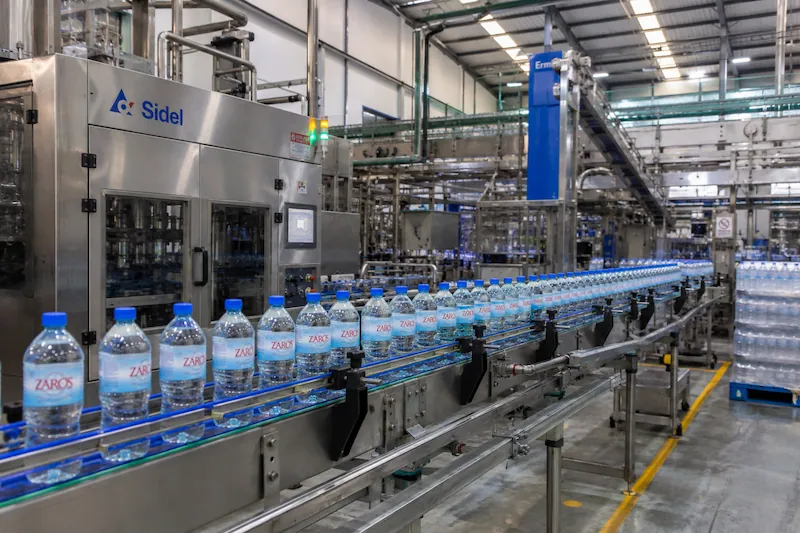
Packaged Drinking Water Bottle Manufacturing Plant
Comprehensive business blueprint for setting up a 2000 LPH BIS/ISI certified packaged drinking water unit, automated 20-liter jar packaging, and PET bottle bottling line.
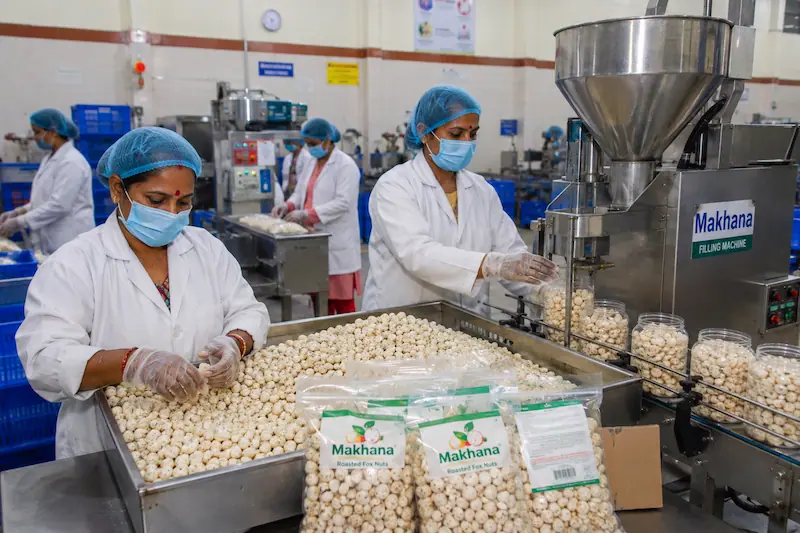
Makhana Processing Business
Start a makhana business at the scale that fits your capital, from a low-cost home-based roasted and packed model to a commercial processing unit with grading, roasting, flavouring and automated packing.
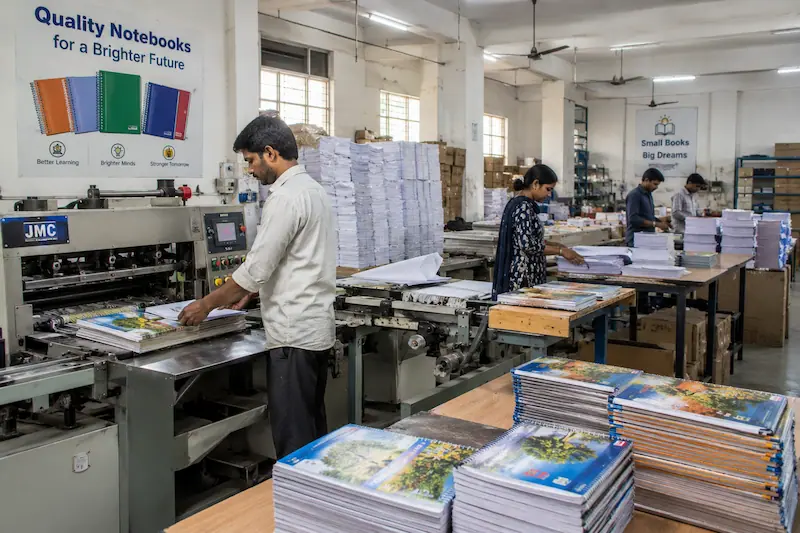
Notebook Manufacturing Business
A scalable notebook manufacturing opportunity covering an asset-light micro start, small workshop production, semi-commercial manufacturing and organised commercial supply.
15. Data Verification & Methodology
This business profile was audited on 28 Aug 2026 with a data confidence score of 95%.
Equipment pricing and operational assumptions are cross-referenced with Indian industrial machinery suppliers, commercial lease indices, and official Ministry guidelines.
16. Frequently Asked Questions
Yes, a micro value-addition model can be possible when suitable existing premises are available. Start with a small floral-waste collection network, sun or low-cost drying, a small pulverizer, manual formulation and low-cost incense forming or outsourced forming, followed by manual packing. This is a trial-scale business and should not be presented as a factory.
A practical planning range is about ₹30,000 to ₹75,000 for a micro operation using existing premises and relatively manual processing. A small dedicated unit is more likely around ₹75,000 to ₹2 lakh, while a semi-commercial setup can require roughly ₹2 lakh to ₹5 lakh.
Sometimes the flowers can be collected under a zero-purchase-price arrangement, but that does not make the input cost zero. Collection labour, transport, sorting, drying, rejected material and storage still cost money. A long-term collection agreement is generally more valuable than relying on occasional free waste.
CSIR-CIMAP, Lucknow reports a technology for recycling flowers and leaves offered at places of worship into incense sticks and fragrant cones. The Principal Scientific Adviser describes it as an eco-friendly technology supporting floral waste recycling and livelihood generation. The commercial formulation and equipment configuration should still be validated for the specific raw-material mix and production target.
The process can include floral-waste drying, pulverising, powder mixing, incense forming, drying, fragrance application and packaging. A micro unit can do several steps manually. Current Indian references show entry incense machines around ₹19,000 to ₹25,000, semi-automatic machines around ₹35,000 to ₹65,000, automatic machines around ₹75,000 to ₹1.5 lakh or more, small mixers around ₹16,000 to ₹30,000 and small drying equipment from roughly ₹17,000 upward. Machine compatibility with floral formulations should be tested before purchase.
Not automatically. Flower powder can have different fibre, particle-size, moisture and binding characteristics from conventional charcoal or wood-based formulations. The extrusion or rolling behaviour must be tested on the selected machine. A machine that works well with a conventional formulation may require changes in formulation or operating settings for floral material.
Yes. The work can be divided among members for collection, segregation, drying, grinding, formulation, forming, drying and packaging. A group model works best when the collection source and sales channel are formalised before capacity is expanded.
There is no universal net-margin figure. Floral waste may reduce raw-material purchase cost, but binders, fragrance, collection, drying, labour, packaging, transport and rejected batches still cost money. Premium direct retail can produce better contribution than bulk wholesale, but it also requires more selling and packaging effort. Calculate profit from actual yield and realised selling price rather than assuming a fixed percentage.
FSSAI regulates food businesses, while incense sticks are non-food products. Therefore FSSAI is generally not the core licence for incense manufacturing. The entrepreneur should instead check Udyam registration, local trade permissions and any applicable fire, pollution, environmental or factory-related requirements based on the premises, process and scale. Udyam registration is officially free and paperless.
A micro operation can work in roughly 150 to 250 sq ft when collection volume is small and some processing is manual, but sufficient drying and storage space is essential. A small commercial unit may need around 250 to 700 sq ft. A larger operation with dedicated raw-waste receiving, drying, grinding, forming, finished-product storage and packing areas can require 1,000 to 5,000 sq ft or more. The main space constraint is often drying and raw-material storage rather than the forming machine alone.
Micro units using manual forming and natural drying can have very low electricity requirements. Electricity rises when grinders, mixers and electric dryers are added. A current small agarbatti dryer listing states 230 V and a 1 HP motor alongside a 20 kg/hour stated drying capacity, while supplier specifications are not uniform. Final electrical load should be calculated from the actual selected machines rather than a generic factory figure.
An eligible new manufacturing enterprise may potentially use PMEGP subject to the current guidelines, applicant eligibility, project classification and bank appraisal. The revised scheme framework provides margin-money subsidy for eligible manufacturing projects within its prescribed limits. The entrepreneur should verify the current KVIC or PMEGP guidelines before applying and should not treat subsidy as guaranteed approval or upfront cash.
Secure a consistent floral-waste source first, then stabilise drying and formulation, then prove repeat sales. Start with manual or entry-level forming and small-batch packaging. Move to semi-automatic machinery when output becomes a genuine bottleneck, and move to automatic production only after the sales channel can absorb the additional capacity.
The business can grow from a one-person micro operation into a regional eco-friendly incense manufacturer. Growth can come from more collection points, higher drying and grinding throughput, multiple incense formats, private-label manufacturing, institutional and temple-linked supply, regional distributors and e-commerce. Larger scale requires stronger quality control, raw-material contracts, working capital, packaging systems and customer diversification.